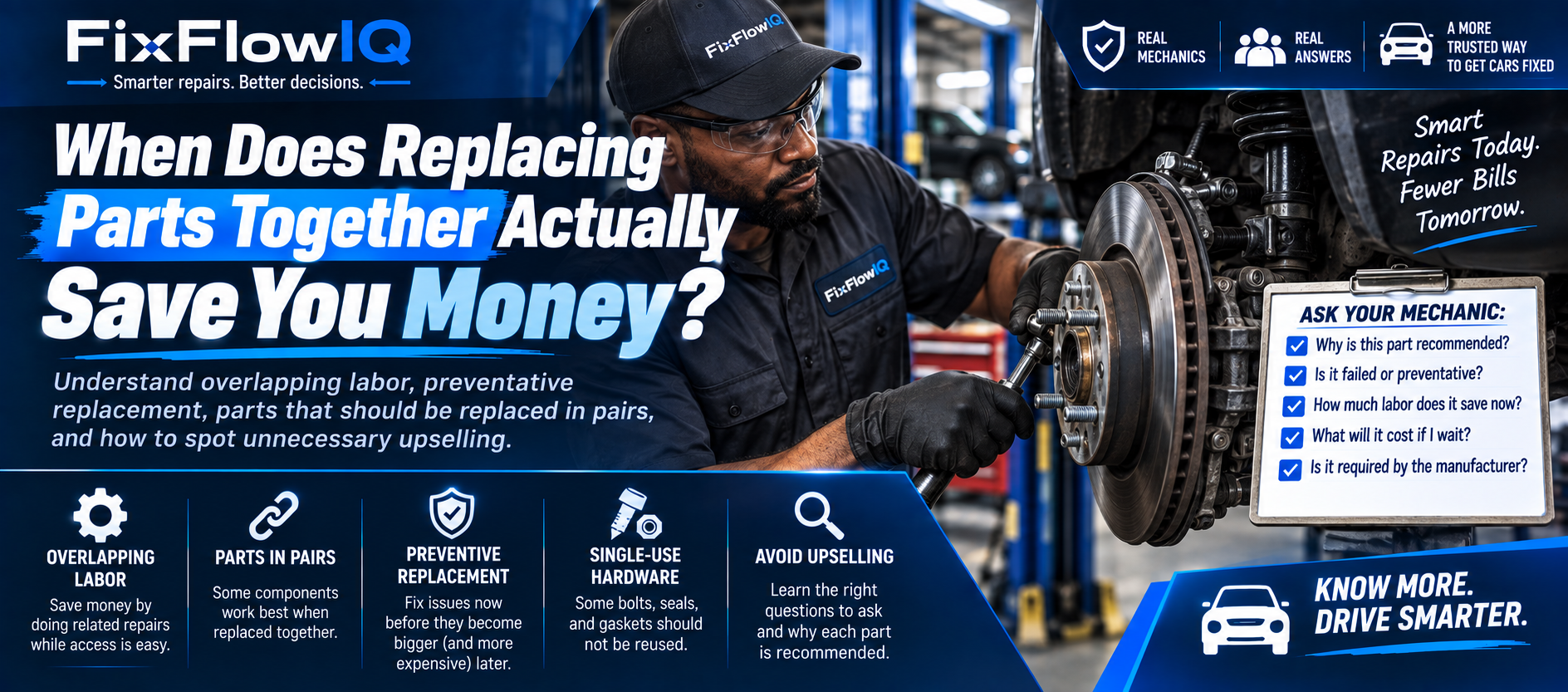
Replacing parts together can sometimes save hundreds in future labor—but not every recommendation is necessary. Learn how to tell smart preventive repairs from unnecessary upselling.
Your mechanic says:
“WHILE WE'RE IN THERE…”
And immediately:
You become suspicious.
You came in for:
ONE REPAIR.
Now you're hearing about:
TWO MORE PARTS.
Maybe:
THREE.
And you're wondering:
“DO I ACTUALLY NEED ALL OF THIS?”
That's a fair question.
But here's something every vehicle owner should understand:
Sometimes:
REPLACING RELATED PARTS TOGETHER CAN SAVE YOU A LOT OF MONEY.
Other times:
It can be:
COMPLETELY UNNECESSARY.
The difference comes down to:
WHY THE ADDITIONAL PART IS BEING RECOMMENDED.
There are several legitimate reasons mechanics replace parts together:
OVERLAPPING LABOR.
MATCHED WEAR.
PARTS DESIGNED TO WORK AS A SET.
SINGLE-USE COMPONENTS.
CONTAMINATION.
ACCESSIBILITY.
MANUFACTURER PROCEDURE.
and:
PREVENTING A RELATED PART FROM DAMAGING THE NEW ONE.
But:
“WE'RE ALREADY IN THERE”
should never be the end of the explanation.
The mechanic should be able to tell you:
WHY.
This is the foundation of:
SMART PARTS REPLACEMENT.
Many automotive repairs require significant labor just to:
REACH THE FAILED PART.
The technician may have to remove:
Covers
Brackets
Belts
Pulleys
Suspension components
Intake components
Exhaust components
Engine accessories
Subframes
Transmissions
Engines
Sometimes:
MOST OF THE REPAIR BILL IS ACCESS.
That's where replacing another related part at the same time can:
SAVE REAL MONEY.
Imagine Part A costs:
$80.
Normally:
Replacing Part A requires:
5 HOURS OF LABOR.
But during another repair:
Those same components have already been removed.
Now replacing Part A requires only:
15 ADDITIONAL MINUTES.
If Part A is already:
WORN, LEAKING, OR NEAR THE END OF ITS EXPECTED SERVICE LIFE,
replacing it now may make financial sense.
Because if it fails six months later:
You're paying for:
THE SAME DISASSEMBLY AGAIN.
That is:
DUPLICATE LABOR.
Sometimes the smarter question is:
“WHEN WILL THIS PART LIKELY NEED REPLACEMENT?”
followed by:
“HOW MUCH LABOR WILL I HAVE TO PAY AGAIN IF I WAIT?”
That changes the economics.
Suppose your vehicle needs:
A TIMING BELT.
On many engines:
The water pump is driven by or accessed through the same:
TIMING SYSTEM.
The technician has already removed much of what is necessary to reach:
THE WATER PUMP.
If the water pump has:
HIGH MILEAGE
and replacement now requires very little additional labor:
It may make sense to replace:
TIMING BELT + WATER PUMP
together.
Why?
Not because:
EVERY WATER PUMP IS AUTOMATICALLY BAD.
But because:
THE LABOR OVERLAPS SIGNIFICANTLY.
This is where the principle becomes even more important.
Suppose your transmission is already:
REMOVED.
The engine's:
REAR MAIN SEAL
is now easily accessible.
If that seal is:
ALREADY LEAKING,
replacing it now may add relatively little labor.
Ignore it?
If it gets worse later:
THE TRANSMISSION MAY HAVE TO COME OUT AGAIN.
That can turn an inexpensive seal into:
A VERY EXPENSIVE REPAIR.
The part itself may be:
CHEAP.
Access may be:
EXPENSIVE.
So when evaluating an additional repair:
Don't only ask:
“HOW MUCH IS THE PART?”
Ask:
“HOW MUCH LABOR AM I SAVING BY DOING IT NOW?”
This is where things get more complicated.
Because:
NOT EVERY “WHILE YOU'RE IN THERE” RECOMMENDATION IS A GOOD ONE.
Preventive replacement should have:
A LOGICAL REASON.
Preventive replacement may make sense when a component is:
Already showing wear
Beginning to leak
Near its service interval
Known to deteriorate with age
Extremely difficult to access later
Inexpensive compared with future labor
Likely to damage another component if it fails
Required by the repair procedure
Contaminated by the original failure
That is:
RISK-BASED PREVENTION.
Now imagine:
The mechanic is replacing your alternator.
They recommend:
A NEW STARTER.
Why?
“THEY'RE BOTH ELECTRICAL PARTS.”
That's not a strong reason.
If the starter:
WORKS CORRECTLY,
tests correctly, and is easy to replace later:
There may be very little benefit to replacing it now.
That's not meaningful:
LABOR OVERLAP.
Whenever another part is recommended:
Ask:
“WHY SHOULD THIS PART BE REPLACED AT THE SAME TIME?”
A good technician should be able to explain.
For example:
“THE PART IS ALREADY WORN.”
Good reason.
“IT'S LEAKING.”
Good reason.
“WE HAVE TO REMOVE IT ANYWAY, AND THE MANUFACTURER REQUIRES A NEW ONE.”
Good reason.
“IF IT FAILS LATER, WE HAVE TO REPEAT SIX HOURS OF THE SAME LABOR.”
Potentially very good reason.
But:
“WE ALWAYS DO THEM.”
That deserves:
MORE QUESTIONS.
Think of these as the foundation of smart repair planning.
 Smart Repair & Replacement Tips
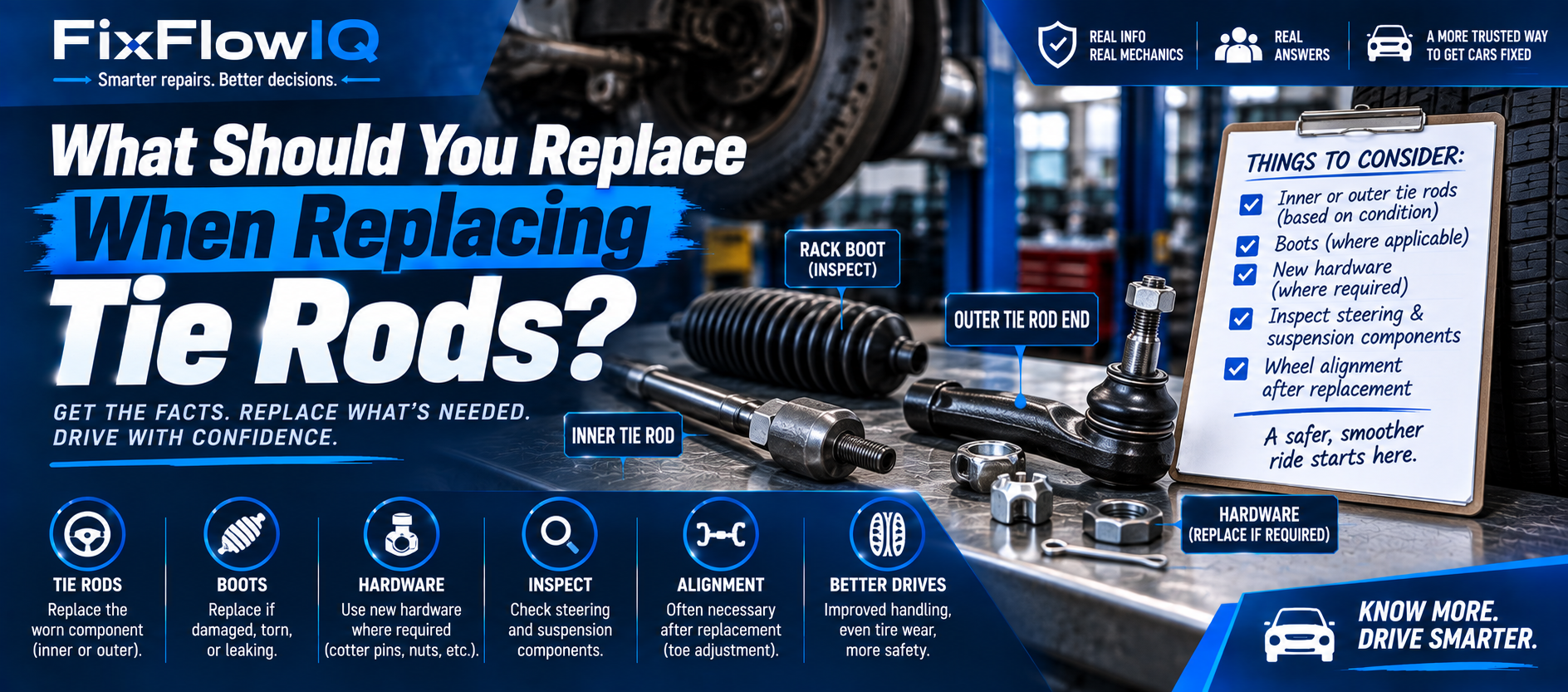
Replacing tie rods? Learn when inner or outer tie rods, boots, and hardware need attention, what else should be inspected, and why an alignment usually follows.
Read Article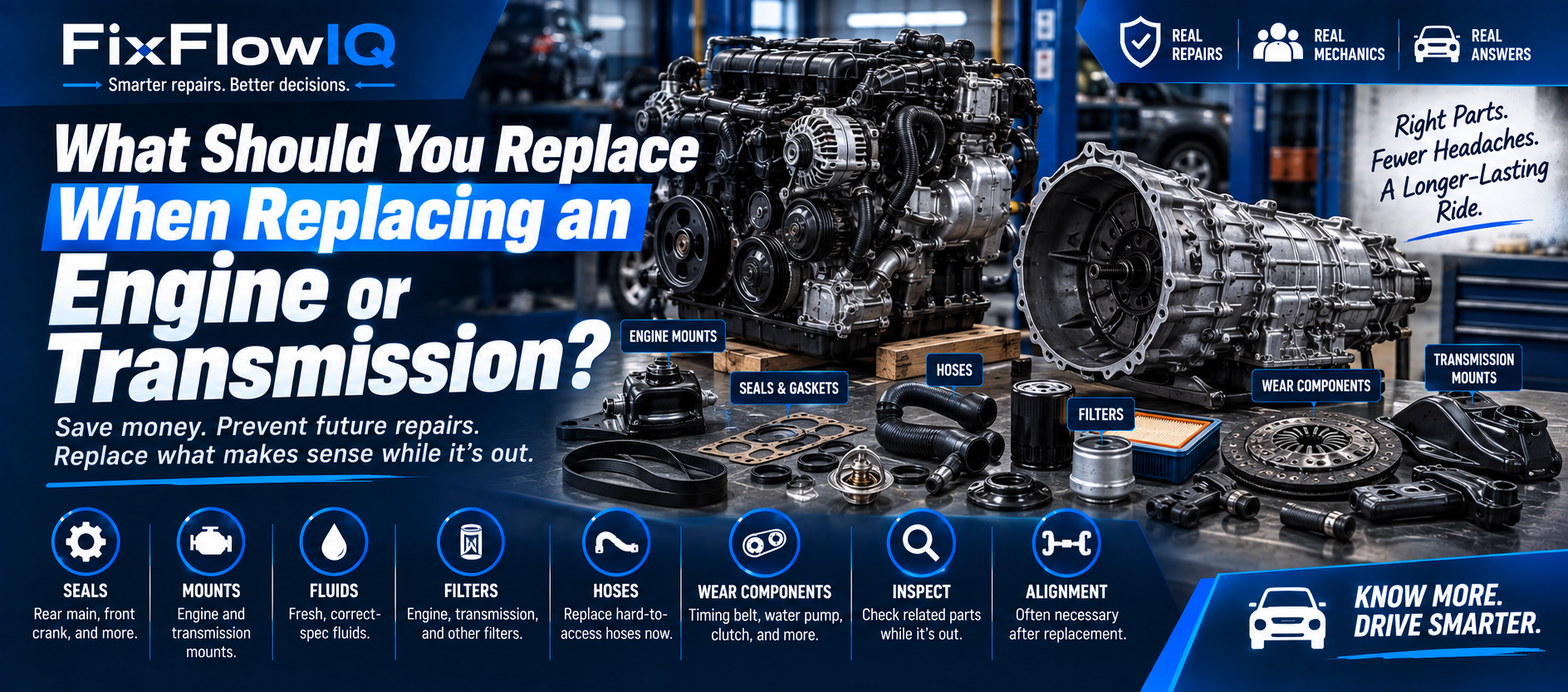 Smart Repair & Replacement Tips
Join hundreds of verified repair professionals already growing their businesses with FixFlowIQ. Receive qualified auto repair leads in Asheville, NC, and across North Carolina, manage bookings, and build your reputation—all from one dashboard.
Offer exclusive partner discounts to attract more customers and grow your business faster.
You save money because:
THE TECHNICIAN IS ALREADY THERE.
Certain components perform best when replaced:
TOGETHER.
A failing related component may shorten the life of:
THE NEW PART.
Some hardware, seals, or fasteners should not be:
REUSED.
The original failure may have contaminated:
OTHER PARTS OF THE SYSTEM.
Understanding which category applies makes evaluating an estimate:
MUCH EASIER.
We've already covered the basic idea.
But this can apply to many repairs.
Examples may include:
TIMING BELT + WATER PUMP.
TRANSMISSION REMOVAL + REAR MAIN SEAL.
CLUTCH + RELEASE BEARING.
ENGINE REMOVAL + DIFFICULT-TO-ACCESS HOSES.
TIMING COVER REMOVAL + LEAKING SEALS.
The important question is:
HOW MUCH LABOR ACTUALLY OVERLAPS?
Suppose you're replacing:
FRONT BRAKES.
The mechanic recommends:
A BATTERY.
Those repairs have essentially:
NO LABOR OVERLAP.
If the battery is bad:
Replace it because:
IT'S BAD.
But don't justify it by saying:
“WHILE WE'RE DOING THE BRAKES.”
The repairs are:
UNRELATED.
Some automotive components are commonly replaced:
IN PAIRS OR BY AXLE.
But this principle is often misunderstood.
Brake pads are normally serviced:
BY AXLE.
If you're replacing the left-front brake pads:
You don't normally replace:
ONLY THE LEFT SIDE.
The left and right front brakes work together.
So the front pads are generally serviced as:
A SET.
Rotors are also commonly replaced:
IN AXLE PAIRS
when replacement is necessary.
Why?
Because braking performance should remain:
BALANCED SIDE TO SIDE.
Shocks and struts are commonly replaced:
IN PAIRS ON THE SAME AXLE.
Why?
One new damper and one heavily worn damper can create differences in:
VEHICLE CONTROL AND DAMPING.
Tires are more complicated.
Depending on:
Remaining tread
Drivetrain
AWD requirements
Tire model
Vehicle manufacturer
Tire condition
you may need:
ONE, TWO, OR FOUR TIRES.
Don't automatically assume:
ALL FOUR.
This is important.
If one:
STARTER
fails:
You don't replace:
TWO STARTERS.
If one:
ALTERNATOR
fails:
There isn't another one to match.
If one:
WHEEL BEARING
fails:
The opposite wheel bearing does not automatically need replacement.
If one:
BALL JOINT
fails:
The opposite one should be:
INSPECTED
but not automatically:
REPLACED.
Ask:
“WHY DOES THIS COMPONENT NEED TO MATCH THE OTHER SIDE?”
If the answer involves:
BALANCED BRAKING.
BALANCED DAMPING.
DRIVETRAIN REQUIREMENTS.
or:
MATCHED PERFORMANCE,
there may be a strong reason.
If the answer is simply:
“THAT'S HOW WE DO IT,”
ask for more explanation.
This is another legitimate reason to replace related parts.
Sometimes:
The old component isn't simply worn.
It may actively threaten:
THE NEW COMPONENT.
Suppose your serpentine belt failed because:
THE TENSIONER IS SEIZED OR MISALIGNED.
Installing:
ANOTHER NEW BELT
without fixing the tensioner could damage:
THE NEW BELT.
In that case:
The tensioner isn't an upsell.
It may be:
THE CAUSE OF THE FAILURE.
Suppose an A/C compressor fails internally and sends:
METAL DEBRIS
through the system.
Simply replacing:
THE COMPRESSOR
may not be enough.
Depending on system design and contamination:
Other components may need:
FLUSHING OR REPLACEMENT.
Why?
Because contamination can damage:
THE NEW COMPRESSOR.
A catastrophic transmission failure can contaminate:
THE TORQUE CONVERTER.
COOLER.
COOLER LINES.
Installing another transmission without addressing contamination can potentially send:
OLD FAILURE DEBRIS INTO THE REPLACEMENT UNIT.
That's not:
PREVENTIVE UPSELLING.
That's:
PROTECTING THE REPAIR.
If a fuel pump fails and the tank contains:
RUST OR DEBRIS,
installing a new pump into the dirty tank may expose it to:
THE SAME CONTAMINATION.
Sometimes the smartest related repair isn't another part.
It's:
CLEANING THE ENVIRONMENT THE NEW PART HAS TO LIVE IN.
This is something many customers don't realize.
Not every nut, bolt, gasket, seal, or washer is designed to be:
REUSED.
Depending on the vehicle:
Manufacturers may specify replacement of:
Torque-to-yield bolts
Axle nuts
Certain suspension bolts
Certain engine bolts
Crush washers
Lock nuts
Cotter pins
Other application-specific hardware
If the service information says:
DO NOT REUSE,
then replacing that hardware is:
PART OF THE REPAIR.
Some engines use:
TORQUE-TO-YIELD HEAD BOLTS.
These bolts may stretch during:
THE TORQUE PROCEDURE.
If the manufacturer specifies:
NEW BOLTS,
reusing the old ones to save money can compromise:
THE REPAIR.
If a repair requires disconnecting:
A SEALED CONNECTION,
the service procedure may require:
A NEW SEAL OR O-RING.
Examples can include:
Fuel-system seals
A/C O-rings
Coolant seals
Transmission seals
Oil seals
Injector seals
The seal may cost:
VERY LITTLE.
But reusing the wrong seal could cause:
A LEAK.
Don't become suspicious simply because an estimate contains:
$3 SEAL.
$8 NUT.
or:
$15 HARDWARE KIT.
Sometimes:
Those inexpensive items are there because:
THE JOB IS BEING DONE CORRECTLY.
Some failures spread:
DEBRIS OR CONTAMINATION
through an entire system.
That's why replacing only the failed component may not be:
ENOUGH.
Examples include:
A/C SYSTEMS.
AUTOMATIC TRANSMISSIONS.
FUEL SYSTEMS.
ENGINE LUBRICATION SYSTEMS.
COOLING SYSTEMS.
and:
HIGH-PRESSURE DIESEL FUEL SYSTEMS.
This is an excellent question:
“DID THE FAILED PART SEND DEBRIS OR CONTAMINATION INTO THE REST OF THE SYSTEM?”
If yes:
Ask:
“WHAT NEEDS TO BE CLEANED OR REPLACED BEFORE THE NEW PART GOES IN?”
That can protect you from:
REPEAT FAILURE.
Imagine your vehicle has:
180,000 MILES.
The mechanic is already replacing a timing belt.
The water pump has:
180,000 MILES TOO.
Even if the pump isn't leaking today:
Its:
AGE + MILEAGE + LABOR OVERLAP
may make replacement worth considering.
Now imagine:
The water pump was replaced:
10,000 MILES AGO.
Same repair.
Very different decision.
This is why:
CONTEXT MATTERS.
Before approving preventive replacement:
Ask:
“WHEN WAS THIS PART LAST REPLACED?”
Sometimes:
You already replaced it recently.
Without service records:
A technician may not know that.
If you're paying significant labor:
Think carefully about:
PART QUALITY.
Suppose replacing a part requires:
8 HOURS OF LABOR.
Saving $40 by installing the cheapest possible part may not make much sense if failure means:
PAYING THAT LABOR AGAIN.
Especially when labor is substantial:
Ask:
“WHAT IS THE PART WARRANTY?”
and:
“DOES THE WARRANTY COVER LABOR?”
Because:
A FREE REPLACEMENT PART
isn't always much consolation if replacing it again requires:
$1,000 IN LABOR.
It often makes sense when:
✓ Labor overlaps significantly
✓ Both components are confirmed worn
✓ Parts are designed to be serviced together
✓ Balanced operation requires matched components
✓ A related component caused the original failure
✓ Contamination threatens the new part
✓ Manufacturer procedure requires replacement
✓ Hardware or seals are single-use
✓ An aging component will become extremely expensive to access later
Be more cautious when:
✗ The additional component tests good
✗ There is little or no labor overlap
✗ The part is easy to replace later
✗ The recommendation has no manufacturer or mechanical basis
✗ The mechanic can't explain why it's needed
✗ The only explanation is “we always replace those”
✗ The component was recently replaced
✗ The recommendation adds major cost but little reduction in future risk
Here's one of the simplest ways to evaluate:
“WHILE WE'RE IN THERE.”
Ask the mechanic for:
Then ask:
Imagine:
Replace now: $120 additional
versus:
Replace later: $850
If the part is already aging or deteriorating:
That's worth:
SERIOUS CONSIDERATION.
Now imagine:
Replace now: $450
versus:
Replace later: $500
and the existing part is healthy.
That's:
A VERY DIFFERENT DECISION.
Ask:
“WHAT IS WRONG WITH THE PART RIGHT NOW?”
Possible answers:
LEAKING.
CRACKED.
LOOSE.
SEIZED.
CONTAMINATED.
WORN BEYOND SPECIFICATION.
NEAR SERVICE INTERVAL.
Those are:
SPECIFIC REASONS.
Compare that with:
“IT'S OLD.”
Age can matter.
But ask:
HOW OLD?
WHAT CONDITION?
WHAT RISK?
When possible:
Ask the mechanic to:
SHOW YOU.
A good explanation might include:
Visible leak
Torn boot
Cracked bushing
Measured play
Contaminated fluid
Damaged hardware
Corrosion
Worn friction material
Diagnostic measurement
Manufacturer service requirement
Transparency helps you understand:
WHY YOU'RE SPENDING THE MONEY.
When a mechanic recommends another part during a repair:
Ask:
1. WHY DOES THIS PART NEED TO BE REPLACED?
Then:
2. IS IT ACTUALLY FAILED, OR IS THIS PREVENTIVE?
Then:
3. HOW MUCH LABOR OVERLAPS WITH THE REPAIR I'M ALREADY PAYING FOR?
Then:
4. HOW MUCH WOULD THIS COST TO REPLACE LATER?
And finally:
5. WHAT HAPPENS IF I DON'T REPLACE IT NOW?
Those five questions can completely change how you evaluate:
A REPAIR ESTIMATE.
A mechanic shouldn't be offended because you ask:
WHY.
You're spending:
YOUR MONEY
on:
YOUR VEHICLE.
A professional recommendation should have:
A MECHANICAL REASON.
That doesn't mean every customer needs to understand every technical detail.
But you should be able to understand:
THE BASIC LOGIC.
For example:
“Your water pump isn't leaking yet, but it has 140,000 miles. We're already removing it to perform the timing-belt service. Replacing it now adds $110. If it fails later, the timing system has to come apart again.”
Now:
You can make an:
INFORMED DECISION.
That's very different from:
“YOU NEED A WATER PUMP TOO.”
This distinction is extremely important.
Customers sometimes hear:
“IT HASN'T FAILED YET”
and assume:
“THEN I DON'T NEED IT.”
But preventive maintenance exists specifically because:
WAITING FOR FAILURE CAN COST MORE.
The question isn't:
“HAS IT FAILED?”
The question is:
“IS REPLACING IT NOW FINANCIALLY AND MECHANICALLY JUSTIFIED?”
You don't save money by:
REPLACING EVERY PART BEFORE IT FAILS.
That's just:
SPENDING MONEY EARLIER.
Smart preventive replacement focuses on:
HIGH-RISK + HIGH-LABOR + HIGH-OVERLAP ITEMS.
Before approving an additional part, think:
CONDITION
plus:
FAILURE RISK
plus:
LABOR OVERLAP
plus:
COST TO REPAIR LATER
plus:
CONSEQUENCE OF FAILURE
versus:
COST TO REPLACE NOW.
You don't need a calculator.
You need:
THE INFORMATION.
Your front brake pads are worn out.
Should the rotors be replaced?
Maybe.
Inspect:
THICKNESS.
CONDITION.
RUNOUT.
SURFACE DAMAGE.
MANUFACTURER LIMITS.
Don't replace rotors simply because:
BRAKE PADS ARE BEING REPLACED.
But don't put new pads against rotors that are:
BELOW SPECIFICATION OR BADLY DAMAGED.
One front strut is leaking badly.
The other has:
150,000 MILES.
Because damping balance matters:
Replacing the pair may make sense.
That's different from:
A SINGLE FAILED WHEEL BEARING.
The opposite bearing can simply be:
INSPECTED.
Transmission is already out.
The clutch disc is worn.
Should you replace:
THE RELEASE BEARING?
Often:
Yes, as part of a proper clutch service.
Why?
Because accessing that relatively inexpensive component later requires:
REMOVING THE TRANSMISSION AGAIN.
That's:
LABOR OVERLAP.
Your alternator failed.
Should you automatically replace:
THE STARTER?
No.
Test:
THE STARTER.
Should you inspect:
THE BATTERY?
Absolutely.
Why?
Because a weak or damaged battery can affect:
THE CHARGING SYSTEM.
Related inspection does not automatically mean:
RELATED REPLACEMENT.
That's an important distinction.
Replacing a head gasket can involve significant:
DISASSEMBLY.
Depending on engine design:
You may need:
New head bolts
Intake/exhaust gaskets
Coolant
Oil
Filter
Timing components
Other seals
Some of those aren't:
OPTIONAL ADD-ONS.
They're part of correctly:
REASSEMBLING THE ENGINE.
Fuel pump fails.
Tank contains:
RUST AND DEBRIS.
Should you just install:
THE NEW PUMP?
No.
The contamination needs:
ATTENTION.
Otherwise:
You may damage:
THE NEW PUMP.
One outer tie rod has:
EXCESSIVE PLAY.
Does that mean:
ALL FOUR INNER AND OUTER TIE RODS MUST BE REPLACED?
No.
Inspect them.
Replace:
WHAT'S ACTUALLY WORN.
But after replacement:
ALIGN THE VEHICLE
because the repair affects:
TOE.
A good estimate shouldn't look like:
A RANDOM SHOPPING LIST OF PARTS.
It should make sense.
For example:
FAILED PART → RELATED DAMAGE → REQUIRED PARTS → PREVENTIVE OPTIONS → LABOR OVERLAP → FINAL REPAIR
When you understand that story:
You can make better decisions.
This is another powerful question:
Ask:
“WHICH OF THESE ITEMS ARE REQUIRED TO COMPLETE THE REPAIR, AND WHICH ARE PREVENTIVE RECOMMENDATIONS?”
Those are:
NOT THE SAME THING.
A required:
ONE-TIME-USE SEAL
is different from:
AN AGING WATER PUMP THAT MAY BE SMART TO REPLACE NOW.
Both can be reasonable.
But you deserve to know:
THE DIFFERENCE.
If your budget is limited:
Ask:
“WHAT MUST BE DONE NOW?”
Then:
“WHAT SHOULD BE DONE WHILE THE LABOR OVERLAPS?”
Then:
“WHAT CAN SAFELY WAIT?”
That turns a confusing repair estimate into:
A REPAIR PLAN.
“Your timing belt is due. The water pump is behind the same timing components and has 120,000 miles, so replacing it now saves most of the future labor.”
Reasonable.
“Your brake pads are worn, but the rotors still measure above specification and are in good condition, so we're leaving them.”
Good.
“The transmission failed internally. The cooler contains debris, so it must be addressed before installing the replacement transmission.”
Important.
“The opposite wheel bearing is tight and quiet, so we're replacing only the failed side.”
Good.
“These head bolts are specified as single-use, so new bolts are part of the repair.”
Correct.
“We replace all related parts whether they're good or bad.”
Ask:
WHY?
A strong recommendation should answer:
WHAT IS WRONG?
WHY DOES IT MATTER?
WHY DO IT NOW?
WHAT LABOR OVERLAPS?
WHAT HAPPENS IF I WAIT?
IS IT REQUIRED OR PREVENTIVE?
If those questions can be answered clearly:
You can evaluate the recommendation based on:
VALUE.
Not:
FEAR.
Imagine two repair quotes.
Includes:
FAILED PART ONLY.
Includes:
FAILED PART + $80 RELATED WEAR COMPONENT + ADDITIONAL HARDWARE + FLUID
At first:
Quote A looks:
$200 CHEAPER.
But suppose that $80 component normally requires:
$600 OF LABOR
to access later.
Now:
Quote B may actually represent:
THE BETTER LONG-TERM VALUE.
But only if:
THE ADDITIONAL WORK IS JUSTIFIED.
The opposite is also true.
Correct repair.
Same repair plus:
$700 OF HEALTHY COMPONENTS THAT DON'T NEED REPLACEMENT.
Quote B isn't automatically better because:
IT INCLUDES MORE.
This is why:
COMPARE REPAIR SCOPE, NOT JUST PRICE.
This principle is exactly why comparing automotive quotes can be:
SO VALUABLE.
Two mechanics may quote the same repair differently.
One may recommend:
THE FAILED PART ONLY.
Another may include:
A RELATED WEAR ITEM.
Another may include:
REQUIRED HARDWARE + FLUIDS + ALIGNMENT.
The cheapest quote may not include:
EVERYTHING NEEDED.
The highest quote may include:
THINGS YOU DON'T NEED.
What matters is understanding:
WHY EACH ITEM IS THERE.
When reviewing quotes through FixFlowIQ:
Look beyond:
TOTAL PRICE.
Compare:
Parts Included • Labor Included • Related Components • Preventive Recommendations • Required Hardware • Fluids • Alignment • Warranty • Provider Discounts • Reviews • Availability
And ask providers:
“WHY ARE YOU RECOMMENDING THIS ADDITIONAL PART?”
“IS IT FAILED OR PREVENTIVE?”
“HOW MUCH LABOR DOES DOING IT NOW SAVE?”
“WHAT WOULD IT COST IF I WAIT?”
That's how you turn competing quotes into:
USEFUL INFORMATION.
Here's the principle behind this entire article series:
DON'T REPLACE A PART JUST BECAUSE IT'S NEAR THE FAILED PART.
But:
DON'T IGNORE A WORN, REQUIRED, OR HARD-TO-ACCESS COMPONENT JUST BECAUSE IT HASN'T COMPLETELY FAILED YET.
Instead:
INSPECT IT.
UNDERSTAND WHY IT'S BEING RECOMMENDED.
COMPARE THE COST NOW VS. LATER.
CONSIDER LABOR OVERLAP.
CONSIDER FAILURE RISK.
Then:
MAKE AN INFORMED DECISION.
Replacing parts together saves money when there is:
REAL MECHANICAL OR FINANCIAL LOGIC BEHIND IT.
That may mean:
OVERLAPPING LABOR.
PAIRED COMPONENTS.
SINGLE-USE HARDWARE.
CONTAMINATION.
MATCHED WEAR.
PREVENTING DAMAGE TO THE NEW PART.
or:
AVOIDING MAJOR DUPLICATE LABOR LATER.
But:
“WHILE WE'RE IN THERE”
should never mean:
“REPLACE EVERYTHING.”
And:
“IT HASN'T FAILED YET”
doesn't automatically mean:
“DON'T REPLACE IT.”
The smartest repair lives:
BETWEEN THOSE TWO EXTREMES.
Before approving additional work:
Ask:
WHY?
Ask:
WHAT CONDITION IS IT IN?
Ask:
IS IT REQUIRED OR PREVENTIVE?
Ask:
HOW MUCH LABOR DO I SAVE NOW?
Ask:
WHAT WILL IT COST IF I WAIT?
Because the goal isn't to:
SPEND THE LEAST MONEY TODAY.
The goal is to:
SPEND YOUR REPAIR MONEY INTELLIGENTLY.
And sometimes:
SPENDING A LITTLE MORE DURING THE RIGHT REPAIR CAN SAVE YOU A LOT MORE LATER.
That's the entire idea behind:
SMART REPAIR & REPLACEMENT.
Oral Thompson
Writes about vehicle care and the FixFlowIQ platform.
Replacing an engine or transmission? Learn which seals, mounts, fluids, hoses, filters, and wear parts may save you serious labor costs while the powertrain is already removed.