Replacing an engine or transmission? Learn which seals, mounts, fluids, hoses, filters, and wear parts may save you serious labor costs while the powertrain is already removed.
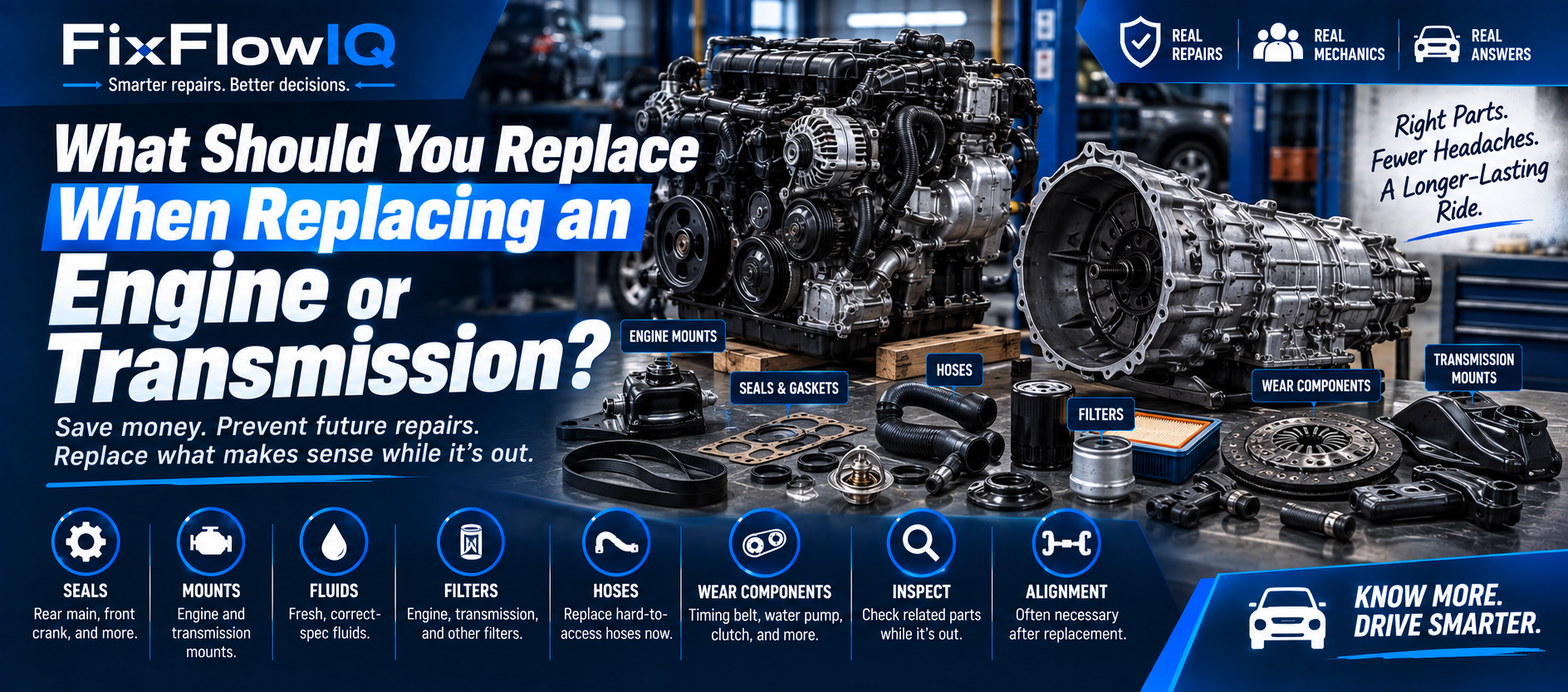
Your vehicle needs:
AN ENGINE.
Or:
A TRANSMISSION.
That's already one of the largest repair bills most vehicle owners will ever face.
Then your mechanic says:
“WHILE WE'RE IN THERE…”
Rear main seal.
Engine mounts.
Transmission mount.
Coolant hoses.
Thermostat.
Belts.
Spark plugs.
Transmission fluid.
Filters.
Maybe even:
A WATER PUMP.
And suddenly you're wondering:
“ARE THEY TRYING TO SELL ME MORE PARTS?”
Not necessarily.
Because engine and transmission replacement create something unusual:
ACCESS.
Components that normally require:
HOURS OF LABOR
may suddenly be:
RIGHT IN FRONT OF THE TECHNICIAN.
That can create one of the best opportunities you'll ever have to perform certain repairs:
BEFORE THE POWERTRAIN GOES BACK INTO THE VEHICLE.
But that does not mean:
REPLACE EVERYTHING.
The smart approach is:
INSPECT EVERYTHING THAT BECOMES ACCESSIBLE.
REPLACE KNOWN WEAR ITEMS WHEN JUSTIFIED.
ADDRESS LEAKS NOW.
CONSIDER LABOR OVERLAP.
and:
DON'T SPEND MONEY ON HEALTHY PARTS JUST BECAUSE THEY'RE EASY TO REACH.
Imagine a seal costs:
$40.
Replacing it normally might require:
8 HOURS OF LABOR.
But during an engine or transmission replacement:
The components are already separated.
The additional labor may be:
MINIMAL.
That's where:
A SMALL ADDITIONAL COST TODAY
could potentially prevent:
A LARGE LABOR BILL LATER.
This is called:
LABOR OVERLAP.
And few automotive repairs create more labor overlap than:
ENGINE AND TRANSMISSION REPLACEMENT.
There are two extremes.
“Only replace the engine. Don't touch anything else.”
That could mean reinstalling:
KNOWN LEAKING OR NEAR-END-OF-LIFE COMPONENTS.
“The engine is out, so replace everything.”
That can waste:
A LOT OF MONEY.
The better strategy is:
CONDITION + AGE + MILEAGE + ACCESS + FAILURE RISK + LABOR SAVINGS.
Before discussing additional parts, determine:
WHAT ENGINE OR TRANSMISSION IS BEING INSTALLED?
You may be choosing between:
NEW.
REMANUFACTURED.
REBUILT.
or:
USED.
These are not:
THE SAME THING.
A used assembly typically comes from:
ANOTHER VEHICLE.
Ask:
What is the mileage?
What vehicle did it come from?
Was it tested?
Is there documentation?
What warranty is included?
Does the warranty cover labor?
What accessories are included?
Which components must be transferred from the old unit?
A used engine with:
70,000 MILES
should not automatically be treated like:
A BRAND-NEW ENGINE.
A remanufactured unit has generally undergone a more extensive rebuilding process according to the remanufacturer's procedures.
But:
WARRANTIES AND BUILD STANDARDS VARY.
Ask exactly:
WHAT IS INCLUDED?
This matters enormously.
A long block may include:
Engine block
Crankshaft
Pistons
Connecting rods
Cylinder heads
Valve train
But may not include:
Intake manifold
Exhaust manifold
Alternator
Starter
A/C compressor
Fuel system
Sensors
Turbocharger
Water pump
Engine mounts
Other accessories
Those components may have to be:
TRANSFERRED FROM YOUR OLD ENGINE.
If your replacement engine doesn't include the:
WATER PUMP
and your old water pump has:
180,000 MILES,
you should at least ask:
“DOES IT MAKE SENSE TO PUT THIS OLD PUMP ON THE REPLACEMENT ENGINE?”
That's the type of decision this article is about.
This is one of the classic:
WHILE-YOU'RE-IN-THERE ITEMS.
The rear main seal sits at the rear of the engine around the:
CRANKSHAFT.
Its job is to prevent:
ENGINE OIL LEAKAGE.
When the engine and transmission are installed:
The rear main seal may be buried between them.
Accessing it later can require:
REMOVING OR SEPARATING THE TRANSMISSION AGAIN.
But when the engine and transmission are already apart:
Access may be:
DRAMATICALLY EASIER.
Not necessarily.
Consider:
Engine mileage
Seal condition
Evidence of leakage
Replacement-engine history
Seal design
Manufacturer procedure
Part quality
Additional labor required
But if the seal is:
ALREADY LEAKING,
ignoring it while everything is apart can be:
VERY EXPENSIVE LATER.
The front crank seal should also be:
INSPECTED.
If it is:
Leaking
Hardened
Damaged
High mileage
Easily accessible during the replacement
replacement may make sense.
Again:
ACCESS MATTERS.
On applicable engines:
Camshaft seals can become difficult to access after:
FULL REASSEMBLY.
If they show leakage or are located behind a timing system already being serviced:
This can be an excellent time to:
ADDRESS THEM.
But don't automatically replace good seals unless:
THE REPAIR PROCEDURE OR CONDITION JUSTIFIES IT.
If the replacement engine uses a:
TIMING BELT,
this deserves serious consideration.
Ask:
WHEN WAS IT LAST REPLACED?
If you don't know:
That's important.
Suppose the used engine has:
85,000 MILES.
But nobody knows when the timing belt was replaced.
If the belt is due at:
100,000 MILES,
installing the engine with the old belt may mean paying for:
ANOTHER MAJOR SERVICE SOON.
Depending on the engine:
A timing service may include:
TIMING BELT.
TENSIONER.
IDLER PULLEYS.
and possibly:
WATER PUMP.
Especially when the pump is driven by:
THE TIMING BELT.
Does an engine replacement mean:
NEW TIMING CHAINS?
No.
But if the replacement engine has:
Known chain stretch
Worn guides
Noisy tensioners
High mileage
Known design concerns
Timing-related faults
then servicing those components before installation may make:
FINANCIAL SENSE.
This is another major:
ACCESS-DEPENDENT DECISION.
Some water pumps are:
VERY EASY TO REPLACE WITH THE ENGINE INSTALLED.
Others are:
BURIED DEEP INSIDE THE ENGINE.
Some are driven by:
THE TIMING BELT.
Others may be:
INTERNAL OR DIFFICULT TO ACCESS.
“HOW MUCH LABOR WOULD THIS WATER PUMP COST TO REPLACE AFTER THE ENGINE IS INSTALLED?”
That changes the decision.
A healthy, easily accessible pump may not need replacement.
An old, difficult-to-access pump with major labor overlap may be:
WORTH DOING NOW.
Inspect or consider replacing the thermostat based on:
Mileage
Age
Overheating history
Engine failure cause
Accessibility
Manufacturer recommendation
If the original engine failed because of:
OVERHEATING,
the cooling system deserves:
EXTRA ATTENTION.
This is a huge one.
Some engines have:
SMALL COOLANT HOSES
located:
BEHIND OR UNDER THE ENGINE.
When the engine is installed:
They can be extremely difficult to access.
With the engine removed:
They may be:
RIGHT THERE.
Look for:
Cracking
Swelling
Hardening
Oil contamination
Heat damage
Soft spots
Coolant residue
Brittle plastic fittings
If a $30 hose is buried behind the engine and already deteriorating:
Replacing it now may prevent:
A VERY EXPENSIVE FUTURE LABOR BILL.
Heater hoses should also be:
INSPECTED.
Especially connections located near:
THE FIREWALL OR REAR OF THE ENGINE.
Again:
Don't replace good hoses automatically.
But don't reinstall:
A CRACKED 15-YEAR-OLD HOSE
simply because:
“IT WASN'T PART OF THE ENGINE.”
Modern engines often use:
PLASTIC COOLING-SYSTEM COMPONENTS.
Over time:
Heat cycling can make them:
BRITTLE.
If an old plastic fitting is extremely difficult to access after engine installation:
Inspect it carefully while:
ACCESS IS EASY.
Engine mounts support the engine while isolating:
VIBRATION.
They should be inspected whenever an engine is being:
REMOVED OR REPLACED.
Look for:
Torn rubber
Separation
Collapsed mount
Fluid leakage from hydraulic mounts
Excessive movement
Broken brackets
If a mount is:
FAILED,
this is usually an excellent time to replace it.
If the mounts are:
HEALTHY,
you may not need them.
But ask:
HOW DIFFICULT WILL THIS MOUNT BE TO REPLACE LATER?
Even during an engine replacement:
Inspect the:
TRANSMISSION MOUNT.
A collapsed mount can affect:
Drivetrain movement
Vibration
Shift feel
Exhaust stress
Axle angles
Replace based on:
CONDITION.
If the old belt is:
Cracked
Frayed
Contaminated
Glazed
Near end of life
this may be a sensible time to install:
A NEW BELT.
Don't automatically replace these because:
THE BELT IS OFF.
Inspect:
Bearing noise
Pulley play
Weak tension
Misalignment
Damage
Replace:
WHAT IS ACTUALLY WORN.
If spark plugs are:
DUE SOON
and they're difficult to access with the engine installed:
Replacing them before installation may save:
SIGNIFICANT LABOR.
This is especially useful on engines where:
REAR BANK ACCESS IS DIFFICULT.
Do not automatically replace healthy coils.
We've covered this before.
Inspect:
COILS + BOOTS.
Replace:
FAILED OR DAMAGED COMPONENTS.
A new engine does not automatically need:
A FULL SET OF COILS.
If the replacement engine has visible:
VALVE-COVER LEAKAGE,
addressing it before installation may be much easier.
But again:
NO LEAK + GOOD SEALS ≠ AUTOMATIC REPLACEMENT.
Inspect the:
OIL PAN.
Look for:
Leaks
Damage
Rust
Dents
Cracks
Failed sealant
Depending on vehicle design:
The oil pan may be dramatically easier to service while:
THE ENGINE IS OUT.
Some engines have oil coolers or housings located:
DEEP IN THE ENGINE VALLEY
or other difficult locations.
If the replacement engine has known leakage there:
This may be the time to:
FIX IT.
If the intake manifold must be transferred:
Use new gaskets when:
THE SERVICE PROCEDURE REQUIRES THEM.
Don't reuse a sealing component that isn't designed for:
REUSE.
Same principle.
If exhaust manifolds are removed or transferred:
Replace required:
GASKETS AND HARDWARE
according to the service procedure and condition.
A turbocharged engine deserves:
ADDITIONAL INSPECTION.
Check:
Shaft play where appropriate
Oil leakage
Coolant leakage
Oil-feed lines
Oil-return lines
Coolant lines
Cracks
Actuator operation
Related hoses
If the old engine suffered:
OIL STARVATION
or:
METAL CONTAMINATION,
the turbocharger may have been exposed to:
THE SAME CONTAMINATED OIL.
Don't automatically bolt it onto:
THE REPLACEMENT ENGINE
without evaluation.
A replacement engine should receive:
THE CORRECT ENGINE OIL
and:
A PROPER FILTER
according to the engine supplier and manufacturer requirements.
This isn't the place to guess.
The cooling system will generally need:
FRESH CORRECT-SPECIFICATION COOLANT.
Use the coolant required by:
THE VEHICLE / ENGINE APPLICATION.
Not simply:
WHATEVER COLOR LOOKS SIMILAR.
A replacement transmission should be filled with:
THE EXACT REQUIRED FLUID SPECIFICATION.
Modern transmissions can be extremely sensitive to:
INCORRECT FLUID.
“ATF” is not:
ONE UNIVERSAL PRODUCT.
Depending on transmission design:
The filter may be:
External
Internal
Pan-mounted
Integrated
Considered non-serviceable under normal maintenance
If the replacement transmission allows filter service and the procedure calls for it:
This may be a sensible time.
If the transmission pan is removed:
Use the appropriate:
GASKET OR SEALANT
during reassembly.
If the pan is:
DAMAGED OR RUSTED,
address that before installation.
The transmission's front seal can become:
VERY EXPENSIVE TO ACCESS LATER.
Why?
Because it sits near the:
TORQUE CONVERTER / INPUT AREA.
If it leaks after installation:
The transmission may have to:
COME BACK OUT.
Not automatically.
But on a used transmission:
Ask about:
Mileage
Leakage
Seal condition
Supplier recommendation
Warranty requirements
Accessibility
This is a classic:
LABOR-OVERLAP DECISION.
Inspect:
AXLE OR OUTPUT SHAFT SEALS.
If they show:
LEAKAGE OR DAMAGE,
replacing them before installation can be:
MUCH EASIER.
If replacing an automatic transmission:
Ask:
IS THE TORQUE CONVERTER INCLUDED?
This is extremely important.
A remanufactured transmission may include:
A REMANUFACTURED TORQUE CONVERTER.
A used transmission may come with:
ITS ORIGINAL CONVERTER.
If the old transmission suffered:
INTERNAL CATASTROPHIC FAILURE,
metal and clutch material may circulate through:
THE TRANSMISSION FLUID.
Reusing a contaminated converter can jeopardize:
THE REPLACEMENT TRANSMISSION.
This is one of the most important parts of a transmission replacement.
Automatic transmissions often circulate fluid through:
A TRANSMISSION COOLER.
That cooler may be:
Inside the radiator
External
Separate heat exchanger
Combination system
If the old transmission sent:
METAL OR CLUTCH MATERIAL
through the cooler:
Installing a replacement transmission without addressing that contamination can send debris:
RIGHT BACK INTO THE NEW TRANSMISSION.
Depending on:
FAILURE TYPE + COOLER DESIGN + TRANSMISSION SUPPLIER REQUIREMENTS,
the cooler may require:
FLUSHING
or:
REPLACEMENT.
Some coolers cannot be reliably cleaned after severe contamination.
Follow:
THE WARRANTY AND MANUFACTURER REQUIREMENTS.
Inspect cooler lines for:
Leaks
Corrosion
Damage
Kinks
Restricted flow
Damaged fittings
Don't put a replacement transmission behind:
A RESTRICTED OR LEAKING COOLER CIRCUIT.
This is another obvious inspection point.
If the transmission is already out:
Inspect the:
TRANSMISSION MOUNT.
Replace if:
Torn
Collapsed
Separated
Fluid leaking
Structurally damaged
This is where some of the largest:
LABOR SAVINGS
can happen.
Automatic-transmission vehicles typically use a:
FLEXPLATE
between the engine and torque converter.
Inspect for:
Cracks
Damaged teeth
Distortion
Loose or damaged mounting areas
Evidence of previous failure
If it's damaged:
REPLACE IT NOW.
Manual-transmission vehicles typically use a:
FLYWHEEL.
Inspect it carefully.
Depending on design and condition:
It may need:
RESURFACING OR REPLACEMENT.
If the transmission is already removed from a manual-transmission vehicle:
This may be one of the biggest:
WHILE-YOU'RE-IN-THERE DECISIONS.
If the clutch has significant mileage:
Ask:
HOW MUCH LIFE IS LEFT?
Transmission goes back in.
Three months later:
CLUTCH STARTS SLIPPING.
Now:
The transmission has to:
COME BACK OUT.
That's exactly the kind of duplicate labor you're trying to avoid.
Depending on the vehicle:
This may include:
CLUTCH DISC.
PRESSURE PLATE.
RELEASE BEARING.
PILOT BEARING / BUSHING.
FLYWHEEL SERVICE.
Even if you're replacing:
ONLY THE TRANSMISSION,
the engine rear main seal may now be:
ACCESSIBLE.
If it is visibly leaking:
This is one of the best opportunities to:
ADDRESS IT.
Because once the transmission is reinstalled:
Access disappears.
On applicable manual-transmission vehicles:
Inspect or replace the:
PILOT BEARING / BUSHING
according to condition and clutch-service procedure.
The part itself may be inexpensive.
Access later:
IS NOT.
If you're performing clutch work:
A release bearing is commonly included as part of:
A COMPLETE CLUTCH SERVICE.
Again:
The labor required to reach it later is:
SUBSTANTIAL.
Some manual transmissions use a:
CONCENTRIC SLAVE CYLINDER
inside the bellhousing.
This is a major:
LABOR-OVERLAP ITEM.
Because if it fails later:
The transmission may need to be:
REMOVED AGAIN.
If the slave cylinder has high mileage or is being disturbed during clutch service:
Replacement may make sense depending on:
CONDITION AND MANUFACTURER GUIDANCE.
Transmission removal often requires:
REMOVING OR DISCONNECTING CV AXLES.
Inspect:
CV boots
Joints
Splines
Axle seals
Threads
Retaining clips
Don't automatically replace good axles.
But don't reinstall:
A TORN CV BOOT
without discussing it.
On rear-wheel-drive and four-wheel-drive vehicles:
Inspect the driveshaft and related components.
Depending on design:
Check:
U-joints
Center support bearing
Flex disc
Slip joint
CV joints
Seals
Replace based on:
CONDITION.
If transmission replacement involves:
TRANSFER-CASE REMOVAL,
inspect:
Input/output seals
Fluid
Mounting surfaces
Splines
Couplers
Leaks
Again:
ACCESS CAN CREATE OPPORTUNITY.
Engine and transmission replacement involves disconnecting:
A LOT OF WIRING.
Inspect connectors for:
Broken locks
Heat damage
Corrosion
Oil intrusion
Damaged pins
Chafed wiring
Brittle insulation
A replacement powertrain won't fix:
BAD WIRING.
Engine and transmission grounds are extremely important.
Poor grounds can cause:
STRANGE ELECTRICAL PROBLEMS.
Make sure:
Ground straps are present
Connections are clean
Cables aren't broken
Mounting points are correct
Do not automatically replace:
EVERY SENSOR.
Some may transfer from the old powertrain.
Inspect them.
Replace if:
Failed
Damaged
Contaminated
Manufacturer-required
Known to be faulty
A new engine doesn't automatically need:
NEW SENSORS EVERYWHERE.
The starter may become:
VERY EASY TO ACCESS
during engine or transmission replacement.
Does that mean replace it?
No.
But if it already has:
KNOWN PROBLEMS
or extremely high mileage:
This may be worth discussing.
Same principle.
If healthy:
KEEP IT.
If failing:
THIS MAY BE A GOOD TIME.
Again:
Don't replace a healthy compressor simply because:
THE ENGINE IS OUT.
But inspect:
Leakage
Pulley/bearing condition
Clutch condition where applicable
Electrical connection
If the compressor is transferred:
Make sure it is:
SERVICEABLE.
Inspect components being transferred such as:
Fuel injectors
Fuel rails
Fuel lines
High-pressure pump where applicable
Seals
Connectors
Use new sealing components when:
REQUIRED BY PROCEDURE.
Small hoses can create:
BIG PROBLEMS.
Inspect:
PCV hoses
Vacuum lines
Brake-booster hose
Emissions hoses
Especially those that become:
DIFFICULT TO ACCESS AFTER INSTALLATION.
Inspect:
Gaskets
Studs
Nuts
Flex sections
Flanges
Broken bolts
Replace sealing components when:
DISTURBED AND REQUIRED.
An engine replacement does not automatically require:
A NEW RADIATOR.
But if the original engine failed from:
OVERHEATING,
the radiator should be:
EVALUATED.
Same principle.
If overheating destroyed the old engine:
Verify:
THE COOLING FANS ACTUALLY WORK.
Installing a replacement engine without fixing:
THE ORIGINAL COOLING FAILURE
could destroy:
ENGINE NUMBER TWO.
This may be:
THE MOST IMPORTANT QUESTION IN THE ENTIRE ARTICLE.
Before installing a replacement:
Ask:
“WHAT KILLED THE ORIGINAL UNIT?”
Investigate:
WHY.
Was it:
Oil leak?
Failed oil pump?
Low oil level?
Blocked pickup?
Turbo failure?
Internal contamination?
Don't install a replacement engine while leaving:
THE ORIGINAL CAUSE UNCORRECTED.
Check:
RADIATOR.
THERMOSTAT.
WATER PUMP.
FANS.
HOSES.
COOLANT LEAKS.
PRESSURE CAP.
OTHER COOLING-SYSTEM COMPONENTS.
Check:
TRANSMISSION COOLER.
COOLER LINES.
FLUID CONDITION.
COOLING SYSTEM WHERE APPLICABLE.
TOWING / LOAD HISTORY.
Address:
CONTAMINATION.
That can include:
TORQUE CONVERTER.
COOLER.
COOLER LINES.
and possibly:
OTHER CONNECTED COMPONENTS.
A replacement unit deserves:
A CLEAN SYSTEM.
This is extremely important.
Replacement engine and transmission suppliers may require specific procedures for:
WARRANTY VALIDITY.
Examples can include:
New fluids
New filters
Cooler flushing
Cooler replacement
Thermostat replacement
Certain seals
Documentation
Installation procedures
Follow the actual warranty requirements for:
YOUR UNIT.
There is no universal list.
But generally:
 Smart Repair & Replacement Tips
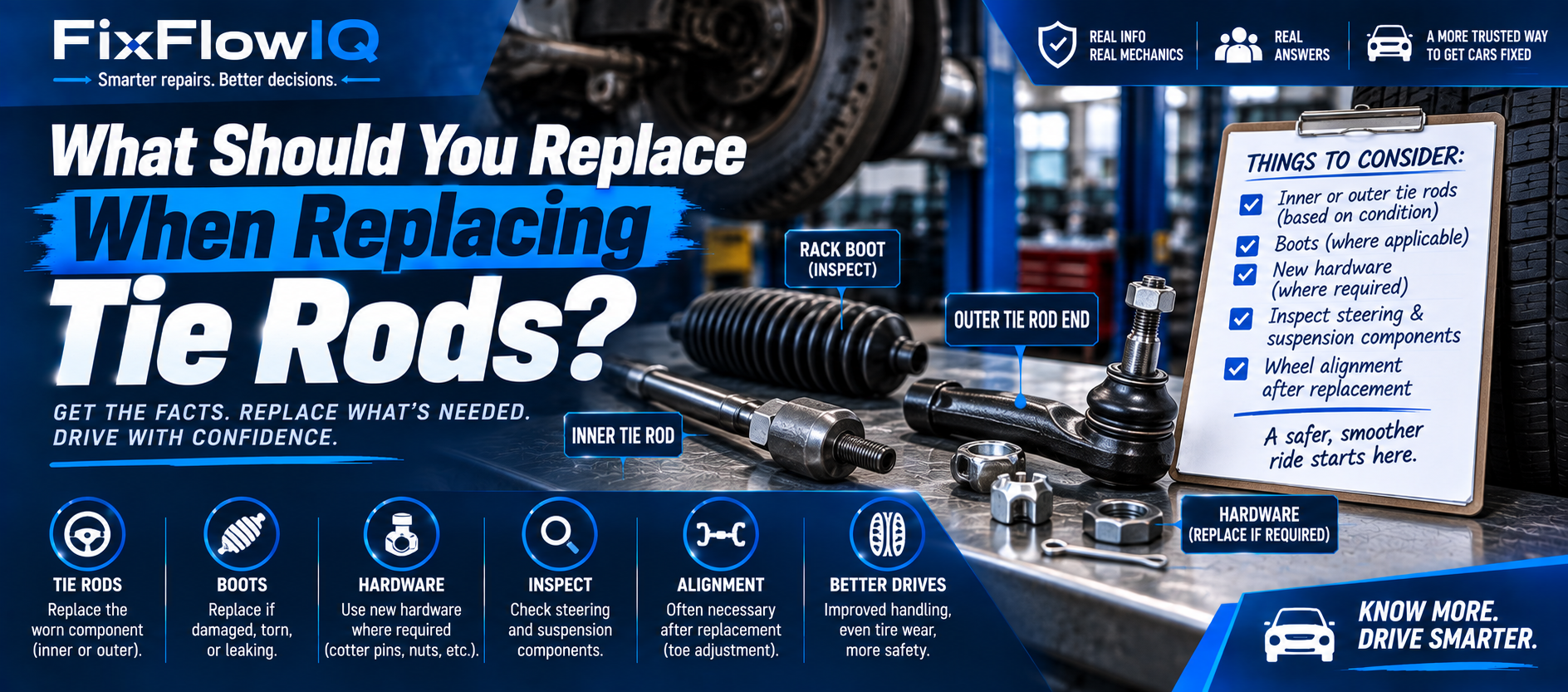
Replacing tie rods? Learn when inner or outer tie rods, boots, and hardware need attention, what else should be inspected, and why an alignment usually follows.
Read Article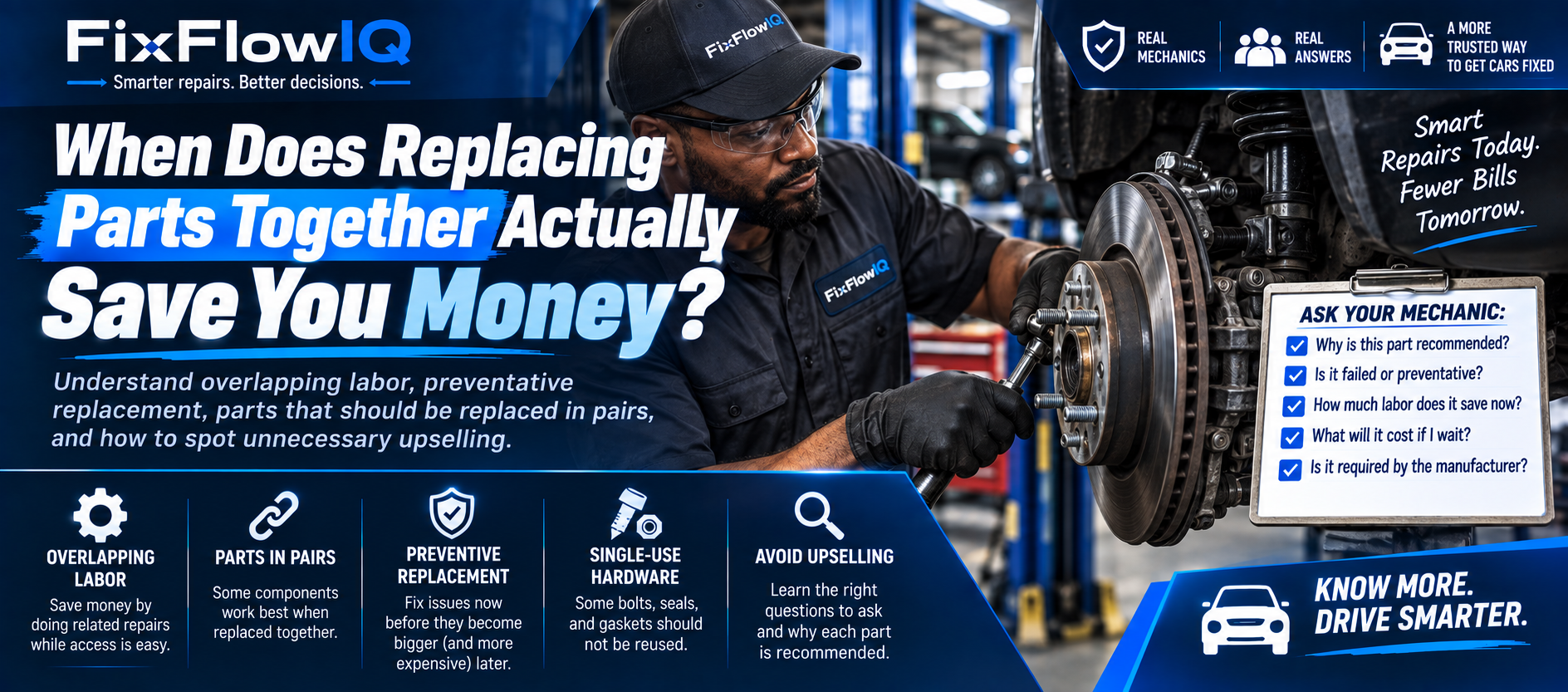 Smart Repair & Replacement Tips
Replacing parts together can sometimes save hundreds in future labor—but not every recommendation is necessary. Learn how to tell smart preventive repairs from unnecessary upselling.
Join hundreds of verified repair professionals already growing their businesses with FixFlowIQ. Receive qualified auto repair leads in Asheville, NC, and across North Carolina, manage bookings, and build your reputation—all from one dashboard.
Offer exclusive partner discounts to attract more customers and grow your business faster.
✓ Rear main seal
✓ Front crank seal
✓ Cam seals where applicable
✓ Engine mounts
✓ Transmission mount
✓ Difficult-to-access coolant hoses
✓ Coolant pipes/fittings
✓ Timing belt / timing components
✓ Water pump
✓ Thermostat
✓ Valve-cover gaskets
✓ Oil-pan sealing
✓ Belts / tensioners
✓ Spark plugs
✓ Turbo and oil/coolant lines where applicable
✓ Transferred accessories
✓ Front/input seal
✓ Axle/output seals
✓ Transmission mount
✓ Transmission filter where applicable
✓ Correct transmission fluid
✓ Torque converter
✓ Transmission cooler
✓ Cooler lines
✓ Flexplate
✓ Axles / driveshaft
✓ Clutch disc
✓ Pressure plate
✓ Release bearing
✓ Pilot bearing/bushing
✓ Flywheel
✓ Internal/concentric slave cylinder where applicable
✓ Rear main seal
✓ Why the original unit failed
✓ Parts that are difficult to access later
✓ Required single-use seals and hardware
✓ Supplier warranty requirements
An engine or transmission replacement does not automatically require:
EVERY SENSOR.
EVERY HOSE.
ALL ENGINE MOUNTS.
STARTER.
ALTERNATOR.
A/C COMPRESSOR.
RADIATOR.
ALL IGNITION COILS.
EVERY SEAL.
or:
EVERY ACCESSORY.
The rule is:
INSPECT FIRST.
Before the powertrain goes back in:
Ask your mechanic:
“IS THERE ANYTHING YOU SEE RIGHT NOW THAT WILL BE EXPENSIVE TO ACCESS AFTER THE ENGINE OR TRANSMISSION IS REINSTALLED?”
That's one of the smartest questions you can ask.
Then ask:
“HOW MUCH DOES IT COST TO DO IT NOW?”
and:
“HOW MUCH LABOR WOULD IT COST IF I WAIT?”
Now you can make:
AN INFORMED FINANCIAL DECISION.
Imagine a difficult-to-access coolant hose costs:
$30.
Engine is already removed.
Additional labor:
15 MINUTES.
Total additional cost:
Maybe:
$60–$100.
But if that hose fails after installation:
Access may require:
SEVERAL HOURS OF LABOR.
Suddenly that $30 hose becomes:
A $600–$900 REPAIR.
That's where:
PREVENTIVE REPLACEMENT CAN SAVE REAL MONEY.
Now imagine:
Your alternator is:
TWO YEARS OLD.
It works perfectly.
It's easy to replace with the engine installed.
Replacing it simply because:
“THE ENGINE IS OUT”
may provide:
VERY LITTLE FINANCIAL BENEFIT.
That's not smart preventive maintenance.
That's:
SPENDING MONEY WITHOUT A STRONG REASON.
For every recommended additional part:
Ask four questions:
If yes:
Strong reason.
Age and mileage matter.
This can dramatically change the economics.
If:
$50 NOW
could avoid:
$700 LATER,
that's worth serious consideration.
“The rear main seal is already leaking and the transmission is removed. Replacing it now adds very little labor.”
Excellent.
“The used engine has an unknown timing-belt history. Since the engine is out and the belt is near its interval, we recommend doing the timing kit now.”
Reasonable.
“These heater hoses are buried behind the engine and visibly cracked. They're inexpensive to replace while the engine is out.”
Good use of labor overlap.
“The transmission failed internally and contaminated the fluid, so the cooler must be flushed or replaced according to the replacement-unit warranty.”
Critical.
“The starter, alternator, coils, and front hoses all tested and inspected well, so we're reusing them.”
Excellent.
“Since the engine is out, we're replacing everything attached to it.”
Ask:
WHY?
Ask:
“Why did the original engine or transmission fail?”
“Is the replacement new, rebuilt, remanufactured, or used?”
“What is the mileage on the replacement?”
“What exactly is included with it?”
“What parts from my old engine or transmission will be reused?”
“Which seals are difficult to access after installation?”
“Is the rear main seal leaking?”
“How old are the engine and transmission mounts?”
“Are there difficult-to-access coolant hoses that should be addressed now?”
“What is the timing-belt or timing-chain condition?”
“Should the water pump be serviced while access is easy?”
“Are any transferred gaskets or seals required to be replaced?”
“Is the transmission cooler contaminated?”
“Does the torque converter need replacement?”
“Does the replacement-unit warranty require cooler flushing or replacement?”
“If it's a manual, how much life is left in the clutch?”
“Which additional repairs are dramatically cheaper while the powertrain is out?”
And one of the most important:
“HOW MUCH WOULD EACH OF THESE ITEMS COST TO REPAIR LATER AFTER EVERYTHING IS REINSTALLED?”
Replacing an engine or transmission creates something extremely valuable:
ACCESS.
And access can equal:
LABOR SAVINGS.
This may be the best opportunity to address:
LEAKING SEALS.
FAILED MOUNTS.
OLD TIMING COMPONENTS.
DIFFICULT-TO-ACCESS HOSES.
WORN CLUTCH COMPONENTS.
CONTAMINATED TRANSMISSION COOLERS.
OLD WATER PUMPS.
and:
OTHER JUSTIFIED WEAR ITEMS.
But the goal isn't:
REPLACE EVERYTHING.
The goal is:
IDENTIFY WHAT IS WORN.
IDENTIFY WHAT IS DIFFICULT TO ACCESS.
IDENTIFY WHAT COULD DAMAGE THE REPLACEMENT UNIT.
COMPARE THE COST NOW VS. LATER.
and:
SPEND MONEY WHERE IT ACTUALLY SAVES MONEY.
Because with an engine or transmission replacement:
Sometimes:
THE MOST EXPENSIVE DECISION ISN'T REPLACING AN EXTRA PART.
It's:
NOT REPLACING A $30 PART WHEN YOU HAD THE PERFECT OPPORTUNITY.
When submitting an engine or transmission replacement request through FixFlowIQ:
Don't simply write:
“NEED ENGINE.”
or:
“NEED TRANSMISSION.”
Provide as much information as possible.
For example:
“My engine overheated and lost compression. I'm comparing used and remanufactured replacement options.”
“My transmission failed internally and the fluid contains metal.”
“I'm installing a used engine and want the timing system inspected before installation.”
“My manual transmission is being replaced and I want to know whether doing the clutch now will save labor.”
Then compare provider quotes based on:
Replacement Unit • Mileage • Warranty • Labor • Seals • Mounts • Fluids • Filters • Timing Components • Hoses • Cooling-System Work • Torque Converter • Cooler Service • Clutch Work • Parts Quality • Provider Discounts
One provider may quote:
THE POWERTRAIN SWAP ONLY.
Another may include:
SEALS AND REQUIRED FLUIDS.
Another may recommend:
A TIMING KIT, REAR MAIN SEAL, OR DIFFICULT-TO-ACCESS HOSES
because doing them now could prevent:
MAJOR DUPLICATE LABOR LATER.
Those differences matter.
Because when comparing an engine or transmission replacement:
THE LOWEST INITIAL QUOTE IS NOT ALWAYS THE LOWEST TOTAL COST OF OWNERSHIP.
FixFlowIQ helps vehicle owners compare:
WHAT IS ACTUALLY INCLUDED.
Because the smartest repair isn't:
REPLACE EVERYTHING.
And it isn't:
DO THE ABSOLUTE MINIMUM.
It's:
FIX THE FAILURE.
PROTECT THE REPLACEMENT POWERTRAIN.
TAKE ADVANTAGE OF SMART LABOR OVERLAP.
and:
AVOID PAYING TWICE FOR THE SAME DISASSEMBLY.
SYMPTOMS FIRST.
DIAGNOSIS SECOND.
REPAIR THIRD.
Oral Thompson
Writes about vehicle care and the FixFlowIQ platform.