Replacing a serpentine belt? Learn when the tensioner, idler pulleys, and belt-driven accessories need attention—and why a new belt won't fix the problem that damaged the old one.

Your vehicle needs a:
SERPENTINE BELT.
At first, that sounds simple.
Remove the old belt.
Install the new belt.
Done.
But then your repair estimate may include:
BELT TENSIONER.
IDLER PULLEY.
Maybe even:
AN ALTERNATOR PULLEY.
A/C COMPRESSOR PULLEY.
or another belt-driven component.
Now you're wondering:
“If I only need a belt, why are these other parts being recommended?”
Sometimes they shouldn't be.
But sometimes:
THE BELT ISN'T THE REAL PROBLEM.
A serpentine belt depends on an entire accessory-drive system to:
TENSION IT.
GUIDE IT.
KEEP IT ALIGNED.
and:
ALLOW IT TO TURN SMOOTHLY.
If one of those components is failing:
Installing a new belt may simply give the underlying problem:
A NEW BELT TO DAMAGE.
The serpentine belt is an external engine-drive belt.
Depending on the vehicle, it may drive components such as:
Alternator
A/C compressor
Water pump
Power-steering pump
Other accessories
Not every vehicle uses the same arrangement.
Some modern vehicles also use:
Multiple accessory belts
Stretch-fit belts
Electric power steering
Electric water pumps
Other accessory-drive configurations
That's why:
VEHICLE-SPECIFIC DESIGN MATTERS.
These are completely different components.
The:
SERPENTINE BELT
usually drives external accessories.
The:
TIMING BELT
synchronizes the crankshaft and camshaft(s) inside the engine's timing system.
Do not confuse:
SERPENTINE-BELT REPLACEMENT
with:
TIMING-BELT SERVICE.
A belt can wear because of:
Age
Mileage
Heat
Normal material deterioration
But it can also be damaged by:
Weak tensioner
Seized idler pulley
Rough pulley bearing
Misaligned pulley
Failing accessory
Oil contamination
Coolant contamination
Damaged pulley
Incorrect belt routing
Incorrect belt size
Foreign material
Excessive vibration
That's why a broken or shredded belt should trigger the question:
“WHY DID IT FAIL?”
Not just:
“WHAT BELT DO I NEED?”
Suppose an old belt has gradually developed normal wear over many years.
That may simply mean:
THE BELT REACHED THE END OF ITS SERVICE LIFE.
But suppose the belt is:
SHREDDED ON ONE EDGE.
or:
MISSING RIBS.
or:
MELTED.
or:
THROWN OFF THE PULLEYS.
Those symptoms may point toward:
ANOTHER PROBLEM IN THE DRIVE SYSTEM.
The old belt can provide useful diagnostic clues.
For example:
May indicate:
AGE AND WEAR.
May indicate:
ALIGNMENT OR TRACKING PROBLEM.
May indicate:
SLIPPING, HEAT, OR TENSION PROBLEMS.
May indicate:
PULLEY DAMAGE, MISALIGNMENT, OR OTHER DRIVE PROBLEMS.
May indicate:
AN ENGINE-OIL LEAK.
May indicate:
A COOLING-SYSTEM LEAK.
May indicate:
A MORE SERIOUS ACCESSORY-DRIVE FAILURE.
The belt can sometimes tell you:
WHAT TO INSPECT NEXT.
Obviously:
If the belt is worn, damaged, contaminated, or due for replacement:
Replace it.
Use the:
CORRECT BELT FOR THE VEHICLE.
That means correct:
Length
Width
Rib count
Application
Material specification
A belt that is:
“CLOSE ENOUGH”
is not necessarily:
CORRECT.
Modern serpentine belts may travel around several pulleys.
The belt must follow:
THE CORRECT ROUTING.
Many vehicles have a belt-routing diagram under the hood.
If not:
The technician should use proper service information.
Incorrect routing can cause:
ACCESSORIES TO OPERATE IMPROPERLY
or:
THE BELT TO FAIL.
The automatic belt tensioner is one of the most important components to inspect during serpentine-belt replacement.
Its job is to maintain:
PROPER BELT TENSION.
It compensates for changes as the belt operates.
If the tensioner becomes weak or damaged:
The belt may not remain properly controlled.
This is the central lesson of this article.
Imagine:
Your old belt squeals because the tensioner can no longer maintain proper tension.
You install:
A BRAND-NEW BELT.
For a short time:
The noise may improve.
Then:
THE SQUEAL RETURNS.
Why?
Because the real problem was:
THE TENSIONER.
The new belt didn't repair it.
A tensioner may show:
Excessive movement
Weak tension
Bearing noise
Pulley wobble
Binding
Misalignment
Damaged spring mechanism
Physical damage
The tensioner should be:
INSPECTED, NOT AUTOMATICALLY CONDEMNED.
Not necessarily.
If the tensioner is:
OPERATING CORRECTLY
and has no evidence of:
Bearing failure
Weakness
Damage
Excessive movement
Misalignment
it may remain serviceable.
But if the tensioner caused the old belt's problem:
REPLACING ONLY THE BELT IS INCOMPLETE.
If the belt and tensioner have:
VERY HIGH MILEAGE
and are both original:
Preventive tensioner replacement may sometimes make sense.
But that recommendation should still be based on:
CONDITION, SERVICE HISTORY, APPLICATION, AND REPAIR VALUE.
Not:
“WE ALWAYS REPLACE BOTH.”
The tensioner usually includes a pulley containing:
A BEARING.
Depending on design:
The pulley may be serviceable separately.
Or:
The entire tensioner assembly may need replacement.
A failing pulley bearing may:
Growl
Grind
Squeal
Develop play
Bind
Seize
If it seizes:
The belt can be:
DESTROYED VERY QUICKLY.
Many serpentine-belt systems use one or more:
IDLER PULLEYS.
Their purpose is to guide the belt and establish the correct belt path.
Like the tensioner pulley:
Each idler typically contains:
A BEARING.
Bearings don't last forever.
With the belt removed, the technician can evaluate:
Bearing smoothness
Noise
Play
Binding
Pulley damage
Alignment
Surface condition
A rough or loose pulley deserves:
ATTENTION.
NO.
A properly functioning idler doesn't automatically need replacement.
But:
A $30–$100 pulley that is already:
ROUGH, LOOSE, OR NOISY
should not be ignored while installing:
A NEW BELT.
Imagine:
NEW BELT: INSTALLED TODAY.
FAILING IDLER: LEFT IN PLACE.
Two weeks later:
The bearing seizes.
The belt:
SHREDS.
Now the customer may lose:
Alternator operation
Water-pump operation on applicable vehicles
Power-steering assist on applicable vehicles
A/C operation
The inexpensive belt wasn't:
THE PROBLEM.
All pulleys in the belt path need to:
TRACK CORRECTLY.
A pulley that sits too far:
FORWARD
or:
BACKWARD
can cause the belt to ride incorrectly.
Possible signs include:
Edge wear
Belt walking
Rib damage
Repeated belt failure
Chirping
Belt coming off
If a vehicle keeps destroying serpentine belts:
Installing another belt is not:
A DIAGNOSIS.
The technician should inspect:
THE ENTIRE BELT PATH.
Possible causes include:
Bent bracket
Damaged tensioner
Incorrectly installed accessory
Worn bearing
Damaged pulley
Improper spacer
Previous repair error
Accessory shaft movement
The exact cause should be:
IDENTIFIED.
The alternator is commonly driven by the serpentine belt.
Does it need replacement with the belt?
ABSOLUTELY NOT—UNLESS THERE'S A PROBLEM WITH IT.
But its pulley and bearing condition should be considered if the belt failed abnormally.
If an alternator bearing begins:
BINDING
or:
SEIZING
it can place abnormal load on the belt.
That may contribute to:
Noise
Belt slip
Heat
Belt damage
Tensioner movement
If the alternator pulley does not rotate correctly:
That problem needs:
DIAGNOSIS.
Some vehicles use an:
OVERRUNNING ALTERNATOR PULLEY
or:
OVERRUNNING ALTERNATOR DECOUPLER.
These are designed to help manage accessory-drive vibration.
If one fails:
It may cause:
Belt flutter
Tensioner movement
Noise
Drive-system vibration
Again:
Vehicle design matters.
The A/C compressor may also be driven by the serpentine belt.
The compressor itself should not be replaced because:
THE BELT IS WORN.
But:
Its pulley and bearing should be considered if the belt has experienced:
ABNORMAL DAMAGE.
Depending on the system design:
A compressor can fail internally or a clutch/pulley bearing can fail.
That can potentially:
LOCK OR DAMAGE THE ACCESSORY DRIVE.
If the belt broke while the A/C was operating:
The compressor system may deserve:
INSPECTION.
But:
Don't assume:
BROKEN BELT = BAD A/C COMPRESSOR.
Diagnose it.
Some vehicles use the serpentine belt to drive:
THE WATER PUMP.
If so:
The pump pulley and bearing should be checked when investigating abnormal belt failure.
Possible water-pump problems include:
Bearing play
Grinding
Leakage
Pulley wobble
Seizure
If the water-pump bearing begins to seize:
The belt may:
SLIP, OVERHEAT, OR BREAK.
Now replacing:
ONLY THE BELT
doesn't fix:
THE FAILED WATER PUMP.
If the serpentine belt drives the water pump:
When the belt breaks:
COOLANT CIRCULATION MAY STOP.
The engine can begin overheating.
If the temperature warning appears:
PULL OVER SAFELY AND SHUT THE ENGINE DOWN.
Do not continue driving simply because:
“IT'S ONLY A BELT.”
Some vehicles use a belt-driven hydraulic:
POWER-STEERING PUMP.
Others use:
ELECTRIC POWER STEERING
and may have no belt-driven steering pump at all.
If the hydraulic pump bearing or pulley fails:
It can affect:
THE SERPENTINE BELT.
On vehicles with belt-driven hydraulic steering:
A broken serpentine belt may result in:
LOSS OF POWER-STEERING ASSIST.
The steering wheel may become:
MUCH HARDER TO TURN.
The steering mechanism still functions mechanically in many designs, but:
MORE EFFORT MAY BE REQUIRED.
The serpentine belt is driven by the engine through the:
CRANKSHAFT PULLEY
often incorporated into a:
HARMONIC BALANCER.
This component should not automatically be replaced during belt service.
But:
It should not be ignored if belt alignment or vibration problems exist.
Some harmonic balancers use:
RUBBER ISOLATION MATERIAL
between sections.
If that material deteriorates:
The pulley may:
Wobble
Shift
Separate
Become misaligned
That can create:
SERIOUS BELT-TRACKING PROBLEMS.
With the engine operating safely and inspection performed by someone qualified:
Visible pulley wobble may indicate:
A PROBLEM THAT NEEDS INVESTIGATION.
Don't install belt after belt while ignoring:
A WOBBLING CRANK PULLEY.
This is an often-overlooked part of serpentine-belt service.
Belts should remain:
CLEAN AND DRY.
If the old belt is soaked in:
ENGINE OIL
or:
COOLANT
the leak should be:
IDENTIFIED.
A fluid leak may:
Degrade belt material
Cause slipping
Attract debris
Create noise
Shorten belt life
Installing a new belt without addressing the leak can result in:
PREMATURE FAILURE.
Possible sources may include:
Valve-cover gasket
Front engine seal
Water pump
Coolant hose
Thermostat housing
Other engine components
Don't guess.
Identify:
WHERE THE FLUID IS COMING FROM.
Some vehicles have shields designed to protect the accessory drive from:
Water
Road debris
Dirt
Foreign objects
If a splash shield is:
MISSING OR DAMAGED
it may expose the belt to conditions it wasn't designed to experience continuously.
Inspect:
RELATED PROTECTION COMPONENTS
when repeated belt problems exist.
Not every accessory belt uses:
AN AUTOMATIC TENSIONER.
Some modern vehicles use:
STRETCH-FIT BELTS.
These are installed using specific procedures and tools.
In many applications:
Once removed:
The belt should not simply be:
REINSTALLED.
Follow:
MANUFACTURER AND BELT-MAKER PROCEDURES.
Improper installation can:
Damage belt ribs
Stretch the belt incorrectly
Damage pulleys
Shorten belt life
Use:
THE CORRECT INSTALLATION METHOD.
Squealing, chirping, or other belt-area noises can involve:
Belt
Tensioner
Idler
Misalignment
Accessory bearing
Contamination
Pulley
Other problems
Simply spraying:
BELT DRESSING
or replacing the belt without diagnosis may:
MASK THE SYMPTOM TEMPORARILY.
Find:
THE CAUSE.
A fresh belt may grip differently than:
THE OLD WORN BELT.
That can temporarily reduce:
NOISE.
But if the tensioner remains weak:
The underlying mechanical problem still exists.
That's why:
“THE NOISE WENT AWAY AFTER THE BELT”
doesn't always prove:
THE BELT WAS THE ONLY PROBLEM.
This is one of the most important practical lessons.
If a belt simply reached its normal replacement interval:
A routine inspection may be enough.
But if the belt:
BROKE
SHREDDED
JUMPED OFF
or:
MELTED
then every component in the drive path deserves:
CAREFUL INSPECTION.
There is no universal list.
Generally:
 Smart Repair & Replacement Tips
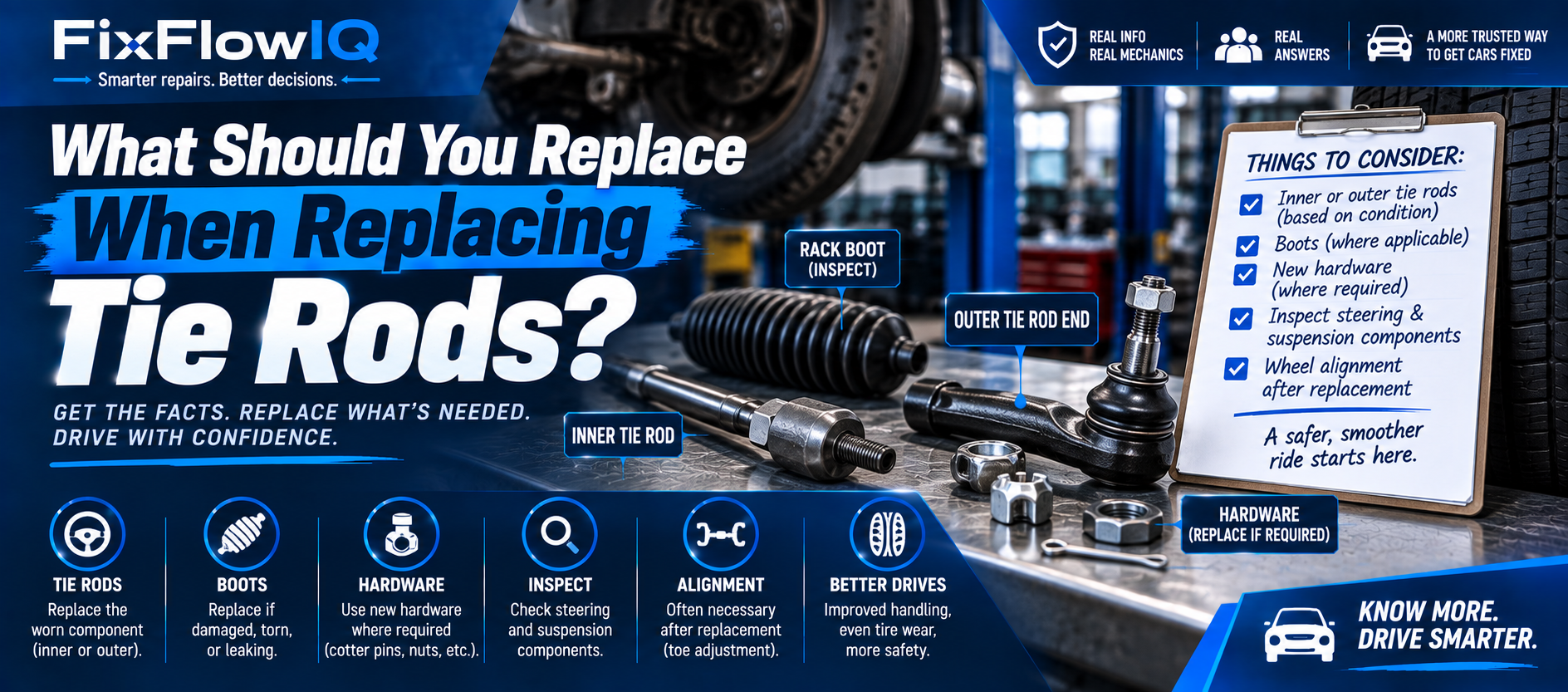
Replacing tie rods? Learn when inner or outer tie rods, boots, and hardware need attention, what else should be inspected, and why an alignment usually follows.
Read Article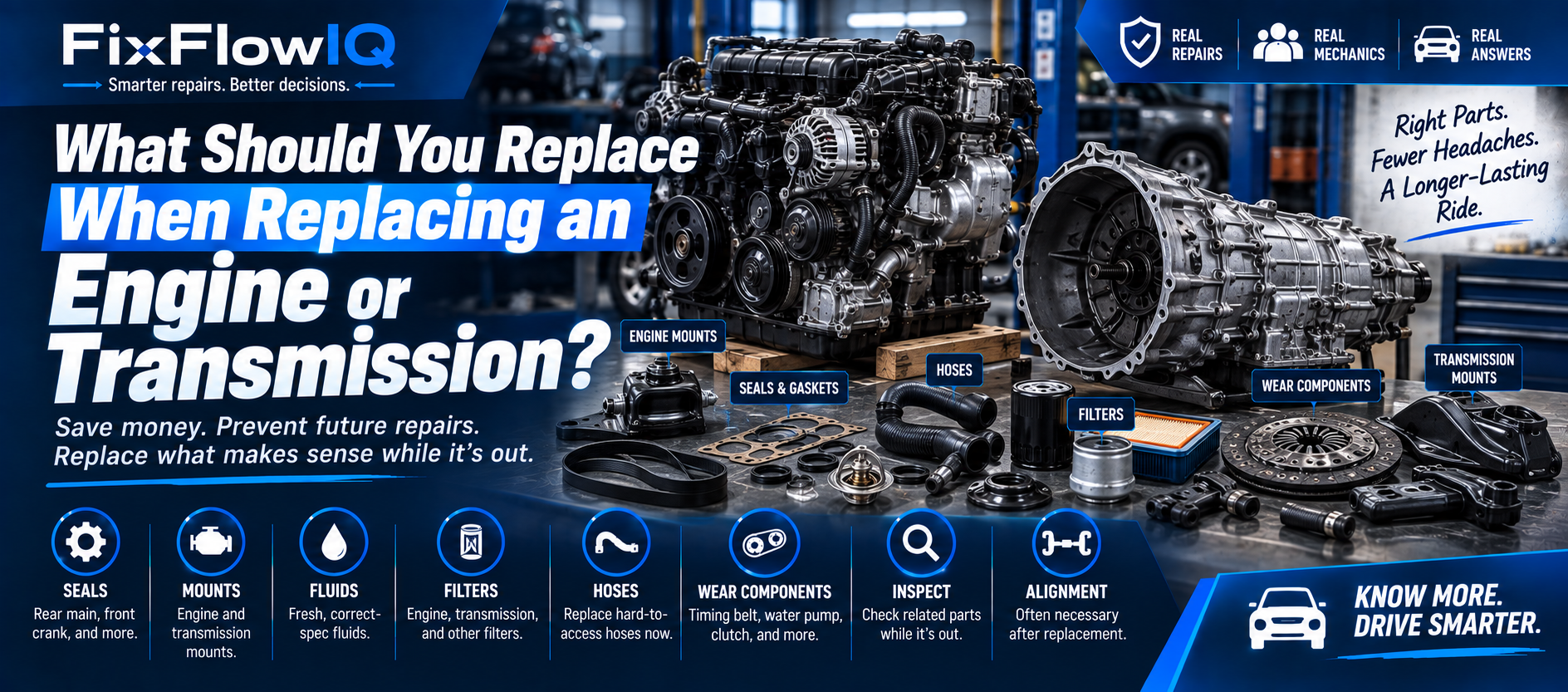 Smart Repair & Replacement Tips
Join hundreds of verified repair professionals already growing their businesses with FixFlowIQ. Receive qualified auto repair leads in Asheville, NC, and across North Carolina, manage bookings, and build your reputation—all from one dashboard.
Offer exclusive partner discounts to attract more customers and grow your business faster.
✓ Serpentine belt
✓ Automatic tensioner
✓ Tensioner pulley
✓ Idler pulley(s)
✓ Pulley alignment
✓ Crankshaft pulley / harmonic balancer
✓ Alternator pulley/bearing
✓ A/C compressor pulley/bearing
✓ Water-pump pulley/bearing when belt-driven
✓ Power-steering pump when belt-driven
✓ Belt tensioner
✓ Idler pulley(s)
✓ Damaged pulleys
✓ Failing belt-driven accessories
✓ Damaged belt shields
✓ Oil leaks contaminating the belt
✓ Coolant leaks contaminating the belt
✓ Pulley misalignment
✓ Seized accessories
✓ Incorrect brackets or hardware
A serpentine-belt job does not automatically mean you need:
A NEW TENSIONER.
ALL NEW IDLERS.
A NEW ALTERNATOR.
A NEW WATER PUMP.
A NEW A/C COMPRESSOR.
or:
A NEW POWER-STEERING PUMP.
Those parts need:
EVIDENCE OF FAILURE OR A STRONG PREVENTIVE JUSTIFICATION.
With a timing belt:
Replacing tensioners and idlers together is often part of:
A PLANNED SYSTEM SERVICE.
With an external serpentine belt:
The approach is often more:
CONDITION-BASED.
That's an important distinction.
Imagine:
New serpentine belt
New belt + failed tensioner
New belt + failed tensioner + damaged idler
Which is best?
You can't know from:
PRICE ALONE.
If the tensioner and idler are actually failing:
Quote A may be:
AN INCOMPLETE REPAIR.
But if they're perfectly good:
Quote C may contain:
UNNECESSARY PARTS.
You need:
EVIDENCE.
If the mechanic says:
“Your idler bearing is bad.”
ask them to show you:
Roughness
Play
Noise
Binding
If they say:
“The tensioner is weak.”
ask:
WHAT DID THEY OBSERVE?
If they say:
“The belt is misaligned.”
ask:
WHICH PULLEY IS CAUSING IT?
A quality repair explanation should connect:
THE FAILED PART
to:
THE SYMPTOM.
Ask:
“Why does the belt need replacement?”
“Is it normally worn, or was it damaged by another component?”
“Did you inspect the tensioner?”
“Is the tensioner weak, noisy, misaligned, or damaged?”
“Did you check every idler pulley?”
“Are any pulley bearings rough or loose?”
“Is the belt tracking correctly?”
“Are any belt-driven accessories binding?”
“Is the crankshaft pulley wobbling?”
“Is there oil or coolant leaking onto the belt?”
“If the belt broke, did the engine overheat?”
“What brand and type of belt are being installed?”
“What warranty comes with the repair?”
Those questions help determine whether you're receiving:
A BELT REPLACEMENT
or:
A COMPLETE ACCESSORY-DRIVE DIAGNOSIS.
This is where FixFlowIQ's Smart Repair philosophy matters.
“Your belt is cracked and due for replacement. The tensioner and idlers are smooth, properly aligned, and operating correctly, so we're replacing only the belt.”
That's reasonable.
“Your belt shredded because the tensioner pulley bearing is failing. We're replacing the belt and failed tensioner assembly.”
Also reasonable.
“Any time we replace a belt, we automatically replace the alternator, water pump, tensioner, and all pulleys.”
Ask:
WHY?
Before approving the repair:
Normal wear?
Noise?
Broken?
Shredded?
Contaminated?
If abnormal failure occurred:
FIND THE CAUSE.
Check:
TENSION • MOVEMENT • BEARING • ALIGNMENT
Check:
SMOOTHNESS • PLAY • NOISE • ALIGNMENT
Alternator?
A/C?
Water pump?
Power steering?
Oil?
Coolant?
Fix it before it damages:
THE NEW BELT.
When replacing a serpentine belt:
Don't automatically replace:
EVERY PULLEY AND ACCESSORY.
But don't automatically assume:
THE BELT IS THE ONLY PROBLEM EITHER.
The tensioner should be:
INSPECTED.
The idler pulleys should be:
INSPECTED.
Pulley alignment should be:
CHECKED.
Belt-driven accessories should be evaluated when:
THE BELT FAILED ABNORMALLY.
And any:
OIL OR COOLANT CONTAMINATION
should be corrected.
The most important lesson is simple:
A NEW BELT DOES NOT FIX A FAILING TENSIONER.
It doesn't fix:
A SEIZED IDLER.
It doesn't fix:
A WOBBLING PULLEY.
It doesn't fix:
A FAILING ACCESSORY BEARING.
And it doesn't fix:
A FLUID LEAK.
The goal isn't:
REPLACE THE MOST PARTS.
The goal is:
FIND OUT WHY THE OLD BELT FAILED.
Then:
REPLACE THE BELT.
REPAIR THE ACTUAL CAUSE.
and:
LEAVE GOOD COMPONENTS ALONE.
When you submit an accessory-belt repair request through FixFlowIQ:
Don't just write:
“NEED SERPENTINE BELT.”
Describe what happened.
For example:
“The belt is squealing when I start the engine.”
“The serpentine belt shredded while driving.”
“The belt keeps walking off one pulley.”
“The tensioner is bouncing while the engine runs.”
“The belt is covered in coolant.”
Then compare provider quotes based on:
Belt • Tensioner • Idlers • Pulley Condition • Accessory Inspection • Warranty • Reviews • Provider Discounts
One provider may quote:
THE BELT ONLY.
Another may identify:
THE FAILED TENSIONER THAT DAMAGED IT.
Understanding those differences helps you compare:
THE ACTUAL REPAIR
instead of:
JUST THE LOWEST NUMBER.
Because replacing a $50 belt twice is not cheaper than:
FIXING THE REASON IT FAILED THE FIRST TIME.
SYMPTOMS FIRST.
DIAGNOSIS SECOND.
REPAIR THIRD.
Oral Thompson
Writes about vehicle care and the FixFlowIQ platform.
Replacing an engine or transmission? Learn which seals, mounts, fluids, hoses, filters, and wear parts may save you serious labor costs while the powertrain is already removed.