Replacing tie rods? Learn when inner or outer tie rods, boots, and hardware need attention, what else should be inspected, and why an alignment usually follows.
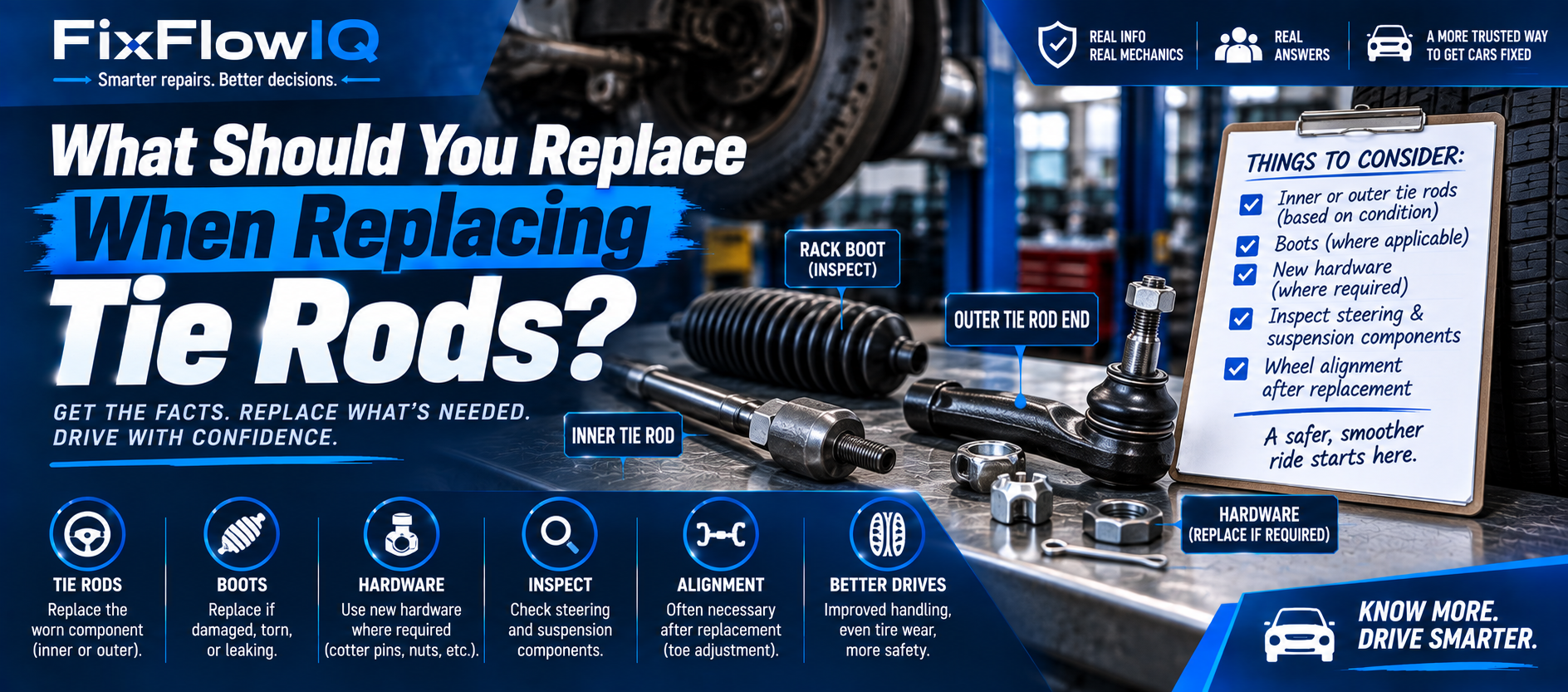
Your vehicle needs:
A TIE ROD.
Or maybe:
A TIE-ROD END.
Then the estimate grows.
You may see:
INNER TIE ROD.
OUTER TIE ROD.
BOOT.
NEW HARDWARE.
Maybe:
WHEEL ALIGNMENT.
And now you're wondering:
“WHAT ACTUALLY NEEDS TO BE REPLACED WHEN REPLACING TIE RODS?”
The answer depends on:
WHICH PART IS WORN.
Because a steering tie-rod assembly can include:
INNER TIE ROD + OUTER TIE-ROD END.
Sometimes only one part is bad.
Sometimes both are.
And sometimes:
THE REAL PROBLEM IS SOMEWHERE ELSE IN THE STEERING OR SUSPENSION.
That is why the smart approach is:
INSPECT FIRST.
REPLACE WHAT'S ACTUALLY WORN.
USE NEW HARDWARE WHEN REQUIRED.
and:
ALIGN THE VEHICLE AFTERWARD.
Tie rods connect the:
STEERING SYSTEM
to:
THE STEERING KNUCKLE / WHEEL ASSEMBLY.
When you turn the steering wheel:
The steering rack or steering gear moves.
The tie rods transfer that movement to the:
FRONT WHEELS.
That means tie rods directly affect:
TOE ALIGNMENT.
STEERING RESPONSE.
TIRE WEAR.
and:
VEHICLE CONTROL.
A worn tie rod can develop:
EXCESSIVE PLAY.
That play may cause:
Loose steering
Wandering
Uneven tire wear
Clunking
Steering-wheel movement
Poor alignment stability
Excessive toe change
Reduced steering precision
In severe cases:
A tie rod can:
SEPARATE.
That can result in:
LOSS OF STEERING CONTROL AT THAT WHEEL.
So significant tie-rod wear should be:
TAKEN SERIOUSLY.
Possible symptoms include:
Steering feels loose
Vehicle wanders
Uneven tire wear
Front-end clunking
Steering wheel is off-center
Vehicle pulls
Excessive play in the wheel
Poor alignment
Knocking while steering
Torn tie-rod boot
Visible looseness at the joint
But:
THESE SYMPTOMS DON'T AUTOMATICALLY PROVE A TIE ROD IS BAD.
Similar symptoms can also come from:
Ball joints
Control-arm bushings
Wheel bearings
Steering rack
Idler arm or pitman arm on applicable vehicles
Sway-bar links
Struts
Tires
Alignment
Other suspension or steering components
That means:
LOOSE STEERING ≠ AUTOMATIC TIE ROD.
Inspection matters.
The outer tie-rod end connects the steering linkage to the:
STEERING KNUCKLE.
It usually contains a:
BALL-AND-SOCKET JOINT
that allows movement as the suspension and steering operate.
Over time:
The joint can wear.
Possible findings include:
Excessive joint play
Torn dust boot
Loss of grease
Corrosion
Binding
Physical damage
Loose taper fit
Abnormal movement
If the joint has confirmed excessive play:
REPLACE IT.
The inner tie rod connects the:
STEERING RACK
to the outer tie rod.
It also uses a joint that allows:
MOVEMENT AND ARTICULATION.
Inner tie rods can wear too.
Possible signs include:
Excessive axial or radial play
Clunking
Steering looseness
Poor toe stability
Movement inside the steering-rack boot
NOT AUTOMATICALLY.
If the outer tie rod is worn but the inner tie rod is:
TIGHT AND SERVICEABLE,
there may be no reason to replace the inner.
Likewise:
If the inner tie rod is worn and the outer is healthy:
You may only need:
THE INNER TIE ROD.
Replacing both may be reasonable when:
Both have measurable play
Both are heavily corroded
Both have very high mileage and confirmed wear
The outer is seized to the inner
Adjustment threads are damaged
Labor overlap makes replacing both sensible
Vehicle-specific design or parts availability makes a combined assembly preferable
But the reason should be:
CONDITION OR REPAIR PRACTICALITY.
Not:
“THEY ALWAYS COME AS A PAIR.”
Now another common question:
“IF ONE TIE ROD IS BAD, SHOULD I REPLACE THE OTHER SIDE TOO?”
Usually:
NO.
Tie rods do not generally have to be replaced:
LEFT + RIGHT TOGETHER
the way some paired wear components are.
The smarter approach is:
CHECK IT.
Inspect for:
Play
Torn boots
Corrosion
Binding
Damage
Loose hardware
If the opposite side is healthy:
LEAVE IT ALONE.
Tie-rod joints are typically protected by:
RUBBER OR SYNTHETIC BOOTS.
These boots keep:
GREASE IN
and:
DIRT AND WATER OUT.
If a boot tears:
The joint may eventually become contaminated.
Not always.
If the boot is:
JUST DAMAGED
and the joint is:
STILL TIGHT AND UNDAMAGED,
some applications may allow:
BOOT REPLACEMENT.
But if contamination has already caused:
PLAY OR WEAR,
then the joint or tie-rod assembly needs:
REPLACEMENT.
When replacing an inner tie rod:
The technician often has to remove or disturb the:
STEERING-RACK BELLOWS BOOT.
This boot protects the inner tie rod and rack area from:
CONTAMINATION.
Inspect it carefully.
Replace it if it is:
Torn
Cracked
Brittle
Oil-soaked
Damaged during removal
No longer sealing correctly
But:
Don't automatically replace a good boot just because:
THE INNER TIE ROD IS BEING CHANGED.
This is important.
If the rack boot is removed and contains:
POWER-STEERING FLUID
on a hydraulic steering rack:
That may indicate:
AN INTERNAL STEERING-RACK SEAL LEAK.
Replacing the inner tie rod will not fix:
A LEAKING STEERING RACK.
Outer tie rods usually thread onto:
THE INNER TIE ROD.
A jam nut or similar hardware helps lock the toe adjustment.
This hardware may be:
Reused
Replaced if damaged
Replaced if heavily corroded
Included with a new component
Inspect it.
If the outer tie rod is seized to the inner tie rod due to:
CORROSION,
the technician may not be able to adjust toe properly.
In that situation:
Replacing only one component may not be practical.
This is especially common in:
RUST-PRONE AREAS.
Some outer tie rods attach to the steering knuckle using:
CASTLE NUT + COTTER PIN.
The cotter pin is generally:
NOT REUSED.
Use:
A NEW COTTER PIN.
Replace hardware when it is:
Single-use
Damaged
Deformed
Stripped
Corroded
Manufacturer-required
Do not compromise a steering repair because:
THE OLD NUT STILL THREADS ON.
The outer tie-rod stud fits into a:
TAPERED HOLE
in the steering knuckle.
Inspect that area for:
Damage
Elongation
Severe corrosion
Improper previous repair
Physical distortion
A new tie rod needs:
A SOUND MOUNTING SURFACE.
If an inner tie rod is worn:
The rack itself should be:
EVALUATED WHERE APPROPRIATE.
Why?
Because looseness can sometimes be mistaken for:
INNER TIE-ROD PLAY.
The technician should determine whether the movement is actually in:
THE TIE ROD
or:
THE STEERING RACK.
If the rack has:
INTERNAL LOOSENESS,
a new inner tie rod may not eliminate:
THE STEERING PLAY.
Diagnosis matters.
Tie-rod replacement is a great time to inspect:
BALL JOINTS.
Why?
Because ball joints also affect:
STEERING AND WHEEL POSITION.
If they have play:
A wheel alignment may not remain:
ACCURATE.
But:
TIE ROD REPLACEMENT ≠ AUTOMATIC BALL-JOINT REPLACEMENT.
Inspect control-arm bushings for:
Cracking
Separation
Excessive movement
Collapse
Damage
A worn control-arm bushing can allow the wheel to move:
FORE AND AFT OR SIDE TO SIDE
depending on design.
Again:
Repair worn parts before:
ALIGNMENT.
A loose wheel bearing can create:
WHEEL MOVEMENT
that may be confused with tie-rod play.
The bearing should be:
CHECKED.
But don't replace it unless:
THE BEARING ITSELF IS BAD.
Sway-bar links can create:
CLUNKING NOISES
that some drivers interpret as steering looseness.
Inspect them where appropriate.
Replace based on:
CONDITION.
Worn struts and shocks don't usually cause tie-rod play.
But they can contribute to:
Poor handling
Tire wear
Vehicle instability
Alignment-related complaints
Inspect them.
Do not automatically:
REPLACE THEM WITH THE TIE RODS.
Tie-rod wear can produce:
TOE-RELATED TIRE WEAR.
Possible patterns include:
Feathering
Scrubbing
Inner-edge wear
Outer-edge wear
Uneven tread
Inspect:
ALL FRONT TIRES.
If the old tie rod caused severe tire wear:
Replacing the tie rod and aligning the vehicle may stop:
FURTHER ABNORMAL WEAR.
But it won't restore:
THE RUBBER THAT'S ALREADY GONE.
The tires may still need:
REPLACEMENT.
This is the most important related service after tie-rod replacement.
A:
WHEEL ALIGNMENT
is generally required or strongly recommended after:
INNER OR OUTER TIE-ROD REPLACEMENT.
Why?
Because tie rods directly control:
TOE.
Even if the technician tries to install the new tie rod at:
APPROXIMATELY THE SAME LENGTH
as the old one:
That is not precise enough for:
FINAL ALIGNMENT.
Tiny changes in tie-rod length can significantly affect:
WHEEL TOE.
A technician may:
COUNT THE THREADS
or measure the old tie rod to get the new one close enough for:
SAFE TRANSPORT TO THE ALIGNMENT RACK.
But that is not:
A SUBSTITUTE FOR AN ALIGNMENT.
Too much toe-in or toe-out can cause:
Rapid tire wear
Steering instability
Pulling
Poor handling
Steering-wheel misalignment
Increased rolling resistance
That's why:
TIE ROD + NO ALIGNMENT
is generally an incomplete repair.
After tie-rod replacement and alignment:
The steering wheel should be:
CENTERED
when the vehicle travels straight.
An off-center steering wheel may indicate:
TOE WAS NOT SET CORRECTLY OR EVENLY.
Don't align a vehicle first and then replace:
LOOSE TIE RODS.
That wastes:
TIME AND MONEY.
The correct order is:
DIAGNOSE → REPAIR LOOSE PARTS → ALIGN.
Ask this especially if the part failed:
PREMATURELY.
Possible causes include:
Torn boot
Water contamination
Pothole impact
Collision
Bent steering component
Poor-quality replacement part
Incorrect installation
Modified suspension
Corrosion
Normal high-mileage wear
Repeated failure deserves:
FURTHER INVESTIGATION.
A tie rod may also be:
BENT
rather than simply worn.
This can happen after:
Curb impact
Pothole
Collision
Off-road impact
Other road damage
If the tie rod is bent:
Inspect nearby components for:
COLLISION OR IMPACT DAMAGE.
If the steering wheel became crooked immediately after:
HITTING A CURB,
you may have more than:
A SIMPLE ALIGNMENT PROBLEM.
Possible damage can involve:
Tie rod
Control arm
Strut
Steering knuckle
Wheel
Tire
Subframe
Inspect:
THE HARD PARTS FIRST.
There is no universal list.
Generally:
 Smart Repair & Replacement Tips
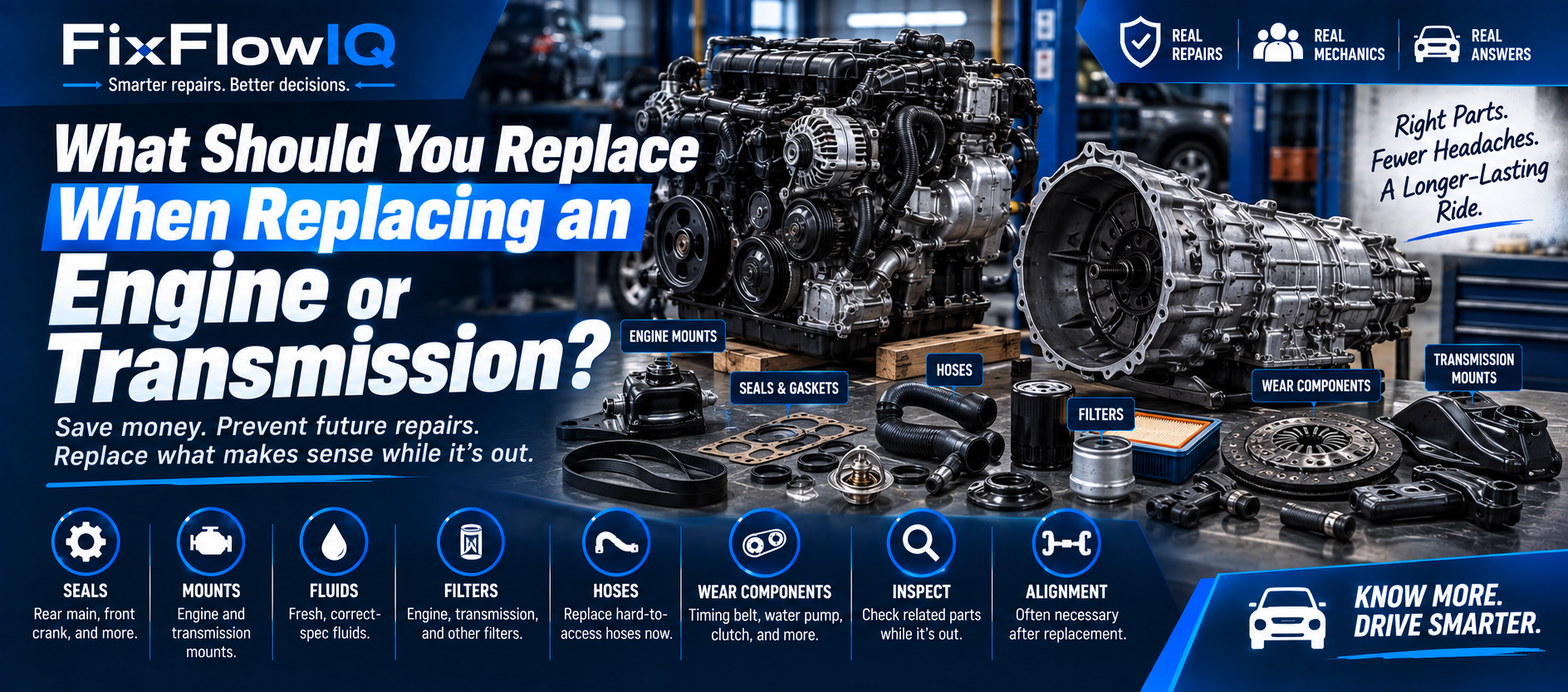
Replacing an engine or transmission? Learn which seals, mounts, fluids, hoses, filters, and wear parts may save you serious labor costs while the powertrain is already removed.
Read Article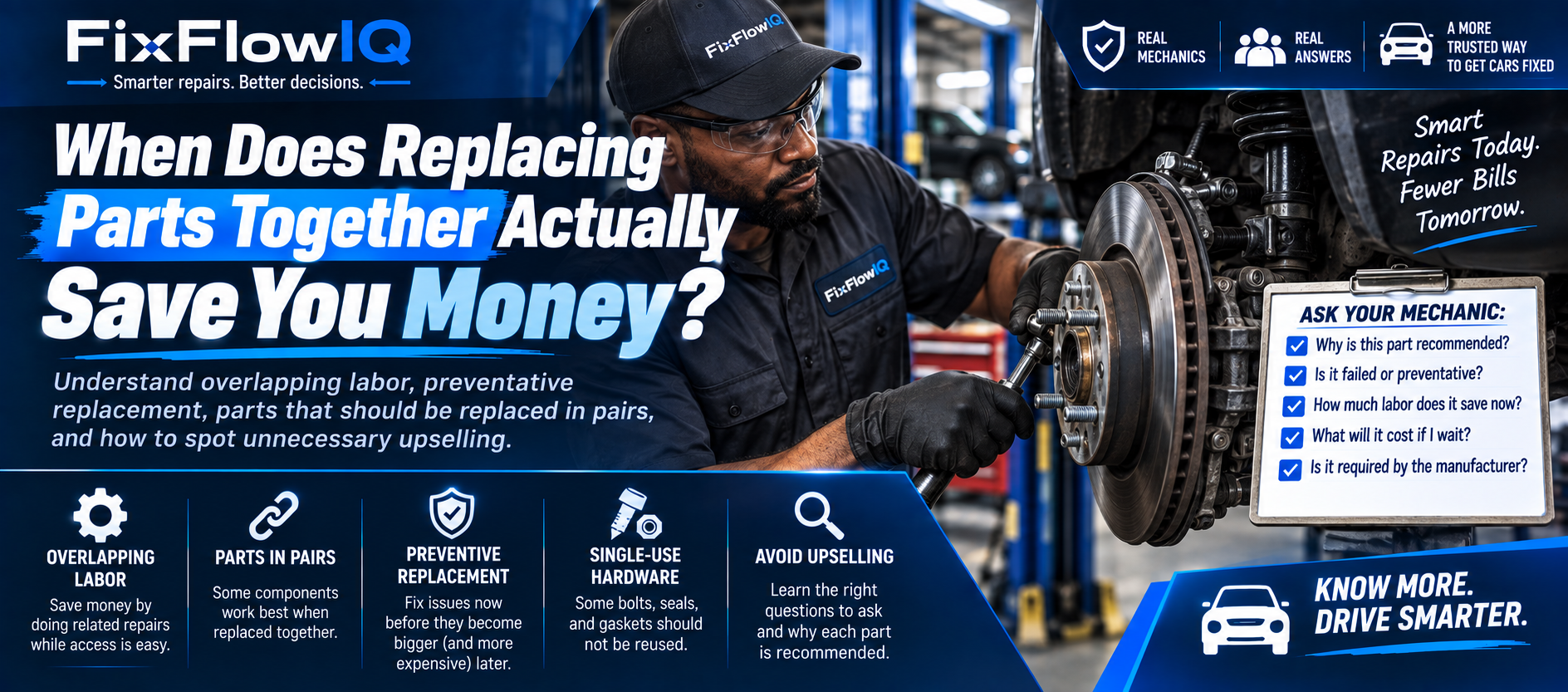 Smart Repair & Replacement Tips
Join hundreds of verified repair professionals already growing their businesses with FixFlowIQ. Receive qualified auto repair leads in Asheville, NC, and across North Carolina, manage bookings, and build your reputation—all from one dashboard.
Offer exclusive partner discounts to attract more customers and grow your business faster.
✓ Confirmed failed inner tie rod
or:
✓ Confirmed failed outer tie-rod end
✓ Opposite inner/outer tie rod only if worn
✓ Tie-rod boot
✓ Steering-rack bellows boot
✓ Jam nut / adjustment hardware
✓ Damaged or single-use hardware
✓ Cotter pin where applicable
✓ Steering rack
✓ Ball joints
✓ Control arms / bushings
✓ Wheel bearings
✓ Sway-bar links
✓ Struts / shocks
✓ Tires
✓ Opposite-side steering components
✓ Wheel alignment
Tie-rod replacement does not automatically require:
BOTH INNER AND OUTER TIE RODS.
BOTH SIDES.
BALL JOINTS.
CONTROL ARMS.
STRUTS.
WHEEL BEARINGS.
STEERING RACK.
or:
EVERY FRONT-END COMPONENT.
Each recommendation should be based on:
ACTUAL CONDITION.
“The passenger-side outer tie-rod end has measurable play. The inner tie rod is tight, so we're replacing only the outer end.”
Reasonable.
“The outer tie rod is seized to the inner tie rod, and the adjustment threads are unusable, so both need replacement.”
Reasonable.
“We checked the ball joints, control arms, and wheel bearings. They're tight, so we're leaving them alone.”
Excellent.
“The repair changes toe, so the estimate includes a four-wheel alignment afterward.”
Correct.
“One tie rod is bad, so we replace every tie rod, both control arms, ball joints, and struts.”
Ask:
WHY?
Imagine:
Outer tie-rod end
Inner + outer tie rod because the threads are seized
Inner + outer tie rod + alignment
Which is best?
You can't know from:
PRICE ALONE.
Maybe Quote A is all the vehicle needs.
Maybe Quote B is necessary because:
CORROSION MADE SEPARATE SERVICE IMPRACTICAL.
Maybe Quote C includes the:
REQUIRED ALIGNMENT.
You need to compare:
THE ACTUAL REPAIR.
Ask:
“Which tie rod is actually worn?”
“Is it the inner or outer tie rod?”
“Does the other part have measurable play?”
“Are the adjustment threads seized?”
“Is the tie-rod boot damaged?”
“Is the steering-rack boot torn?”
“Is there any fluid inside the rack boot?”
“Did you inspect the opposite-side tie rods?”
“Did you inspect the ball joints and control arms?”
“Are the wheel bearings tight?”
“Are the tires showing toe-related wear?”
“Is alignment included in the quote?”
“Will the steering wheel be centered afterward?”
“What brand tie rods are being installed?”
“What warranty comes with the parts and labor?”
These questions help you understand:
WHAT ACTUALLY NEEDS REPAIR.
Inner?
Outer?
Both?
Torn?
Leaking?
Contaminated?
Serviceable?
Seized?
Damaged?
Make sure the play isn't:
INSIDE THE RACK.
Replace only if:
WORN.
Look for:
TOE-RELATED WEAR.
Cotter pins?
Single-use nuts?
Damaged fasteners?
Because tie rods set:
TOE.
Steering wheel centered?
Vehicle tracks straight?
No looseness?
When replacing tie rods:
Replace:
THE INNER OR OUTER TIE ROD THAT IS ACTUALLY WORN.
Do not automatically replace:
BOTH COMPONENTS
unless condition, corrosion, or repair practicality justifies it.
Inspect:
THE BOOTS.
Replace them when:
DAMAGED OR REQUIRED.
Use:
NEW HARDWARE
when the manufacturer specifies it or when existing hardware is:
DAMAGED OR CORRODED.
Inspect the:
STEERING RACK.
BALL JOINTS.
CONTROL-ARM BUSHINGS.
WHEEL BEARINGS.
STRUTS.
OPPOSITE-SIDE TIE RODS.
and:
TIRES.
But most importantly:
After tie-rod replacement:
ALIGN THE VEHICLE.
Because tie rods directly determine:
TOE ALIGNMENT.
The goal isn't:
REPLACE THE WHOLE FRONT END.
And it isn't:
PUT A NEW TIE ROD ON AND GUESS AT THE TOE.
The goal is:
REPLACE THE WORN JOINT.
INSPECT EVERYTHING THAT CAN AFFECT STEERING.
USE THE CORRECT HARDWARE.
and:
FINISH THE REPAIR WITH A PROPER ALIGNMENT.
When submitting a tie-rod repair request through FixFlowIQ:
Don't just write:
“NEED TIE RODS.”
Describe what you know.
For example:
“The passenger-side outer tie-rod end has play.”
“My steering feels loose and the front tires are wearing unevenly.”
“The outer tie rod is seized to the inner tie rod.”
“A shop says I need all four tie-rod components even though only one has play.”
“I want an estimate that includes the alignment afterward.”
Then compare providers based on:
Inner Tie Rod • Outer Tie Rod • Boots • Hardware • Front-End Inspection • Wheel Alignment • Parts Quality • Warranty • Reviews • Availability • Provider Discounts
One provider may quote:
THE OUTER TIE ROD ONLY.
Another may explain that:
THE INNER AND OUTER ARE SEIZED TOGETHER.
Another may include:
THE ALIGNMENT
that is necessary to correctly finish:
THE REPAIR.
Those differences matter.
Because the smartest steering repair isn't:
THE QUOTE WITH THE MOST PARTS.
And it isn't:
THE CHEAPEST TIE-ROD INSTALLATION WITH NO ALIGNMENT.
It's the one that restores:
TIGHT STEERING.
CORRECT TOE.
EVEN TIRE WEAR.
and:
PREDICTABLE VEHICLE CONTROL.
SYMPTOMS FIRST.
DIAGNOSIS SECOND.
REPAIR THIRD.
Oral Thompson
Writes about vehicle care and the FixFlowIQ platform.
Replacing parts together can sometimes save hundreds in future labor—but not every recommendation is necessary. Learn how to tell smart preventive repairs from unnecessary upselling.