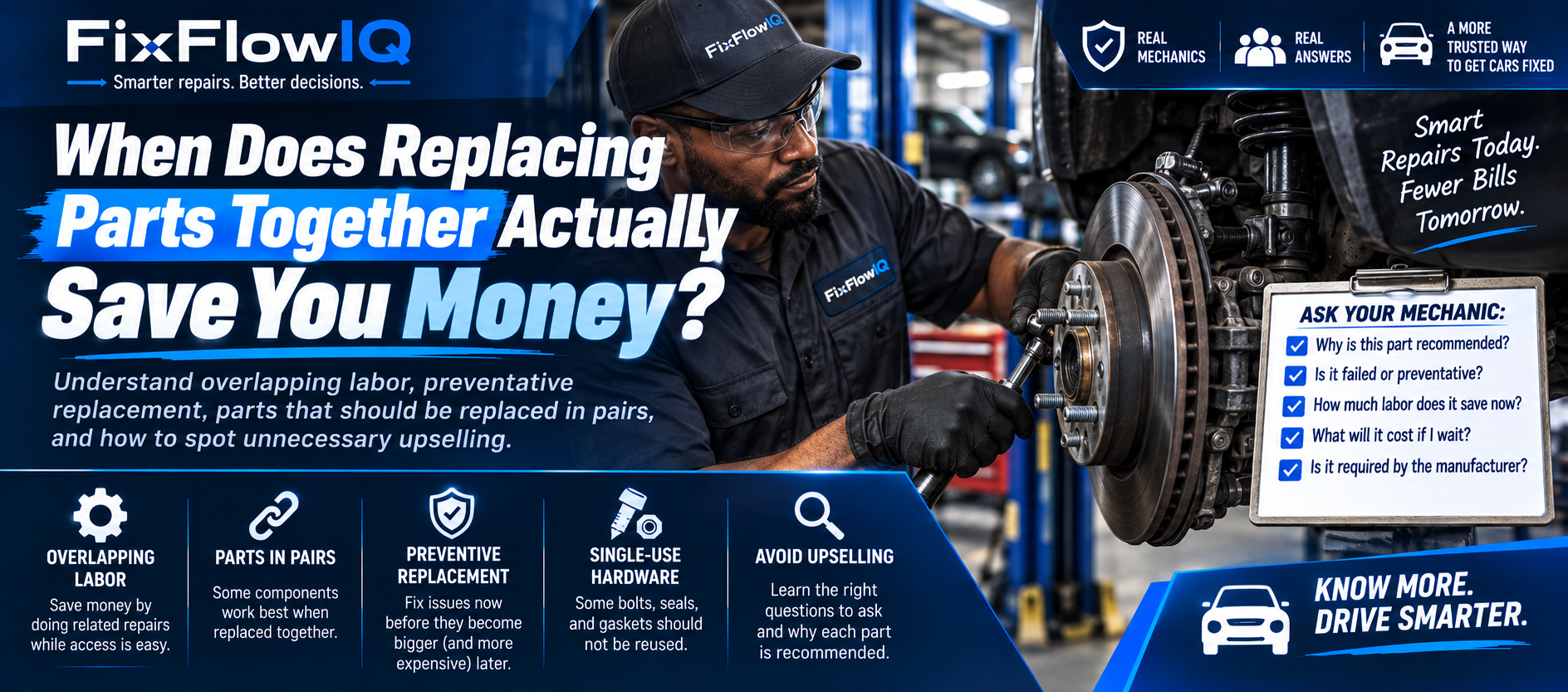
A timing belt job may involve more than the belt. Learn when tensioners, idler pulleys, the water pump, seals, and coolant should be replaced—and why doing the right work together can save money.

Your vehicle needs a:
TIMING BELT.
You get a repair estimate.
But instead of seeing only:
TIMING BELT
you may also see:
TENSIONER.
IDLER PULLEYS.
WATER PUMP.
CAMSHAFT OR CRANKSHAFT SEALS.
COOLANT.
And suddenly:
A timing-belt replacement looks like a much larger repair.
So you ask:
“If only the timing belt is due, why are all these other parts on the estimate?”
That's a smart question.
Because sometimes:
REPLACING RELATED COMPONENTS DURING A TIMING-BELT JOB CAN SAVE YOU SIGNIFICANT MONEY LATER.
But that doesn't mean:
EVERYTHING BEHIND THE TIMING COVER SHOULD AUTOMATICALLY BE REPLACED.
The goal is:
REPLACE WHAT SHOULD BE REPLACED.
INSPECT WHAT SHOULD BE INSPECTED.
and:
TAKE ADVANTAGE OF OVERLAPPING LABOR WHEN IT ACTUALLY MAKES SENSE.
The timing belt synchronizes critical internal engine components.
In a typical timing-belt engine:
The belt keeps the:
CRANKSHAFT
and:
CAMSHAFT(S)
rotating in the correct relationship.
That synchronization allows:
PISTONS
and:
VALVES
to operate at precisely the right time.
The engine depends on that timing:
EVERY SECOND IT RUNS.
These two belts are often confused.
The:
SERPENTINE BELT
typically drives external accessories such as:
Alternator
A/C compressor
Power-steering pump on some vehicles
Water pump on some engines
The:
TIMING BELT
synchronizes the engine's internal valve timing.
They perform:
VERY DIFFERENT JOBS.
If the timing belt:
BREAKS
STRIPS TEETH
JUMPS TIMING
or:
LOSES PROPER TENSION
the camshaft and crankshaft can lose synchronization.
On some engines:
The engine simply stops running.
But on many engines:
The consequences can be much more serious.
Many engines that use timing belts are:
INTERFERENCE ENGINES.
In an interference engine:
The pistons and valves occupy overlapping areas inside the cylinder at different moments.
Proper timing keeps them from:
HITTING EACH OTHER.
If the timing belt fails:
The pistons may contact open valves.
That can potentially result in:
Bent valves
Damaged pistons
Cylinder-head damage
Other internal engine damage
A relatively inexpensive maintenance item can suddenly become:
A MAJOR ENGINE REPAIR.
You generally don't want to wait for a timing belt to:
BREAK
before replacing it.
Timing belts typically have manufacturer-recommended replacement intervals based on:
MILEAGE, TIME, OR BOTH.
The exact interval varies significantly by:
YEAR • MAKE • MODEL • ENGINE
Always follow:
THE MANUFACTURER'S MAINTENANCE SCHEDULE FOR YOUR SPECIFIC VEHICLE.
A belt may look:
“FINE.”
That doesn't necessarily mean it has unlimited life remaining.
Age, heat cycles, material degradation, mileage, tension, and operating conditions all matter.
If the manufacturer specifies a replacement interval:
FOLLOW THE INTERVAL.
Here's where this repair gets interesting.
The timing belt doesn't operate by itself.
It relies on other components to:
GUIDE IT.
TENSION IT.
and:
KEEP IT TRACKING CORRECTLY.
Depending on the engine, the same timing belt may also drive:
THE WATER PUMP.
That means a brand-new timing belt can still be put at risk by:
AN OLD BEARING, FAILED TENSIONER, SEIZED PULLEY, OR LEAKING WATER PUMP.
Instead of thinking:
“I'm replacing a belt.”
Think:
“I'm servicing the timing-belt system.”
That system may include:
TIMING BELT.
TENSIONER.
IDLER PULLEYS.
WATER PUMP.
and related hardware depending on the engine.
That's why timing-belt kits often contain:
MORE THAN ONE COMPONENT.
Obviously:
The timing belt itself is the primary maintenance component.
Use a:
QUALITY BELT THAT MEETS THE VEHICLE'S SPECIFICATIONS.
Correct:
Width
Tooth profile
Length
Material specification
Application
all matter.
This is not a place to:
GUESS.
Installing the belt isn't simply:
REMOVE OLD BELT → INSTALL NEW BELT.
The crankshaft and camshaft(s) must remain or be positioned in:
CORRECT SYNCHRONIZATION.
Timing marks and vehicle-specific procedures matter.
One incorrect tooth can potentially cause:
Poor running
Check-engine light
Reduced performance
No-start
Internal engine damage on some applications
Timing-belt replacement requires:
PRECISION.
The tensioner helps maintain:
PROPER BELT TENSION.
Depending on the engine, it may use:
Spring-loaded mechanism
Hydraulic mechanism
Mechanical adjustment
Other design
The tensioner has an important job.
Too little tension can allow:
BELT SLACK OR TOOTH JUMPING.
Incorrect excessive tension can also create:
BEARING AND BELT PROBLEMS.
This is the key question.
Suppose your original timing belt has reached its replacement interval.
The tensioner has often experienced:
THE SAME MILEAGE.
THE SAME HEAT CYCLES.
THE SAME YEARS OF OPERATION.
Installing a new belt while leaving a worn tensioner can potentially undermine:
THE ENTIRE REPAIR.
In many timing-belt services:
YES.
Especially when it is part of the recommended timing-belt service kit or manufacturer procedure.
The goal isn't:
MORE PARTS.
It's:
DON'T TRUST A NEW BELT TO AN OLD FAILING TENSIONING COMPONENT.
Timing systems commonly use one or more:
IDLER PULLEYS.
These guide the belt through its intended path.
Inside the pulley:
There is typically a:
BEARING.
Bearings wear.
An idler pulley can potentially:
Become noisy
Develop play
Bind
Seize
Misalign the belt
Damage the belt
If a pulley seizes:
The timing belt may be damaged even if:
THE BELT ITSELF IS BRAND NEW.
That's why replacing only the belt can sometimes be:
FALSE ECONOMY.
Often:
YES—when included in the recommended timing service procedure or kit.
Again:
Follow vehicle-specific guidance.
If the system uses multiple timing-belt pulleys:
They should all be properly:
INSPECTED AND SERVICED AS REQUIRED.
This is one of the biggest questions surrounding timing-belt replacement.
Should you replace the water pump?
The answer is:
IT DEPENDS ON HOW THE ENGINE IS DESIGNED.
On many engines:
The timing belt itself drives:
THE WATER PUMP.
That means the water pump is physically part of the timing-belt drive system.
If the water-pump bearing fails:
It can potentially affect:
THE TIMING BELT.
If the pump leaks:
Coolant can potentially contaminate the timing area.
Because of:
LABOR OVERLAP.
This is one of the best examples in automotive repair.
Imagine the timing-belt service requires substantial disassembly to reach:
THE WATER PUMP.
You replace the belt today.
Six months later:
The old water pump begins leaking.
Now the mechanic may need to remove many of:
THE SAME COMPONENTS AGAIN.
You aren't just paying for another water pump.
You're potentially paying again for:
OVERLAPPING LABOR.
Suppose:
Water pump now: Additional part cost + relatively small additional labor because everything is already apart.
versus:
Water pump later: Part cost + substantial timing-system disassembly again.
In the right application:
Replacing the pump during timing-belt service can be:
SMART PREVENTIVE MAINTENANCE.
Important distinction:
Not every engine's water pump is:
TIMING-BELT DRIVEN.
Some water pumps are driven by:
Serpentine belt
Separate belt
Electric motor
Other drive arrangement
If the water pump is unrelated to timing-belt access:
The labor-overlap argument may be:
MUCH WEAKER.
Ask:
“Is my water pump driven by the timing belt or accessed through the timing-belt system?”
That's the question that matters.
If the water pump is replaced:
Its required:
GASKET OR SEAL
should also be replaced according to the repair procedure.
Never reuse a sealing component that the manufacturer specifies as:
SINGLE-USE.
The sealing surfaces should also be:
PROPERLY PREPARED.
If the water pump is replaced:
Coolant normally must be:
DRAINED OR LOST DURING THE REPAIR.
Afterward:
The cooling system needs the:
CORRECT COOLANT TYPE AND MIXTURE
according to manufacturer specifications.
This is important.
Coolant isn't simply:
“GREEN STUFF.”
Modern vehicles use different coolant chemistries and specifications.
Using an incompatible coolant can potentially create:
Corrosion
Deposits
Reduced protection
Seal problems
Cooling-system issues
Use:
THE CORRECT VEHICLE-SPECIFIC COOLANT.
After coolant is refilled:
Air may remain trapped in the system.
Some engines require specific:
BLEEDING OR VACUUM-FILL PROCEDURES.
Air pockets can potentially contribute to:
Overheating
Poor heater performance
Incorrect coolant level
Temperature fluctuations
So:
REFILLING ISN'T ALWAYS THE SAME AS PROPERLY BLEEDING.
Behind the timing cover:
You may find:
CAMSHAFT SEALS
and:
CRANKSHAFT SEALS.
Should all of them automatically be replaced during every timing-belt service?
NO.
This is where the:
“REPLACE EVERYTHING WHILE YOU'RE IN THERE”
mindset can go too far.
A seal may deserve replacement if it is:
Actively leaking
Seeping significantly
Clearly deteriorated
Required by the manufacturer procedure
Disturbed during the repair
Known to be problematic in that specific application
But replacing a perfectly dry seal isn't automatically:
THE RIGHT DECISION.
Because replacing a seal introduces:
ITS OWN RISK.
Improper installation can:
Damage the seal
Damage the sealing surface
Create a leak that didn't exist before
So the decision should consider:
CONDITION + ACCESS + FAILURE HISTORY + MANUFACTURER GUIDANCE.
Even if a seal isn't automatically replaced:
The timing area should be inspected for:
ENGINE-OIL LEAKS.
Oil contamination can damage some timing-belt materials and should not be ignored.
If oil is entering the timing area:
The source should be:
IDENTIFIED AND CORRECTED.
Don't install a new belt into:
AN ACTIVE OIL LEAK.
The same principle applies to:
COOLANT.
If the old water pump or another cooling-system component is leaking into the timing area:
That problem should be corrected before installing:
THE NEW TIMING BELT.
Timing covers don't normally need replacement simply because the belt is being serviced.
But they should be inspected.
Look for:
Cracks
Missing pieces
Broken mounting points
Warping
Damage from previous repairs
The cover protects the timing system from:
DEBRIS AND CONTAMINATION.
If damaged:
Repair or replacement may be appropriate.
Depending on the engine:
Certain bolts, fasteners, or hardware may be:
ONE-TIME USE.
Examples may include:
Torque-to-yield bolts
Specific tensioner fasteners
Crankshaft pulley bolts
Other manufacturer-designated hardware
If the service procedure says:
REPLACE THE FASTENER
then:
REPLACE IT.
Timing components must be tightened to:
THE CORRECT SPECIFICATIONS.
Too loose:
Components can move.
Too tight:
Threads, bearings, or components can be damaged.
Some fasteners also require:
TORQUE + ANGLE PROCEDURES.
This is why proper service information matters.
The accessory belt often needs to be removed to access the timing system.
Does that mean it automatically needs replacement?
NO.
Inspect it.
Replace it if it is:
Cracked
Frayed
Glazed
Contaminated
Damaged
Due by condition or service interval
This is a perfect example of:
ACCESS DOES NOT AUTOMATICALLY EQUAL REPLACEMENT.
On some vehicles:
An engine mount must be removed to access the timing belt.
Does that mean:
REPLACE THE ENGINE MOUNT?
No.
But:
If the mount is already:
Torn
Collapsed
Leaking hydraulic fluid
Excessively worn
then doing it during overlapping labor may make sense.
Again:
INSPECT FIRST.
This is the central lesson.
Suppose a timing-belt job requires:
4–7 HOURS OF LABOR
depending on the vehicle.
If the mechanic already has:
Engine supported
Mount removed
Accessory belts removed
Covers removed
Timing system exposed
Coolant drained
then replacing a $70–$150 related component might require:
VERY LITTLE ADDITIONAL LABOR.
If that same component fails later:
You may have to pay for:
HOURS OF THE SAME DISASSEMBLY AGAIN.
That's where:
SMART REPLACEMENT SAVES MONEY.
Customers sometimes focus only on:
PART PRICE.
But automotive repair costs include:
PARTS + LABOR + ACCESS.
A component may cost only:
$100.
But if reaching it requires:
$700 WORTH OF LABOR
then accessibility matters enormously.
This is why timing-belt jobs are one of the clearest examples of:
THINKING AHEAD.
Depending on the application:
A quality timing-belt kit may include:
✓ Timing belt
✓ Tensioner
✓ Idler pulley(s)
Some kits also include:
✓ Water pump
✓ Water-pump gasket/seal
✓ Additional hardware
But:
CHECK THE CONTENTS.
Don't assume every kit contains:
EVERYTHING REQUIRED.
A timing system isn't an ideal place to save:
$50
by using questionable components.
Remember:
The belt isn't the only potential failure point.
A low-quality:
TENSIONER BEARING
or:
IDLER PULLEY
can potentially cause the same catastrophic outcome as:
A FAILED BELT.
Quality matters.
There is no universal list for every engine.
But a typical timing-belt service may include:
 Smart Repair & Replacement Tips
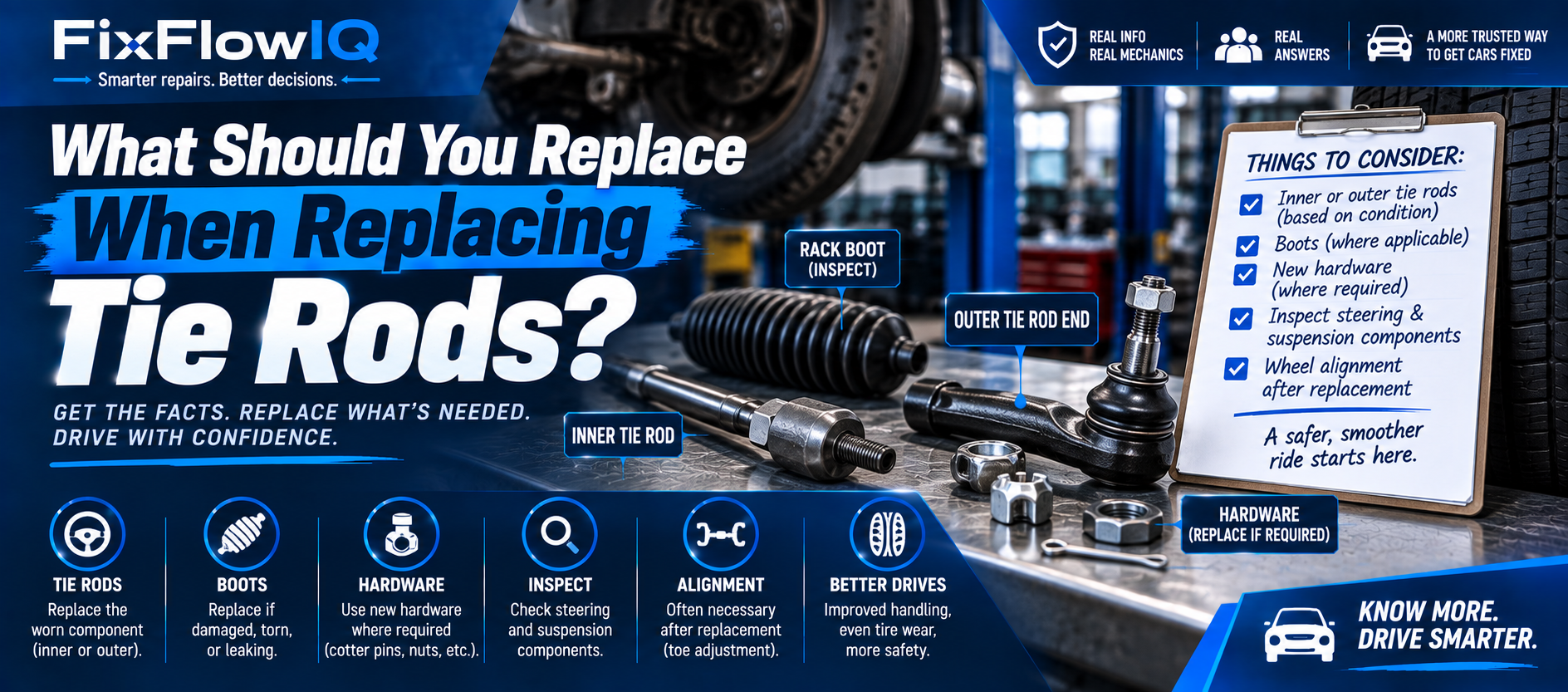
Replacing tie rods? Learn when inner or outer tie rods, boots, and hardware need attention, what else should be inspected, and why an alignment usually follows.
Read Article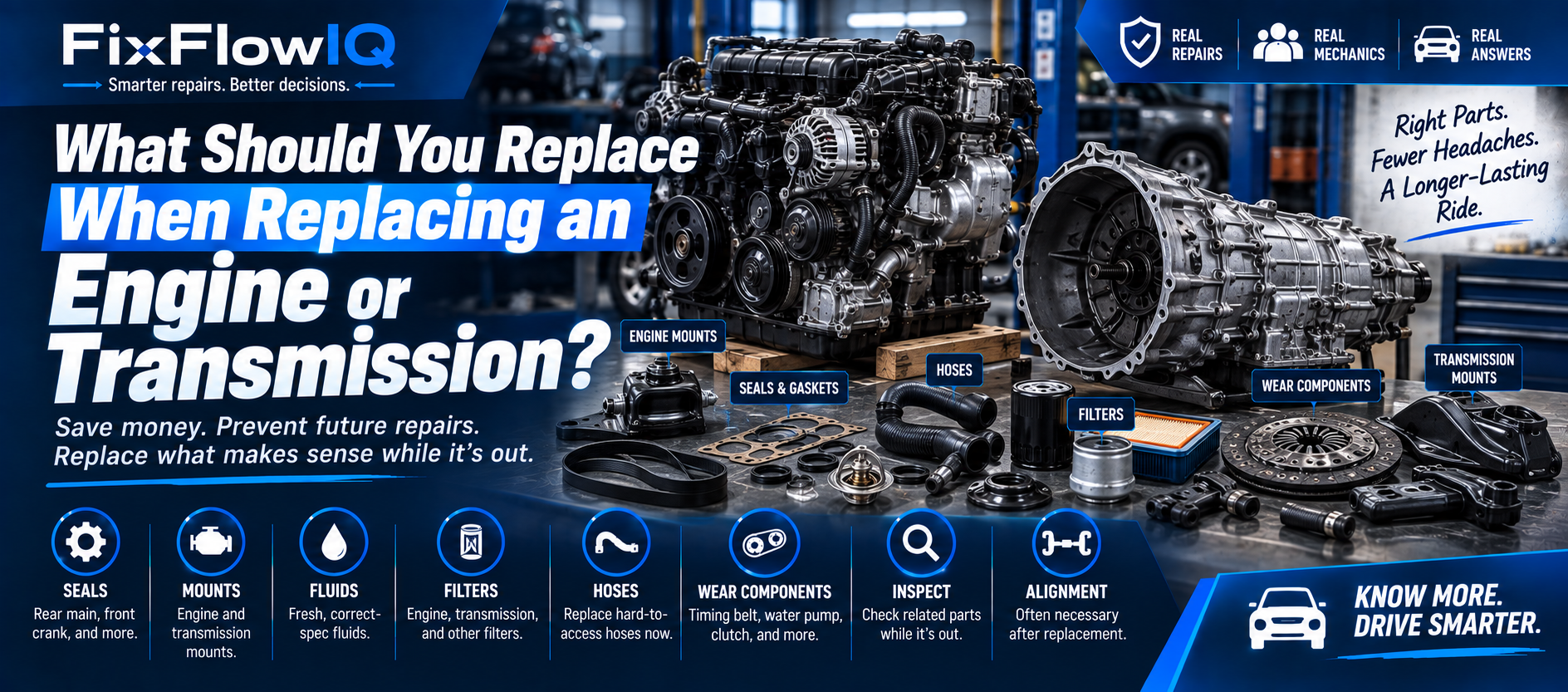 Smart Repair & Replacement Tips
Join hundreds of verified repair professionals already growing their businesses with FixFlowIQ. Receive qualified auto repair leads in Asheville, NC, and across North Carolina, manage bookings, and build your reputation—all from one dashboard.
Offer exclusive partner discounts to attract more customers and grow your business faster.
✓ Timing belt
✓ Timing-belt tensioner
✓ Timing idler pulley(s)
✓ Water pump
✓ Water-pump gasket/seal
✓ Required coolant
✓ Camshaft seal(s)
✓ Crankshaft seal
✓ Timing covers
✓ One-time-use hardware
✓ Serpentine/accessory belt
✓ Engine mount
✓ Oil leaks
✓ Coolant leaks
✓ Belt tracking
✓ Pulley condition
✓ Tensioner condition
✓ Timing covers
✓ Accessory belt
✓ Engine mounts
✓ Cooling-system condition
If you're comparing timing-belt quotes:
Ask every mechanic:
“Does this price include the water pump?”
Then ask:
“Is the water pump driven by the timing belt on my engine?”
If one quote is:
$800
and another is:
$1,050
but the second includes:
BELT + TENSIONER + IDLERS + WATER PUMP + COOLANT
while the first includes:
ONLY THE BELT
you aren't comparing:
THE SAME REPAIR.
Consider:
Timing belt only
versus:
Timing belt
Tensioner
Idler pulleys
Timing-driven water pump
Fresh coolant
At first:
Quote A appears to save:
$300.
But if the original water pump fails shortly afterward:
You may pay for:
MUCH OF THE SAME LABOR AGAIN.
Or worse:
If a pulley or tensioner fails:
It could potentially damage the new timing belt.
Suppose another estimate includes:
TIMING BELT
TENSIONER
IDLERS
WATER PUMP
ALL CAM SEALS
CRANK SEAL
SERPENTINE BELT
ENGINE MOUNTS
THERMOSTAT
and several unrelated components.
That doesn't automatically mean:
“MORE COMPLETE REPAIR.”
Ask:
WHY DOES EACH PART NEED REPLACEMENT?
Maybe there's a legitimate reason.
Maybe there isn't.
This entire Smart Repair & Replacement Tips series comes down to one principle:
DON'T REPLACE EVERYTHING NEARBY.
Instead:
when failure risk, service procedure, or labor overlap strongly justifies it.
when condition should determine the decision.
when there is no reasonable justification for replacement.
That's:
SMART REPAIR.
Ask your mechanic:
“What is the manufacturer's timing-belt replacement interval?”
“Does this quote include the tensioner?”
“Does it include all timing-belt idler pulleys?”
“Is my water pump driven by the timing belt?”
“Does the quote include the water pump?”
“How much additional labor is the water pump if we do it now?”
“Are any camshaft or crankshaft seals leaking?”
“Are you recommending those seals because they're leaking or simply because they're accessible?”
“Does the repair require fresh coolant?”
“What coolant specification will be used?”
“Are there any one-time-use bolts or hardware?”
“What brand or quality level is the timing-belt kit?”
“What warranty comes with the repair?”
These questions help you compare:
THE ACTUAL REPAIR
instead of:
JUST THE TOTAL PRICE.
If you're told:
“Your cam seals are leaking.”
ask to see:
THE LEAK.
If oil is visibly entering the timing area:
That can provide a clear reason for replacement.
Transparency turns:
“TRUST ME.”
into:
“HERE'S WHY.”
A timing-belt service is a major maintenance job.
Ask whether the parts are:
OEM
OEM-equivalent
Reputable aftermarket
Economy aftermarket
The cheapest kit may not provide:
THE BEST LONG-TERM VALUE.
Especially when replacing it again requires:
SIGNIFICANT LABOR.
Because timing-system failure can be serious:
Understand the warranty.
Ask:
How long?
How many miles?
Parts and labor?
What components are covered?
Does the water pump have separate coverage?
A strong warranty can add meaningful value to:
THE REPAIR QUOTE.
Some repairs should be:
FIX ONLY WHAT FAILED.
Timing-belt service is different.
Because you're often servicing a group of components that:
WORK TOGETHER
and:
SHARE EXPENSIVE ACCESS LABOR.
That's why the smartest repair may involve replacing components that:
HAVEN'T FAILED YET
when there is a strong technical and financial reason to do so.
This distinction is extremely important.
“We're already in there, so let's replace everything.”
“Your timing-driven water pump has the same mileage as the belt. It requires nearly the same labor to access later, so replacing it now can avoid paying that labor twice.”
Those are:
NOT THE SAME THING.
The difference is:
REASON + EVIDENCE + VALUE.
Before approving the repair:
Timing belt due?
Failed tensioner?
Bad pulley?
Leaking pump?
Follow:
VEHICLE-SPECIFIC SERVICE INFORMATION.
Tensioner?
Idler?
Timing-driven water pump?
Leaking seal?
Damaged mount?
Worn accessory belt?
This framework helps separate:
SMART PREVENTIVE WORK
from:
UNNECESSARY PARTS REPLACEMENT.
When replacing a timing belt:
Don't think only about:
THE BELT.
Think about:
THE TIMING SYSTEM.
Depending on your vehicle, a proper timing-belt service may include:
TIMING BELT.
TENSIONER.
IDLER PULLEYS.
TIMING-DRIVEN WATER PUMP.
WATER-PUMP SEAL.
and:
FRESH COOLANT.
Other components such as:
CAMSHAFT SEALS
CRANKSHAFT SEAL
ACCESSORY BELT
and:
ENGINE MOUNTS
should generally be evaluated based on:
CONDITION, ACCESS, MANUFACTURER PROCEDURE, AND ACTUAL NEED.
The goal isn't:
REPLACE THE MOST PARTS.
And it isn't:
BUY THE CHEAPEST TIMING-BELT JOB.
The goal is:
DO THE RIGHT WORK WHILE THE ENGINE IS ALREADY APART.
Because paying a little more for the correct related component today may save you from:
PAYING THE SAME LABOR TWICE TOMORROW.
And when timing-system failure can potentially damage an engine:
DOING THE REPAIR CORRECTLY MATTERS.
When you submit a timing-belt request through FixFlowIQ:
Don't just write:
“Need timing belt.”
Include:
Year • Make • Model • Engine • Mileage
Then ask providers to explain:
WHAT THEIR QUOTE INCLUDES.
Compare:
Timing Belt • Tensioner • Idlers • Water Pump • Coolant • Warranty • Parts Quality • Provider Discounts
One quote may look cheaper because it includes:
ONLY THE BELT.
Another may include:
THE COMPLETE TIMING-BELT SERVICE.
FixFlowIQ helps you see those differences before you choose.
Because the best automotive quote isn't automatically:
THE LOWEST NUMBER.
It's the quote that gives you:
THE RIGHT REPAIR.
THE RIGHT VALUE.
and:
THE CONFIDENCE TO UNDERSTAND WHAT YOU'RE PAYING FOR.
SYMPTOMS FIRST.
DIAGNOSIS SECOND.
REPAIR THIRD.
Oral Thompson
Writes about vehicle care and the FixFlowIQ platform.
Replacing an engine or transmission? Learn which seals, mounts, fluids, hoses, filters, and wear parts may save you serious labor costs while the powertrain is already removed.