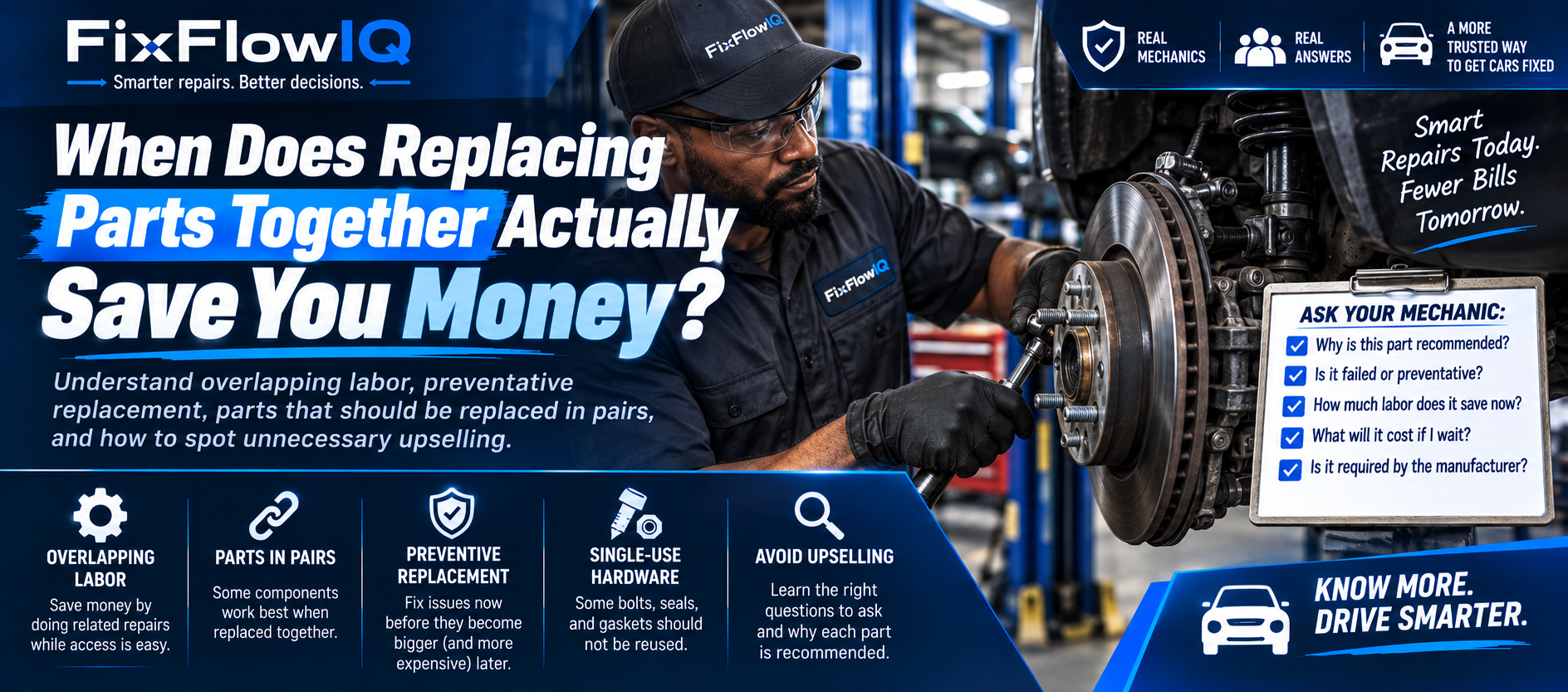
Replacing an A/C compressor may involve more than installing one new part. Learn when the drier, expansion device, seals, refrigerant, oil, and other components may need attention—and why contamination matters.

Your vehicle's A/C compressor fails.
You get an estimate.
And instead of seeing:
A/C COMPRESSOR
you see several additional items:
RECEIVER-DRIER.
ACCUMULATOR.
EXPANSION VALVE.
ORIFICE TUBE.
O-RINGS.
REFRIGERANT.
COMPRESSOR OIL.
Maybe even:
SYSTEM FLUSHING.
That can immediately raise a reasonable question:
“Why am I paying for all of this if only the compressor failed?”
Sometimes those additional parts and procedures are necessary.
Sometimes they're recommended because they protect the replacement compressor.
And sometimes a component only needs to be:
INSPECTED.
The important thing is understanding:
WHY.
Your vehicle's air-conditioning system is a:
CLOSED REFRIGERANT CIRCUIT.
The compressor doesn't operate independently.
Depending on the system design, refrigerant and oil circulate through components such as:
Compressor
Condenser
Receiver-drier or accumulator
Expansion valve or orifice tube
Evaporator
Refrigerant lines and hoses
If a compressor fails internally:
The problem may no longer be isolated to:
THE COMPRESSOR.
This should be one of the first questions asked.
A compressor can fail for different reasons.
Possible causes include:
Internal mechanical wear
Lubrication problem
Refrigerant loss
Contamination
Excessive system pressure
Electrical or control problem
Clutch or pulley problem on applicable systems
Another A/C system fault
The correct repair depends heavily on:
THE FAILURE MODE.
This distinction matters.
Suppose the compressor isn't operating because of:
An electrical problem.
That may be very different from a compressor that has:
SEIZED INTERNALLY AND SENT METAL DEBRIS THROUGH THE SYSTEM.
Both situations can result in:
NO COLD AIR.
But they may require:
VERY DIFFERENT REPAIRS.
That's why:
SYMPTOM FIRST. DIAGNOSIS SECOND. PARTS THIRD.
One of the biggest concerns after an internal compressor failure is:
CONTAMINATION.
A mechanically damaged compressor can potentially release:
Metal particles
Degraded lubricant
Debris
Other contamination
into the refrigerant circuit.
Once that material circulates:
Simply installing a new compressor may not solve the entire problem.
Imagine installing a brand-new compressor into a system that still contains:
DEBRIS FROM THE OLD COMPRESSOR.
When the system begins circulating again:
That contamination can potentially travel back toward:
THE NEW COMPRESSOR.
Now the replacement component may be exposed to the same contaminated system.
The result can be:
ANOTHER COMPRESSOR FAILURE.
That's why a professional A/C repair should consider:
THE CONDITION OF THE ENTIRE SYSTEM.
Depending on the A/C system design, your vehicle may use a:
RECEIVER-DRIER
or:
ACCUMULATOR.
These components perform important functions involving:
Refrigerant management
Moisture removal
System protection
They contain:
DESICCANT
designed to absorb moisture.
Moisture doesn't belong inside an automotive A/C refrigerant system.
It can contribute to:
Corrosion
Chemical contamination
Poor system performance
Damage to components
Once the refrigerant circuit has been opened for a major repair:
The condition of the drier or accumulator becomes important.
Often:
YES—depending on the system, repair procedure, failure type, manufacturer guidance, and warranty requirements.
Many compressor-replacement procedures call for replacing the moisture-control component.
But there is another complication:
On some vehicles, the receiver-drier may be:
INTEGRATED INTO THE CONDENSER.
That means servicing the drier may involve:
Replacing a desiccant element when serviceable
Replacing part of the condenser assembly
Replacing the entire condenser
depending on design.
This is why:
Vehicle-specific service information matters.
The A/C system uses a device to control refrigerant flow into the evaporator.
Depending on the design, this may be:
AN EXPANSION VALVE
or:
AN ORIFICE TUBE.
Should it automatically be replaced every time a compressor is replaced?
Not necessarily in every vehicle and every situation.
But it deserves attention.
If the compressor failed internally:
Debris may reach small passages in the system.
An orifice tube can sometimes provide visible evidence of contamination.
If it is:
CLOGGED
or:
COVERED IN METALLIC DEBRIS
that tells the technician something important about:
WHAT HAS BEEN CIRCULATING THROUGH THE SYSTEM.
This is where good repair judgment matters.
Depending on:
System design
Compressor failure mode
Contamination level
Manufacturer procedure
Component condition
Compressor warranty requirements
the expansion valve or orifice tube may need:
REPLACEMENT.
But FixFlowIQ's consumer-first rule applies:
DON'T REPLACE PARTS SIMPLY BECAUSE THEY'RE NEARBY.
There should be:
A REASON.
Whenever A/C connections are opened:
The sealing surfaces deserve attention.
Automotive A/C systems commonly use:
O-RINGS AND OTHER SEALS
at refrigerant connections.
Old seals can become:
Flattened
Hardened
Damaged
Contaminated
Disturbed during disassembly
Reusing a questionable seal can lead to:
A REFRIGERANT LEAK AFTER THE REPAIR.
When connections are opened during compressor replacement:
Appropriate O-rings or seals should generally be replaced as required by the repair procedure.
They must also be:
COMPATIBLE WITH THE REFRIGERANT AND LUBRICANT USED IN THAT SYSTEM.
A tiny seal can create:
A BIG CALLBACK
if it leaks.
If the A/C system is opened to replace the compressor:
The refrigerant must be properly:
RECOVERED
using appropriate equipment.
After repairs:
The system must be evacuated and recharged with the:
CORRECT TYPE AND AMOUNT OF REFRIGERANT.
Automotive A/C systems are designed for:
A SPECIFIC REFRIGERANT CHARGE.
Too little refrigerant can cause problems.
Too much refrigerant can also cause problems.
The correct approach is:
CHARGE THE SYSTEM TO THE MANUFACTURER'S SPECIFICATION.
Not:
“Add some until it gets cold.”
Different vehicles may use different refrigerants.
Common examples include:
R-134a
and:
R-1234yf.
Never assume the refrigerant type.
Use the:
VEHICLE-SPECIFIC SPECIFICATION.
The compressor depends on proper lubrication.
Automotive A/C systems use refrigerant-compatible oil.
The exact:
Oil type
Viscosity
Quantity
Distribution procedure
depends on the vehicle and compressor.
Insufficient lubrication can contribute to:
PREMATURE COMPRESSOR FAILURE.
But that doesn't mean:
MORE OIL IS BETTER.
An excessive amount of oil can reduce system performance and create other issues.
The technician needs to account for:
Oil removed with old components
Oil retained elsewhere in the system
Oil supplied in the replacement compressor
Manufacturer procedure
The goal is:
THE CORRECT TOTAL SYSTEM OIL CHARGE.
Replacement compressors vary.
A compressor may arrive:
Dry
With shipping oil
With a specified amount of lubricant
Pre-filled according to a particular application
The technician should verify:
WHAT IS ACTUALLY IN THE REPLACEMENT COMPRESSOR.
Guessing can be expensive.
Does the condenser always need replacement with an A/C compressor?
NO.
But after a severe internal compressor failure:
It may become one of the most important components to evaluate.
Many modern vehicles use:
PARALLEL-FLOW CONDENSERS.
These contain very small internal passages.
If metallic debris from a failed compressor enters those passages:
It may be difficult or impossible to reliably remove all contamination through flushing.
In certain contaminated systems:
CONDENSER REPLACEMENT MAY BE NECESSARY.
The decision should depend on:
Compressor failure type
Amount of contamination
Condenser design
Manufacturer procedure
Whether the condenser can be effectively flushed
Compressor manufacturer's warranty requirements
This is exactly the distinction FixFlowIQ wants consumers to understand:
REPLACE WHEN JUSTIFIED.
INSPECT WHEN APPROPRIATE.
DON'T GUESS.
After certain compressor failures:
Parts of the A/C system may need to be:
FLUSHED.
The goal is to remove:
Debris
Contaminated oil
Residue
Other unwanted material
before the new compressor is placed into service.
But:
Not every A/C component can or should be flushed.
Depending on system design and service procedure, components such as:
Compressor
Receiver-drier
Accumulator
Expansion device
are generally handled differently from flushable lines or components.
Some modern condensers may also be unsuitable for effective flushing after severe contamination.
Follow:
VEHICLE- AND COMPONENT-SPECIFIC SERVICE INFORMATION.
This is important.
If debris is trapped inside a component with tiny passages:
Running flushing solvent through it doesn't necessarily mean:
EVERYTHING CAME OUT.
The goal isn't to:
SAY THE SYSTEM WAS FLUSHED.
The goal is:
REMOVE THE CONTAMINATION THAT COULD DAMAGE THE NEW COMPRESSOR.
Lines and hoses do not automatically require replacement during compressor service.
But they should be evaluated for:
Damage
Leakage
Contamination
Deterioration
Restrictions
If a line can be properly cleaned and is otherwise serviceable:
Replacement may not be necessary.
Again:
INSPECTION IS NOT THE SAME AS AUTOMATIC REPLACEMENT.
If the compressor is driven by the engine's accessory belt:
The belt system should be inspected.
Look at:
Serpentine belt
Belt tensioner
Idler pulleys
Compressor pulley
Related accessory-drive components
Why?
Because a seized compressor or damaged pulley can potentially affect:
THE BELT SYSTEM.
Inspect it.
Replace it when:
Damaged
Contaminated
Cracked or deteriorated
Manufacturer procedure requires it
Failure damaged the belt
The principle remains:
EVIDENCE BEFORE PARTS.
This is where unnecessary compressor replacements can happen.
A compressor that isn't operating doesn't automatically mean:
THE COMPRESSOR ITSELF IS BAD.
Depending on the vehicle, compressor operation may involve:
Fuses
Relays
Pressure sensors
Temperature sensors
Wiring
Control modules
Clutch circuits
Variable-displacement control valves
Other electronic controls
The system should be:
DIAGNOSED BEFORE THE COMPRESSOR IS CONDEMNED.
If the real issue is:
WIRING
or:
A CONTROL CIRCUIT
installing a compressor may leave the customer with:
THE SAME PROBLEM AND A MUCH BIGGER BILL.
This is why diagnosis matters.
Some compressors use an electromagnetic clutch.
Depending on the compressor design and failure:
A problem may involve:
Clutch
Coil
Bearing
Pulley
Compressor internally
Whether those components can be serviced separately depends on:
THE VEHICLE AND COMPRESSOR DESIGN.
Don't assume:
“The clutch doesn't engage, therefore the whole compressor needs replacement.”
Replacement compressor manufacturers may specify procedures required for warranty coverage.
These may involve:
Replacing the drier/accumulator
Replacing or inspecting the expansion device
Flushing appropriate components
Replacing contaminated components
Using the correct oil
Verifying the refrigerant charge
Documenting the repair
Ignoring those requirements could potentially affect:
WARRANTY COVERAGE.
Ask the repair provider:
“What does the compressor manufacturer require?”
Automotive refrigerant should not simply be:
VENTED INTO THE AIR.
Proper A/C service requires appropriate:
RECOVERY, EVACUATION, LEAK TESTING, AND RECHARGING EQUIPMENT.
This is one reason compressor replacement is generally not:
A SIMPLE REMOVE-AND-REPLACE JOB.
After repairs:
A vacuum is normally applied to the refrigerant circuit as part of proper service.
This helps:
Remove air
Remove moisture
Verify system integrity as part of the service process
Then the system can be charged according to specification.
A system holding vacuum can be useful information.
But it doesn't necessarily guarantee:
THE SYSTEM WILL NEVER LEAK UNDER OPERATING PRESSURE.
Proper leak-testing procedures may also be appropriate.
If you're quoted an A/C compressor plus several related parts:
Don't immediately assume:
UPSELL.
But don't approve everything without understanding it either.
Ask:
“Why did the compressor fail?”
“Was there metal or contamination in the system?”
“Does the receiver-drier or accumulator need replacement?”
“Is the drier integrated into the condenser?”
“Does the expansion valve or orifice tube need replacement, or just inspection?”
“Can the condenser be flushed, or does its design require replacement if contaminated?”
“Which parts of the system will be flushed?”
“Are you replacing the disturbed O-rings and seals?”
“What refrigerant and oil specification does my vehicle require?”
“Does the compressor warranty require these additional parts or procedures?”
Those are:
SMART QUESTIONS.
If the compressor failed internally:
Ask whether the technician can show you:
Metal debris
Contaminated oil
Damaged compressor
Restricted orifice tube
Other evidence
A good explanation can turn:
“WHY ARE YOU SELLING ME ALL THESE PARTS?”
into:
“NOW I UNDERSTAND WHY THEY'RE NEEDED.”
That's what repair transparency should look like.
There is no universal parts list for every vehicle.
But a compressor repair may involve:
 Smart Repair & Replacement Tips
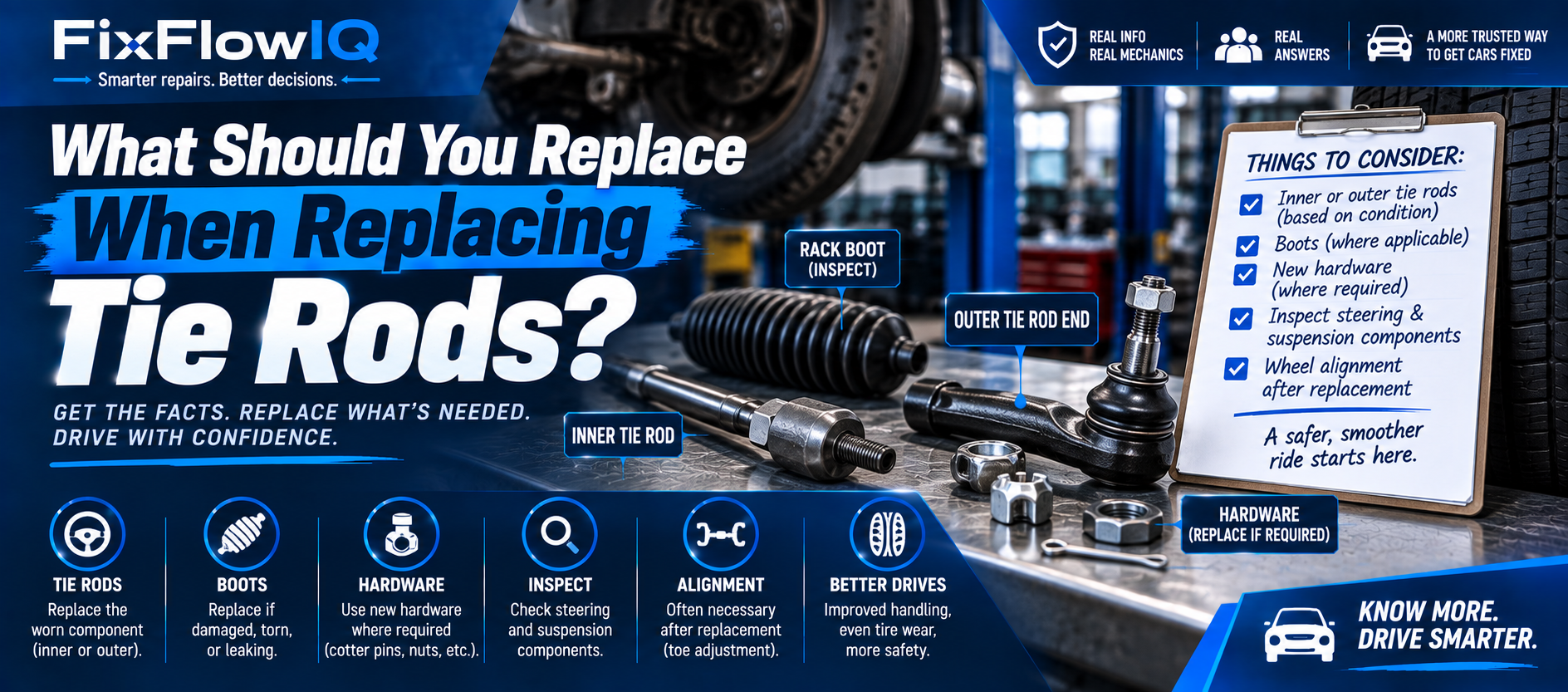
Replacing tie rods? Learn when inner or outer tie rods, boots, and hardware need attention, what else should be inspected, and why an alignment usually follows.
Read Article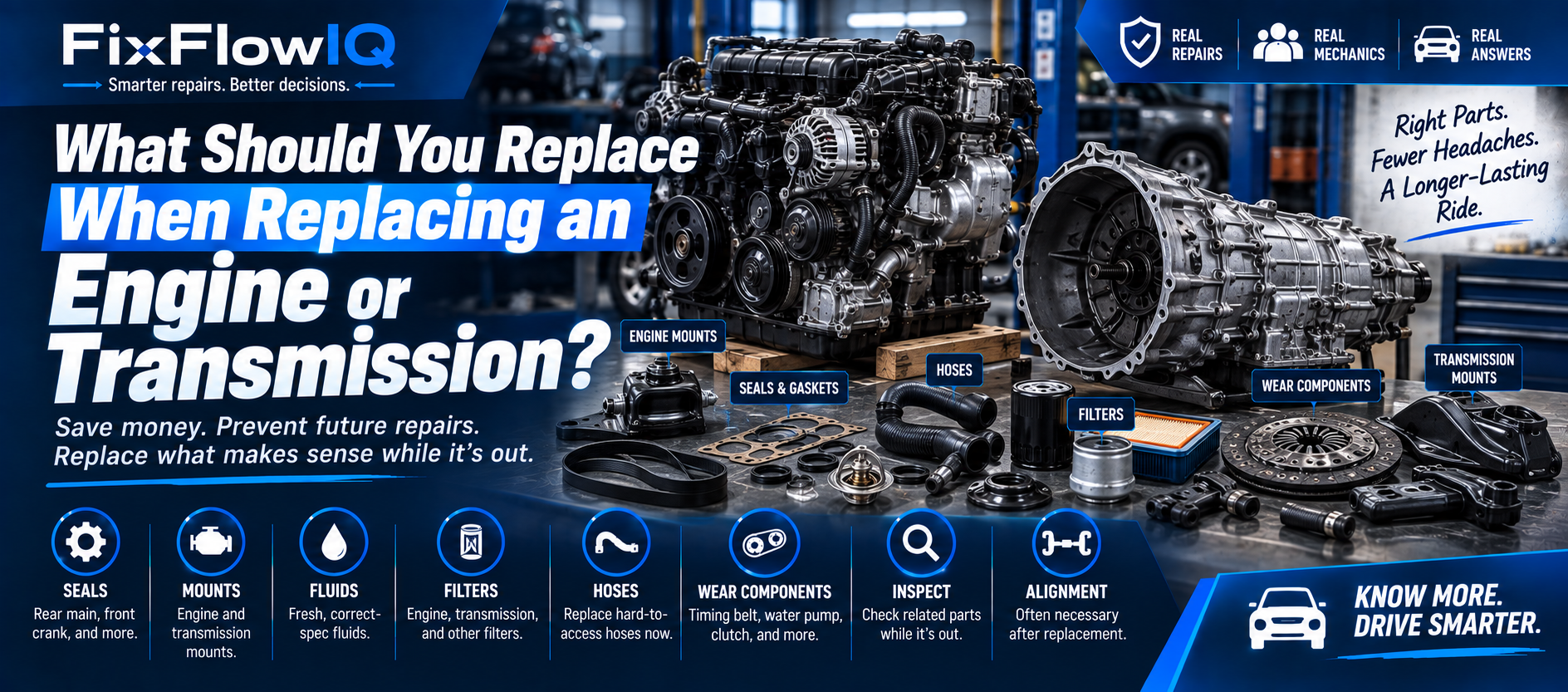 Smart Repair & Replacement Tips
Join hundreds of verified repair professionals already growing their businesses with FixFlowIQ. Receive qualified auto repair leads in Asheville, NC, and across North Carolina, manage bookings, and build your reputation—all from one dashboard.
Offer exclusive partner discounts to attract more customers and grow your business faster.
Depending on manufacturer procedure:
✓ Compressor
✓ Disturbed O-rings and seals
✓ Correct refrigerant charge
✓ Correct compressor/system oil as required
✓ Receiver-drier or accumulator when required
✓ Expansion valve
✓ Orifice tube
✓ Condenser
✓ Refrigerant lines
✓ Belt
✓ Tensioner or pulley components
✓ System contamination
✓ Electrical controls
✓ Refrigerant leaks
✓ Belt drive
✓ Condenser condition/design
✓ Expansion device condition
✓ Hoses and lines
✓ Reason the original compressor failed
This is the principle behind FixFlowIQ's Smart Repair & Replacement Tips:
RELATED DOES NOT AUTOMATICALLY MEAN REQUIRED.
A good repair should distinguish between:
MUST REPLACE.
SHOULD REPLACE BECAUSE OF THE FAILURE.
SHOULD INSPECT.
and:
DOESN'T NEED TO BE TOUCHED.
That's how consumers avoid both:
UNDER-REPAIRING
and:
UNNECESSARY UPSELLING.
Imagine two estimates.
Compressor only: $700
Compressor + required drier + seals + proper flushing + oil + refrigerant + contamination correction: $1,050
At first:
Estimate A looks cheaper.
But if the original compressor contaminated the system and the new compressor fails six months later:
The customer may pay:
TWICE.
The better comparison isn't:
“WHO HAS THE CHEAPEST COMPRESSOR?”
It's:
“WHO IS REPAIRING THE SYSTEM CORRECTLY?”
The opposite is also true.
A $1,500 estimate isn't automatically better because it contains:
MORE PARTS.
Every recommended component should have:
A REASON.
Ask:
Why does this part need replacement?
What evidence supports it?
Is this manufacturer-required?
Is this contamination-related?
Is this preventive because labor overlaps?
That's how you distinguish:
SMART REPAIR
from:
PARTS CANNON.
When an A/C compressor is replaced:
The compressor may not be:
THE ONLY THING THAT NEEDS ATTENTION.
Depending on the vehicle and failure:
The repair may also involve:
RECEIVER-DRIER OR ACCUMULATOR.
EXPANSION VALVE OR ORIFICE TUBE.
O-RINGS AND SEALS.
REFRIGERANT.
COMPRESSOR OIL.
SYSTEM FLUSHING.
and sometimes:
THE CONDENSER OR OTHER CONTAMINATED COMPONENTS.
But the correct parts list depends on:
WHY THE COMPRESSOR FAILED.
A clean electrical failure isn't the same as:
A COMPRESSOR THAT FILLED THE SYSTEM WITH METAL.
So don't ask only:
“What parts are you replacing?”
Ask:
“Why are you replacing them?”
A quality repair provider should be able to explain:
WHAT FAILED.
WHAT WAS CONTAMINATED.
WHAT MUST BE REPLACED.
WHAT ONLY NEEDS INSPECTION.
and:
HOW THE REPAIR PROTECTS THE NEW COMPRESSOR.
That's how you save money in the long run:
Not by automatically choosing:
THE FEWEST PARTS.
And not by automatically approving:
THE MOST PARTS.
But by choosing:
THE RIGHT PARTS FOR THE ACTUAL FAILURE.
When you submit an A/C repair request through FixFlowIQ:
Describe the symptoms first.
For example:
“The A/C stopped cooling and the compressor is making a grinding noise.”
“The compressor won't engage.”
“The A/C gradually became warmer over several weeks.”
“A shop says the compressor failed internally and found metal contamination.”
Then compare provider quotes based on more than:
THE NUMBER AT THE BOTTOM.
Look at:
Pricing • Repair Scope • Warranty • Reviews • Provider Discounts
One mechanic may quote:
JUST THE COMPRESSOR.
Another may explain:
WHY THE DRIER, SEALS, AND CONTAMINATION PROCEDURE ARE NECESSARY.
That difference matters.
Because FixFlowIQ isn't about finding:
THE CHEAPEST REPAIR.
It's about helping customers make:
A BETTER-INFORMED REPAIR DECISION.
SYMPTOMS FIRST.
DIAGNOSIS SECOND.
REPAIR THIRD.
Oral Thompson
Writes about vehicle care and the FixFlowIQ platform.
Replacing an engine or transmission? Learn which seals, mounts, fluids, hoses, filters, and wear parts may save you serious labor costs while the powertrain is already removed.