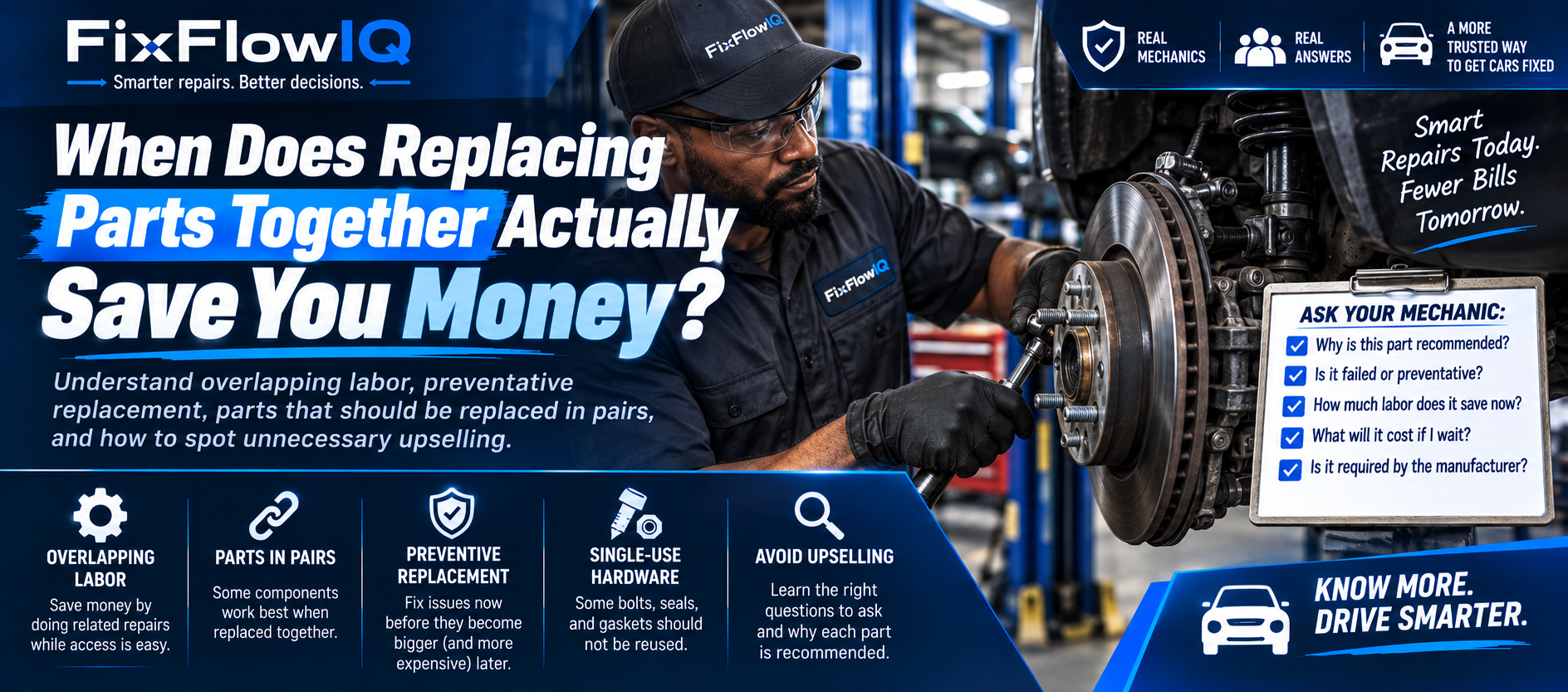
A brake job can involve more than brake pads. Learn when pads, rotors, hardware, wear sensors, and fluid need service—and which brake parts should only be replaced when inspection shows a problem.

Your vehicle needs:
BRAKES.
You receive an estimate.
And instead of seeing only:
BRAKE PADS
you may see:
BRAKE PADS.
ROTORS.
HARDWARE.
WEAR SENSOR.
Maybe:
BRAKE FLUID.
Or even:
CALIPERS.
Now you're wondering:
“What actually needs to be replaced together?”
That's exactly the right question.
Because a proper brake job isn't about:
REPLACING EVERY COMPONENT NEAR THE WHEEL.
But it's also usually not about:
REPLACING ONE WORN PAD ON ONE SIDE OF THE VEHICLE.
Brake components have different rules.
Some should generally be serviced:
TOGETHER BY AXLE.
Some should be:
REPLACED BASED ON CONDITION.
And others should simply be:
INSPECTED.
Understanding the difference can help you avoid both:
UNDER-REPAIRING YOUR BRAKES
and:
PAYING FOR PARTS YOU DON'T NEED.
Most passenger vehicles have:
TWO FRONT BRAKES
and:
TWO REAR BRAKES.
When discussing brake service, mechanics commonly refer to:
FRONT AXLE
and:
REAR AXLE.
That doesn't necessarily mean the physical axle itself.
It means:
THE LEFT AND RIGHT BRAKES AT THE SAME END OF THE VEHICLE.
This distinction matters because many brake friction components are generally serviced:
IN MATCHED AXLE SETS.
When you press the brake pedal:
The left and right brakes on an axle are expected to work:
TOGETHER.
You generally want:
SIMILAR FRICTION CHARACTERISTICS.
SIMILAR PAD THICKNESS.
SIMILAR ROTOR CONDITION.
and:
BALANCED BRAKING PERFORMANCE.
That's why replacing friction components on only one side is generally:
NOT STANDARD BRAKE SERVICE.
Brake pads are one of the most common wear components on a vehicle.
When you apply the brakes:
The pads clamp against the rotor.
That friction converts the vehicle's motion into:
HEAT.
Over time:
The friction material wears away.
Generally:
YES—ON THE SAME AXLE.
If the front-left brake pads are worn out:
You normally replace:
THE FRONT-LEFT AND FRONT-RIGHT PAD SET TOGETHER.
Likewise:
If the rear pads require replacement:
You generally service:
BOTH REAR SIDES.
Suppose you install brand-new pads on:
THE LEFT FRONT
while leaving substantially worn pads on:
THE RIGHT FRONT.
Now you may have differences in:
Friction material
Pad thickness
Heat behavior
Bedding condition
Overall brake response
That's not how a normal brake job should be approached.
For friction components:
MATCH THE AXLE.
Here's where things become important.
If the left-front pads are completely worn out but the right-front pads still have substantial material remaining:
Don't just say:
“The left side wore faster.”
Ask:
WHY?
Significant uneven wear can indicate problems involving:
Caliper slide pins
Caliper piston
Brake hose
Pad movement in bracket
Corrosion
Hardware
Installation
Other mechanical issues
Uneven wear is:
A CLUE.
If a sticking caliper caused one set of pads to wear rapidly:
Installing new pads without correcting the caliper problem can result in:
THE SAME THING HAPPENING AGAIN.
That's why:
WEAR PATTERN MATTERS.
Brake rotors provide the friction surface that the pads clamp against.
Over time, rotors can develop:
Wear
Grooves
Rust
Heat damage
Thickness variation
Surface irregularities
Other damage
But:
DO ROTORS ALWAYS HAVE TO BE REPLACED WITH BRAKE PADS?
Not necessarily.
A rotor may potentially remain serviceable if it:
Meets minimum thickness specifications
Has an acceptable surface
Has no disqualifying damage
Meets manufacturer service requirements
Depending on the vehicle and repair strategy:
A rotor may be:
REUSED
or, where appropriate:
RESURFACED.
But many modern brake jobs involve replacing rotors because of:
Limited machining allowance
Rotor condition
Labor economics
Corrosion
Wear
Manufacturer procedure
Customer expectations for long-term performance
Every rotor has specifications.
A rotor should not simply be judged by:
LOOKING AT IT.
Measurements may include:
ROTOR THICKNESS
and, when diagnosing certain complaints:
RUNOUT OR THICKNESS VARIATION.
If the rotor is below its allowable specification:
It should not remain in service.
When rotor replacement is necessary:
It is generally good practice to replace:
BOTH ROTORS ON THE SAME AXLE.
For example:
BOTH FRONT ROTORS
or:
BOTH REAR ROTORS.
Why?
Because you want similar:
FRICTION SURFACES.
THERMAL CHARACTERISTICS.
WEAR CONDITION.
and:
BRAKING RESPONSE
across the axle.
Suppose only one rotor is severely overheated.
Before simply replacing the pair:
Ask:
WHY DID THAT ONE ROTOR OVERHEAT?
Possible causes include:
Sticking caliper
Seized slide pin
Restricted hose
Parking-brake problem
Pad binding in bracket
Other brake-system faults
Again:
SYMPTOM FIRST.
DIAGNOSIS SECOND.
REPAIR THIRD.
Brake-pad hardware can include components such as:
Abutment clips
Anti-rattle clips
Springs
Shims
Retainers
depending on the brake design.
These components help the pads:
FIT, MOVE, AND OPERATE CORRECTLY.
Rusty, bent, damaged, or contaminated hardware can interfere with:
PAD MOVEMENT.
If the pad can't move correctly in the bracket:
It may:
Drag
Wear unevenly
Make noise
Overheat
Fail to release properly
That's why brake hardware should not be treated as:
DECORATION.
Often:
YES WHEN NEW HARDWARE IS SPECIFIED, SUPPLIED, CORRODED, DAMAGED, OR NO LONGER SERVICEABLE.
Many quality brake-pad sets include:
NEW HARDWARE.
If the repair procedure calls for new clips or hardware:
Use them.
This can create a situation where:
THE NEW PART ISN'T THE PROBLEM.
The pad simply can't move correctly because:
THE BRACKET OR HARDWARE WASN'T PROPERLY SERVICED.
Proper brake service includes:
CLEANING AND INSPECTING THE CONTACT AREAS.
Some vehicles use:
ELECTRONIC BRAKE-PAD WEAR SENSORS.
Others use:
MECHANICAL WEAR INDICATORS.
Electronic sensors may contact the rotor when the pad reaches a certain wear level.
Once activated or damaged:
The sensor may require:
REPLACEMENT.
It depends on:
THE VEHICLE AND SENSOR DESIGN.
Some sensors are effectively:
ONE-TIME USE.
Others may be reusable if they haven't contacted the rotor and remain undamaged.
Follow:
VEHICLE-SPECIFIC SERVICE INFORMATION.
If your vehicle reports:
BRAKE PAD WEAR
the technician should determine:
WHICH AXLE TRIGGERED THE WARNING
and inspect:
ALL FOUR BRAKES.
A warning is:
A REASON TO INSPECT.
Not necessarily a reason to replace:
EVERY BRAKE COMPONENT ON THE VEHICLE.
This is where customers can easily spend unnecessary money.
A brake job does:
NOT AUTOMATICALLY REQUIRE NEW CALIPERS.
Calipers are not routine friction material like:
BRAKE PADS.
They should generally be replaced or repaired when:
CONDITION JUSTIFIES IT.
A proper brake inspection may evaluate:
Piston operation
Fluid leakage
Dust boot condition
Slide-pin movement
Corrosion
Mounting condition
Uneven pad wear
Evidence of dragging or overheating
If the caliper is functioning properly:
There may be no reason to replace it.
Examples include:
Seized piston
Significant fluid leak
Damaged bore or piston
Severe corrosion
Mechanical damage
Integrated parking-brake mechanism failure
Other non-serviceable failure
But:
“We're doing pads and rotors”
is not by itself a reason to install:
FOUR NEW CALIPERS.
This is different from pads and rotors.
Calipers do not universally have to be replaced in axle pairs simply because:
ONE FAILED.
If one caliper has a confirmed failure and the opposite caliper is operating correctly:
Vehicle-specific condition and repair practices should determine whether one or both are replaced.
Ask:
“Why does the opposite caliper need replacement?”
There should be:
A REASON.
On floating-caliper systems:
The caliper uses:
SLIDE PINS
to move correctly.
These should be inspected for:
Binding
Corrosion
Damage
Torn boots
Lack of proper lubrication
A seized slide pin can cause:
UNEVEN PAD WEAR.
If they are:
CLEAN, UNDAMAGED, AND SERVICEABLE
they may simply require proper cleaning and lubrication using:
THE CORRECT BRAKE-COMPATIBLE LUBRICANT.
If they're:
PITTED, SEIZED, OR DAMAGED
replacement may be appropriate.
Caliper brackets normally do not need replacement during every brake job.
But:
The pad contact surfaces should be inspected.
Severe corrosion can prevent the pads from:
MOVING FREELY.
Depending on condition:
The bracket may require:
CLEANING
or:
REPLACEMENT.
Again:
CONDITION DECIDES.
Flexible brake hoses carry hydraulic pressure to the calipers or wheel cylinders.
They should be inspected for:
Cracking
Bulging
Leakage
Chafing
Damage
Twisting
Deterioration
But:
BRAKE HOSES ARE NOT AUTOMATIC BRAKE-JOB REPLACEMENT PARTS.
This is worth knowing.
A hose may appear acceptable externally but develop an internal restriction.
That can sometimes contribute to:
A BRAKE THAT DOESN'T RELEASE CORRECTLY.
If one wheel remains applied after pedal release:
The technician may need to distinguish between:
CALIPER PROBLEM
and:
HYDRAULIC HOSE PROBLEM.
Don't replace parts by guessing.
Brake fluid transfers hydraulic force from the brake pedal through the braking system.
Unlike brake pads:
It isn't replaced simply because:
THE WHEELS ARE ALREADY OFF.
Its service depends on:
Manufacturer maintenance schedule
Fluid condition
Contamination
Moisture content where applicable
Repairs that opened the hydraulic system
Many common automotive brake fluids absorb moisture over time.
That can reduce:
BOILING-POINT PERFORMANCE
and contribute to:
INTERNAL CORROSION.
That's why some manufacturers specify periodic:
BRAKE-FLUID REPLACEMENT.
NO.
Pads and rotors being worn does not automatically mean:
THE BRAKE FLUID IS BAD.
Ask:
“Why are you recommending brake-fluid service?”
Good answers may include:
“It's due according to the maintenance schedule.”
or:
“Testing shows the fluid condition is outside our service criteria.”
That's different from:
“We always sell a flush with brakes.”
Different vehicles require specific brake-fluid standards.
Examples may include:
DOT 3
DOT 4
or other specified fluids.
Always use:
THE VEHICLE'S REQUIRED SPECIFICATION.
Don't choose brake fluid based only on:
COLOR OR PRICE.
Not every vehicle has disc brakes at all four wheels.
Some use:
REAR DRUM BRAKES.
These may contain:
Brake shoes
Drums
Wheel cylinders
Springs
Adjusters
Hardware
The same principle applies:
FRICTION COMPONENTS ARE GENERALLY SERVICED BY AXLE.
If rear shoes require replacement:
Both rear sides are normally serviced together.
Drum-brake springs and hardware experience:
HEAT AND MECHANICAL CYCLING.
Depending on:
Age
Condition
Manufacturer procedure
Hardware kit availability
replacement may be recommended during shoe service.
But:
WHEEL CYLINDERS SHOULD NOT AUTOMATICALLY BE REPLACED JUST BECAUSE THE SHOES ARE NEW.
Inspect them for:
LEAKAGE AND OPERATION.
Depending on the vehicle:
The parking brake may use:
Rear caliper mechanism
Electronic parking-brake motor
Separate drum-style shoes inside the rear rotor
Cable system
These components should be:
INSPECTED WHEN RELEVANT.
But again:
Don't automatically replace the parking-brake system because:
THE REAR PADS ARE WORN.
Many modern vehicles use:
ELECTRONIC PARKING BRAKES.
Rear brake service may require:
SERVICE MODE
or a manufacturer-specific procedure before retracting the caliper piston.
Improperly forcing components can potentially:
DAMAGE THE SYSTEM.
This is another reason modern brake service may involve more than:
PUSH THE PISTON BACK AND INSTALL PADS.
This deserves its own section because it's one of the most important lessons in the article.
Imagine:
LEFT FRONT: NEW PADS + NEW ROTOR
RIGHT FRONT: OLD PADS + OLD ROTOR
Technically:
The vehicle may still stop.
But that's not a balanced approach to:
BRAKE SERVICE.
You want the friction components across an axle to have:
COMPARABLE CONDITION AND PERFORMANCE.
That's why pads—and when replacement is required, rotors—are generally serviced:
LEFT + RIGHT TOGETHER.
This is another important distinction.
If your:
FRONT BRAKES ARE WORN OUT
but your:
REAR BRAKES HAVE PLENTY OF SERVICE LIFE REMAINING
you generally do not need to replace the rear brakes simply because:
THE FRONTS ARE BEING DONE.
Brake service is typically considered:
BY AXLE.
So:
FRONT LEFT + FRONT RIGHT
or:
REAR LEFT + REAR RIGHT.
Not automatically:
ALL FOUR CORNERS.
A customer may be told:
“You need brakes.”
That statement isn't specific enough.
Ask:
FRONT OR REAR?
PADS OR SHOES?
ROTORS OR DRUMS?
HOW MUCH MATERIAL IS LEFT?
WHAT ARE THE MEASUREMENTS?
Those details matter.
Instead of:
“Your pads are low.”
ask:
“What thickness are they?”
Brake-pad thickness can often be measured in:
MILLIMETERS.
Knowing the actual measurement helps you understand:
HOW WORN THEY ARE.
If a shop recommends rotors because they're too thin:
Ask:
“What is the measured thickness?”
and:
“What is the minimum specification?”
Now you can compare:
MEASUREMENT VS. SPECIFICATION.
That's much more useful than:
“The rotors look bad.”
If one pad is significantly thinner than another:
Ask the technician to show you.
For example:
INNER PAD: NEARLY GONE
OUTER PAD: SUBSTANTIAL MATERIAL REMAINING
That wear pattern may indicate:
A MECHANICAL PROBLEM THAT NEEDS ATTENTION.
Evidence makes repair recommendations easier to understand.
Brake noise can come from many sources.
Possible causes include:
Worn pads
Rust
Debris
Hardware
Rotor condition
Wear indicator
Loose or damaged components
Other causes
A squeak does not automatically mean:
PADS + ROTORS + CALIPERS + FLUSH.
Diagnosis still matters.
If the brakes produce:
GRINDING
especially during braking:
Friction material may be severely worn or another mechanical problem may exist.
Continuing to drive can potentially damage:
THE ROTOR
and reduce braking performance.
Have it inspected:
PROMPTLY.
Drivers often hear:
“Your rotors are warped.”
Brake pulsation can involve:
Rotor thickness variation
Runout
Hub condition
Installation issues
Rust or debris between mounting surfaces
Other causes
Proper diagnosis should determine:
WHY THE PULSATION EXISTS.
When installing a rotor:
The mating surface between the:
HUB
and:
ROTOR
should be properly inspected and prepared.
Rust or debris can affect how the rotor sits.
A high-quality brake job isn't just:
NEW PARTS.
It's also:
PROPER INSTALLATION.
Improper wheel installation can create problems.
Wheel fasteners should be tightened according to:
THE MANUFACTURER'S SPECIFICATION AND PROPER PROCEDURE.
Brake work ends only after:
THE WHEEL IS INSTALLED CORRECTLY.
New friction components may require:
BEDDING / BREAK-IN
according to the brake-component manufacturer's instructions.
This helps establish the appropriate friction interface between:
PAD AND ROTOR.
Ask the mechanic whether:
ANY BREAK-IN PROCEDURE IS RECOMMENDED.
There is no universal parts list for every brake job.
But generally:
 Smart Repair & Replacement Tips
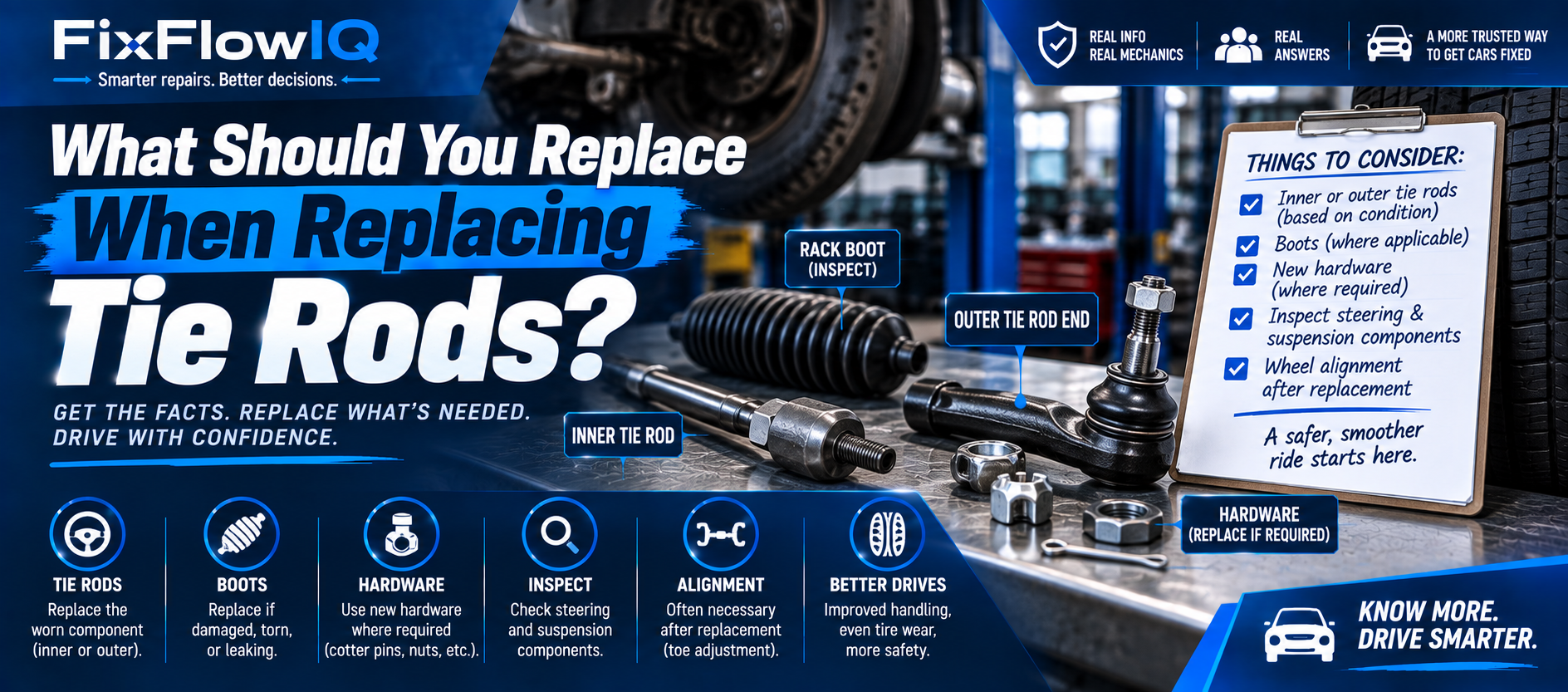
Replacing tie rods? Learn when inner or outer tie rods, boots, and hardware need attention, what else should be inspected, and why an alignment usually follows.
Read Article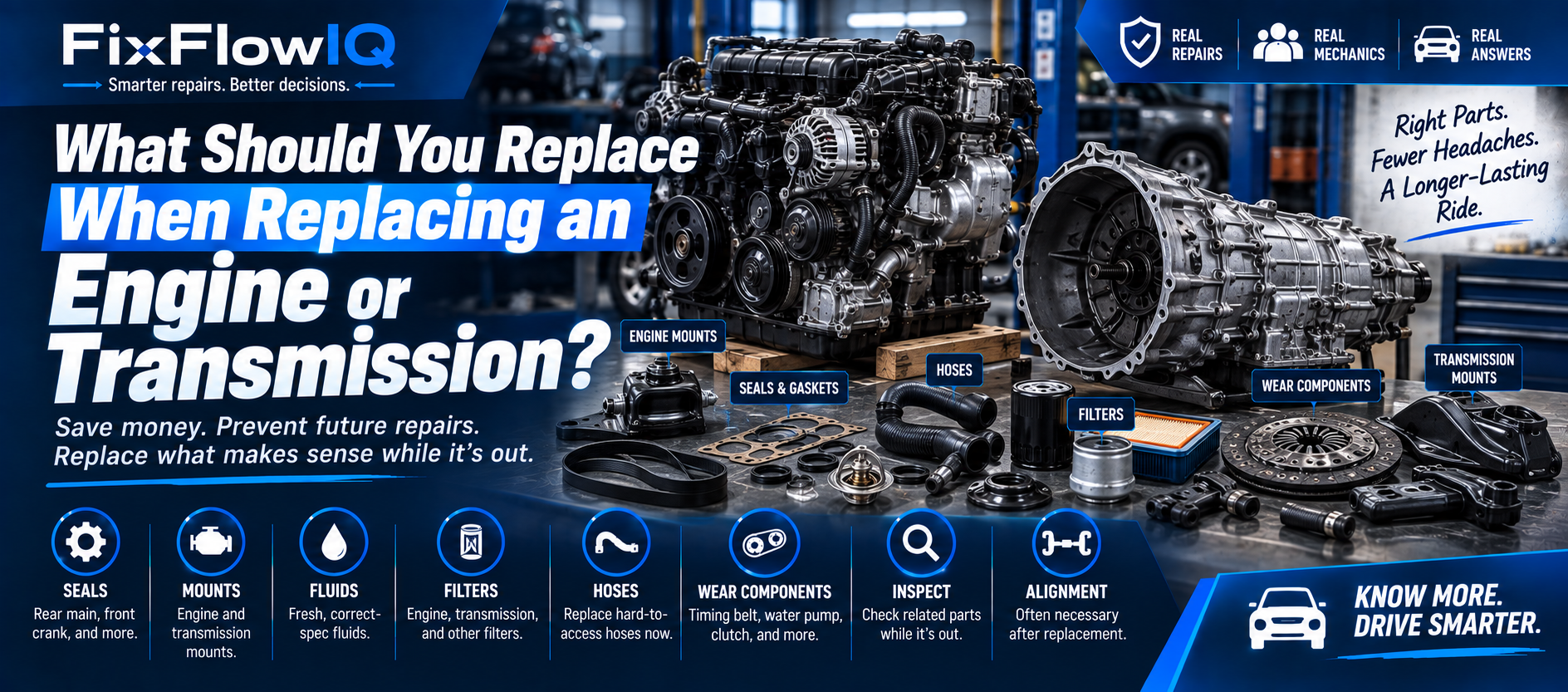 Smart Repair & Replacement Tips
Join hundreds of verified repair professionals already growing their businesses with FixFlowIQ. Receive qualified auto repair leads in Asheville, NC, and across North Carolina, manage bookings, and build your reputation—all from one dashboard.
Offer exclusive partner discounts to attract more customers and grow your business faster.
✓ Brake pads — left and right on the same axle
✓ Brake shoes — left and right on the same axle
✓ Rotors — generally as an axle pair when replacement is necessary
✓ Drums — generally as an axle pair when replacement is necessary
✓ Brake hardware
✓ One-time-use wear sensors
✓ Required clips, shims, or retainers
✓ Calipers
✓ Caliper brackets
✓ Slide pins
✓ Brake hoses
✓ Parking-brake components
✓ Wheel cylinders
✓ Electronic parking-brake components
✓ Brake fluid
This is the FixFlowIQ Smart Repair principle again:
ACCESS DOES NOT AUTOMATICALLY MEAN REPLACEMENT.
Just because the mechanic can see:
CALIPER • HOSE • HUB • SENSOR • PARKING BRAKE
doesn't mean all of them need:
NEW PARTS.
Inspect them.
Measure them.
Test them.
Then:
REPLACE WHAT'S JUSTIFIED.
The opposite matters too.
Suppose:
One caliper slide is seized.
The pads are worn unevenly.
The rotor has overheated.
A quote for:
“JUST PADS”
may look inexpensive.
But if the underlying problem isn't corrected:
The new pads may:
WEAR OUT AGAIN.
A cheap incomplete brake job can become:
AN EXPENSIVE BRAKE JOB TWICE.
Imagine three quotes.
Front pads only
Front pads + rotors + hardware
Front pads + rotors + hardware + caliper
Which is best?
You can't know from:
PRICE ALONE.
You need to know:
WHY THE ROTORS ARE BEING REPLACED.
WHY THE CALIPER IS BEING REPLACED.
WHAT THE PAD MEASUREMENTS ARE.
WHAT CAUSED THE WEAR.
Then you can compare:
THE ACTUAL REPAIR.
Ask:
“Are these front brakes or rear brakes?”
“What is the remaining pad thickness?”
“Are both sides wearing evenly?”
“Do the rotors need replacement?”
“What is the rotor thickness compared with specification?”
“Are the rotors damaged, corroded, or showing excessive variation?”
“Does this quote include new brake hardware?”
“Does my vehicle use a replaceable brake-wear sensor?”
“Are the caliper pistons operating correctly?”
“Are the slide pins moving freely?”
“Why are you recommending a caliper?”
“Have the brake hoses been inspected?”
“Why are you recommending brake-fluid service?”
“Is the brake fluid due according to the manufacturer's maintenance schedule?”
“What warranty comes with the brake repair?”
These questions help separate:
NECESSARY REPAIR
from:
UNEXPLAINED PARTS REPLACEMENT.
“Both front pads are worn to 2 mm. The rotors measure below specification, and we're replacing the pad hardware with the new pad set.”
Clear.
Measurable.
Justified.
“You need pads, rotors, calipers, hoses, and a fluid flush because that's what we always do.”
Ask:
WHY?
Every component should have:
A REASON.
When reviewing a brake estimate:
Front?
Rear?
Both?
Pad thickness?
Rotor thickness?
Fluid condition?
If not:
WHY NOT?
Pads and rotors should generally be approached:
BY AXLE.
Caliper?
Hose?
Sensor?
Hardware?
Brake fluid?
Manufacturer schedule?
Now you're comparing:
EVIDENCE + REPAIR SCOPE
instead of:
JUST PRICE.
During a brake job:
Some parts make sense to replace:
TOGETHER.
Others don't.
Brake pads are generally replaced:
LEFT + RIGHT ON THE SAME AXLE.
When rotors require replacement:
They're generally replaced:
AS AN AXLE PAIR.
Brake hardware and wear sensors may also need replacement depending on:
CONDITION AND DESIGN.
But components such as:
CALIPERS.
BRAKE HOSES.
CALIPER BRACKETS.
PARKING-BRAKE COMPONENTS.
and:
WHEEL CYLINDERS
should generally be replaced because:
INSPECTION SHOWS THEY NEED IT.
Not simply because:
“WE'RE ALREADY DOING BRAKES.”
Brake fluid should be serviced according to:
VEHICLE REQUIREMENTS, CONDITION, AND MAINTENANCE SCHEDULE
—not automatically because new pads are being installed.
The goal isn't:
REPLACE THE MOST PARTS.
And it isn't:
DO THE CHEAPEST POSSIBLE BRAKE JOB.
The goal is:
BALANCED BRAKING.
CORRECT REPAIR.
SAFE OPERATION.
and:
NO UNNECESSARY PARTS.
When you submit a brake-repair request through FixFlowIQ:
Don't just write:
“I NEED BRAKES.”
Describe what you're experiencing.
For example:
“The front brakes are grinding.”
“The steering wheel shakes when braking.”
“The brake-wear warning came on.”
“A shop measured my front pads at 2 mm.”
“The left-front brake is wearing much faster than the right.”
Then compare provider quotes based on:
Pads • Rotors • Hardware • Sensors • Caliper Condition • Brake Fluid • Warranty • Reviews • Provider Discounts
One quote may include:
PADS ONLY.
Another may include:
PADS + ROTORS + HARDWARE.
And another may include:
ADDITIONAL PARTS BECAUSE A RELATED FAILURE WAS FOUND.
Understanding those differences helps you determine:
WHY ONE QUOTE COSTS MORE THAN ANOTHER.
Because the best brake repair isn't automatically:
THE CHEAPEST.
And it isn't automatically:
THE ONE WITH THE MOST PARTS.
It's the one that addresses:
WHAT'S ACTUALLY WRONG.
SYMPTOMS FIRST.
DIAGNOSIS SECOND.
REPAIR THIRD.
Oral Thompson
Writes about vehicle care and the FixFlowIQ platform.
Replacing an engine or transmission? Learn which seals, mounts, fluids, hoses, filters, and wear parts may save you serious labor costs while the powertrain is already removed.