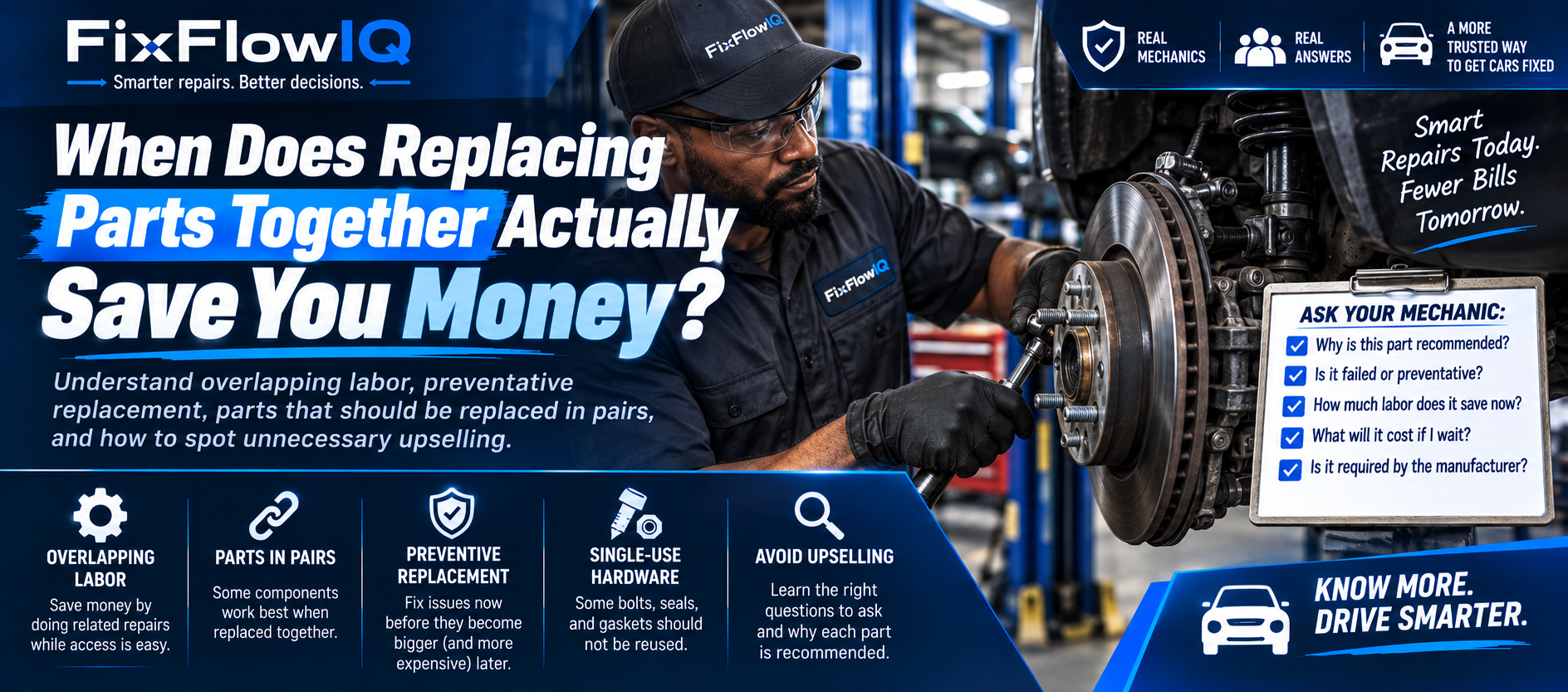
Replacing a water pump may involve coolant, seals, belts, or timing components. Learn what should be replaced, what should be inspected, and when doing related work together can save money.

Your vehicle needs a:
WATER PUMP.
You receive an estimate.
But instead of seeing only:
WATER PUMP
you may also see:
COOLANT.
GASKET OR SEAL.
SERPENTINE BELT.
THERMOSTAT.
HOSES.
Or, on some vehicles:
TIMING BELT.
TENSIONER.
IDLER PULLEYS.
Suddenly a water-pump replacement looks like:
A MUCH BIGGER REPAIR.
So the obvious question is:
“What actually needs to be replaced with the water pump?”
The answer depends heavily on:
WHY THE PUMP FAILED.
HOW THE PUMP IS DRIVEN.
WHERE IT IS LOCATED.
and:
WHAT MUST BE REMOVED TO REACH IT.
Some related parts make sense to replace.
Others should only be:
INSPECTED.
And some should be left alone unless there is:
AN ACTUAL REASON TO REPLACE THEM.
The water pump circulates coolant through the engine's cooling system.
That coolant moves through areas such as:
ENGINE.
CYLINDER HEAD.
RADIATOR.
HEATER CORE.
and other cooling-system passages depending on the vehicle.
Its purpose is to help move heat:
AWAY FROM THE ENGINE.
Without proper coolant circulation:
The engine can:
OVERHEAT.
Modern cooling systems are designed to operate with:
THE CORRECT ENGINE COOLANT.
That coolant typically provides:
Freeze protection
Boiling protection
Corrosion protection
Lubrication for certain cooling-system components
Proper heat-transfer characteristics
That's why:
COOLANT TYPE MATTERS.
Water pumps can fail in different ways.
Possible problems include:
Coolant leakage
Bearing failure
Shaft play
Impeller damage
Corrosion
Seal failure
Pulley damage
Internal mechanical failure
Electric motor or control failure on electric pumps
The failure type matters because it can determine:
WHAT ELSE NEEDS ATTENTION.
Suppose the water pump has:
A SMALL COOLANT LEAK.
That's different from a pump whose bearing:
SEIZED AND DAMAGED THE DRIVE BELT.
Likewise:
An electric water-pump failure is very different from:
A TIMING-BELT-DRIVEN WATER PUMP.
Same component name.
Very different:
REPAIR STRATEGY.
This is one of the most important questions.
Depending on the vehicle, a water pump may be driven by:
SERPENTINE BELT.
TIMING BELT.
TIMING CHAIN OR INTERNAL MECHANISM.
SEPARATE DRIVE BELT.
or:
ELECTRIC MOTOR.
That changes:
EVERYTHING.
When the water pump is replaced:
The required sealing component should normally be:
REPLACED WITH IT.
Depending on design, this may be:
Paper/fiber gasket
Rubber O-ring
Molded seal
Metal gasket
Manufacturer-specified sealant
Other sealing arrangement
The old seal generally should not simply be:
REUSED.
Installing a new gasket isn't enough.
The mating surface should also be properly:
CLEANED AND INSPECTED.
Problems can occur if the surface has:
Old gasket material
Corrosion
Pitting
Damage
Improper sealant
Debris
A brand-new water pump can still leak if:
THE SEALING SURFACE ISN'T PREPARED CORRECTLY.
If the manufacturer specifies sealant:
Use:
THE CORRECT TYPE AND AMOUNT.
Excessive sealant can potentially:
Squeeze into coolant passages
Break loose
Create contamination
Interfere with proper sealing
Follow:
THE VEHICLE-SPECIFIC PROCEDURE.
In most water-pump replacements:
Some or all coolant must be:
DRAINED OR LOST.
That means the cooling system will need to be:
REFILLED.
But don't think of coolant as:
“WHATEVER ANTIFREEZE IS ON THE SHELF.”
Different vehicles use different:
COOLANT CHEMISTRIES AND SPECIFICATIONS.
Using the wrong coolant—or mixing incompatible types—can potentially contribute to:
Corrosion
Deposits
Reduced cooling-system protection
Seal problems
Other cooling-system issues
The correct approach is:
USE THE MANUFACTURER-SPECIFIED COOLANT.
Generally, if coolant has been:
DRAINED INTO A SERVICE CONTAINER
its condition and the manufacturer's procedures matter.
But during a major water-pump repair, using the correct fresh coolant may make sense—especially when the existing coolant is:
Old
Contaminated
Incorrect
Due for service
Don't assume:
NEW PUMP = AUTOMATIC FULL COOLANT FLUSH.
But also don't fill a new cooling-system component with:
OLD, CONTAMINATED COOLANT.
More antifreeze isn't automatically:
BETTER.
The cooling system should have the correct:
COOLANT/WATER CONCENTRATION
for the vehicle and climate.
Many products come:
PREMIXED.
Others require:
PROPER DILUTION.
Follow the coolant manufacturer's and vehicle manufacturer's requirements.
If the water pump is driven by an external belt:
That belt should be:
INSPECTED.
But:
Does it automatically need replacement?
NO.
Consider replacement if the belt is:
Cracked
Frayed
Glazed
Contaminated with coolant
Damaged by the failed pump
Excessively worn
Due for replacement
A belt soaked with leaking coolant may not be something you want to reinstall.
If the pump bearing locked:
The belt may have:
Slipped
Overheated
Glazed
Shredded
Stretched or otherwise damaged
In that situation:
Replacing the pump but reinstalling the damaged belt may be:
A POOR REPAIR DECISION.
This is the other side of the rule.
If the belt is:
RECENT, CLEAN, UNDAMAGED, AND SERVICEABLE
there may be no reason to replace it merely because:
THE MECHANIC REMOVED IT.
Access isn't automatically:
A REPLACEMENT JUSTIFICATION.
If an external belt drives the water pump:
The belt tensioner should also be:
INSPECTED.
A worn tensioner can cause:
Belt noise
Improper belt tension
Belt tracking problems
Premature belt wear
Accessory-drive problems
NO.
Replace it when:
Bearing is rough or noisy
Pulley has play
Tensioning mechanism is weak or damaged
It was damaged during the pump failure
Condition otherwise justifies replacement
Again:
INSPECT. DON'T AUTOMATICALLY REPLACE.
Accessory-drive idlers should also be inspected when relevant.
Check for:
Bearing noise
Roughness
Play
Damage
Misalignment
A noisy idler doesn't become good simply because:
THE WATER PUMP IS NEW.
But a good idler doesn't need replacement just because:
THE BELT IS OFF.
This is one of the most commonly recommended related components.
Does a thermostat need to be replaced every time a water pump is replaced?
NO.
But there are situations where it deserves serious consideration.
Examples include:
Engine overheated severely
Thermostat is known or suspected to be malfunctioning
Thermostat is due for service
Thermostat housing must already be removed
Significant labor overlap exists
Manufacturer procedure recommends replacement
Cooling-system contamination affected it
The key is:
WHY?
Suppose the water pump failed and the engine:
OVERHEATED BADLY.
Now the mechanic should evaluate more than:
THE PUMP.
Excessive heat can potentially affect:
Thermostat
Hoses
Plastic cooling components
Seals
Cylinder-head gasket
Other engine components
That doesn't mean:
REPLACE ALL OF THEM.
It means:
INSPECT FOR CONSEQUENCES OF THE OVERHEAT.
If an engine is overheating:
Don't automatically replace:
WATER PUMP + THERMOSTAT
and hope the problem disappears.
Overheating can involve:
Low coolant
Cooling-system leak
Radiator restriction
Cooling fan problem
Thermostat
Water pump
Air trapped in system
Head-gasket problem
Other causes
Diagnosis matters.
Water-pump replacement is a good opportunity to:
INSPECT THE COOLING-SYSTEM HOSES.
Look for:
Swelling
Cracking
Soft spots
Hard/brittle rubber
Leakage
Abrasion
Oil contamination
Damaged connections
But:
DO NOT AUTOMATICALLY REPLACE EVERY HOSE.
If a hose is clearly deteriorated:
Replacing it while the coolant is already drained may save:
TIME AND FUTURE LABOR.
But a good hose should not automatically become:
AN EXTRA LINE ITEM.
Again:
CONDITION + LABOR OVERLAP + VEHICLE AGE
should guide the decision.
Clamps should be inspected too.
Depending on design and condition:
A damaged, corroded, distorted, or inappropriate clamp may need replacement.
But factory spring clamps can often remain serviceable for a long time.
Don't assume:
NEW HOSE = EVERY CLAMP MUST BE REPLACED
unless condition or procedure requires it.
Many modern engines use:
PLASTIC COOLANT FLANGES, HOUSINGS, AND CONNECTORS.
These can become brittle with:
AGE + HEAT CYCLES.
If one must be removed during water-pump service:
It should be inspected carefully.
If cracked or deteriorated:
Replacement may make sense.
But once again:
DON'T REPLACE EVERY PLASTIC COOLING COMPONENT JUST BECAUSE THE PUMP FAILED.
Now the repair changes significantly.
On some engines:
The water pump is located:
INSIDE THE TIMING-BELT SYSTEM
and is driven directly by:
THE TIMING BELT.
This creates major:
LABOR OVERLAP.
Suppose the timing belt must be removed to access:
THE WATER PUMP.
Now ask:
How old is the timing belt?
How many miles are on it?
When was it last replaced?
What is the manufacturer's replacement interval?
Because reinstalling an old timing belt after paying for most of the timing-system labor may not make:
FINANCIAL SENSE.
If the timing belt is:
Due soon
At its service interval
Contaminated
Damaged
Old
Required to be replaced after removal by procedure
then replacing it during water-pump service may be:
THE SMARTER REPAIR.
If the timing system is already open:
The tensioner deserves attention.
Remember:
A new timing belt can still fail if:
THE TENSIONER FAILS.
If the tensioner has similar age and mileage to the belt:
It may make sense to replace it as part of:
A COMPLETE TIMING-BELT SERVICE.
The same principle applies to:
IDLER PULLEYS.
Their bearings have experienced:
THE SAME YEARS AND MILEAGE.
If the timing system is being renewed:
A proper kit may include:
BELT + TENSIONER + IDLERS + WATER PUMP.
In our timing-belt article, the question was:
“Should I replace the water pump while doing the timing belt?”
Here the question is:
“Should I replace the timing belt while doing the water pump?”
When they share:
THE SAME ACCESS LABOR
the logic works:
BOTH DIRECTIONS.
Imagine:
Replace timing-driven water pump today.
Reuse a timing belt that's close to its service interval.
Then:
Six months later:
Replace the timing belt.
You may pay for:
MUCH OF THE SAME LABOR TWICE.
Replace:
WATER PUMP + TIMING BELT + TENSIONER + IDLERS
while the system is already apart.
Higher bill today?
Possibly.
Lower combined labor over time?
VERY POSSIBLY.
That's the difference between:
MORE PARTS
and:
SMART LABOR OVERLAP.
This is critical.
If the water pump is:
EXTERNALLY MOUNTED
and driven by:
THE SERPENTINE BELT
then selling an entire timing-belt service because:
“WE'RE DOING THE WATER PUMP”
may make no sense.
The relationship depends on:
ENGINE DESIGN.
Ask:
“Does my water pump require accessing or removing the timing system?”
Some engines place the water pump:
INSIDE OR NEAR THE TIMING-CHAIN SYSTEM.
This can create substantial labor.
But:
A timing chain is not automatically a scheduled replacement item like many timing belts.
Do not automatically replace:
CHAIN + GUIDES + TENSIONERS
simply because the water pump is accessible.
Their condition and the manufacturer procedure should determine:
WHAT IS NECESSARY.
Many modern vehicles use:
ELECTRIC WATER PUMPS.
These are not mechanically driven by:
A BELT.
They may be controlled electronically based on:
Engine temperature
Operating conditions
Climate-control demand
Engine management strategy
For an electric pump:
The repair considerations are different.
A pump-related fault may involve:
Electric motor
Wiring
Connector
Fuse
Control circuit
Communication problem
Power or ground
Actual pump failure
A fault code doesn't automatically mean:
“REPLACE THE PUMP.”
Diagnosis matters.
Depending on vehicle design:
The system may use a pressure cap on the:
RADIATOR
or:
EXPANSION TANK.
A faulty cap can affect:
COOLING-SYSTEM PRESSURE.
Does it need replacement with every water pump?
NO.
But if cooling-system behavior suggests a pressure-control problem:
It may deserve:
TESTING.
The coolant reservoir or expansion tank should be inspected when relevant.
Look for:
Cracks
Leakage
Deteriorated plastic
Damaged fittings
Contamination
Again:
INSPECTION DOES NOT EQUAL AUTOMATIC REPLACEMENT.
After the water pump is installed:
The system must be:
PROPERLY REFILLED AND BLED.
Air trapped inside the cooling system can cause:
Overheating
Temperature fluctuations
Poor heater operation
Incorrect coolant level
Reduced coolant circulation
Some vehicles require specific:
BLEEDING PROCEDURES.
Others may benefit from:
VACUUM-FILL EQUIPMENT.
This is why:
INSTALLATION QUALITY MATTERS AS MUCH AS PART QUALITY.
A technically correct water-pump replacement can still result in overheating if:
THE COOLING SYSTEM ISN'T FILLED CORRECTLY.
After repair:
The technician should verify:
THE COOLING SYSTEM IS SEALED.
Depending on the situation, this may involve:
Pressure testing
Visual inspection
Checking operating temperature
Confirming coolant level after bleeding
Inspecting connections
Don't assume the original water pump was:
THE ONLY LEAK.
This is important.
A failed water pump may have caused:
SEVERE OVERHEATING.
Replacing the pump fixes:
THE FAILED PUMP.
It does not automatically repair damage caused by:
THE OVERHEATING EVENT.
If overheating was severe:
Further evaluation may be appropriate.
Depending on severity, a technician may investigate:
Continued coolant loss
Combustion gases in cooling system
Misfires
Abnormal exhaust
Oil/coolant contamination
Excessive cooling-system pressure
Continued overheating
Don't automatically assume:
HEAD GASKET FAILURE.
But don't ignore:
WARNING SIGNS EITHER.
There is no universal list.
But generally:
 Smart Repair & Replacement Tips
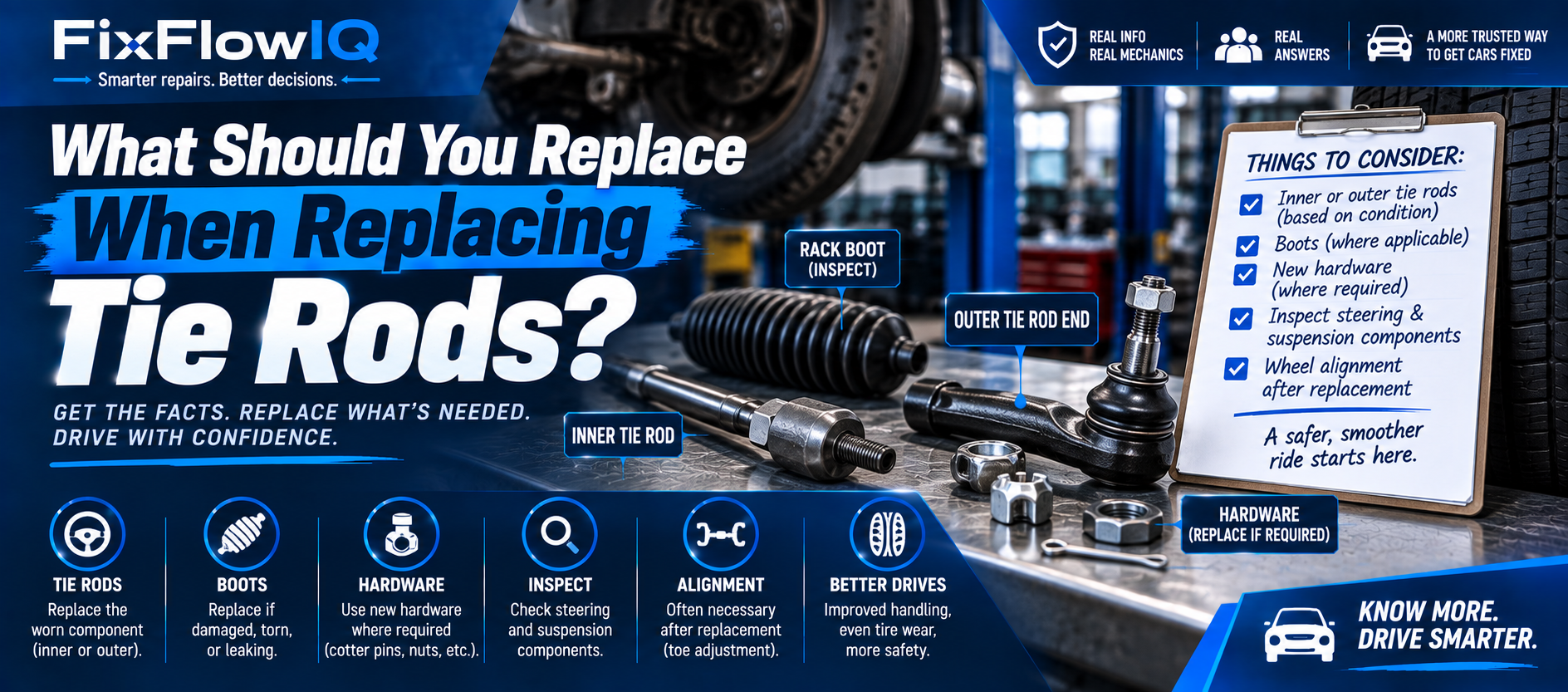
Replacing tie rods? Learn when inner or outer tie rods, boots, and hardware need attention, what else should be inspected, and why an alignment usually follows.
Read Article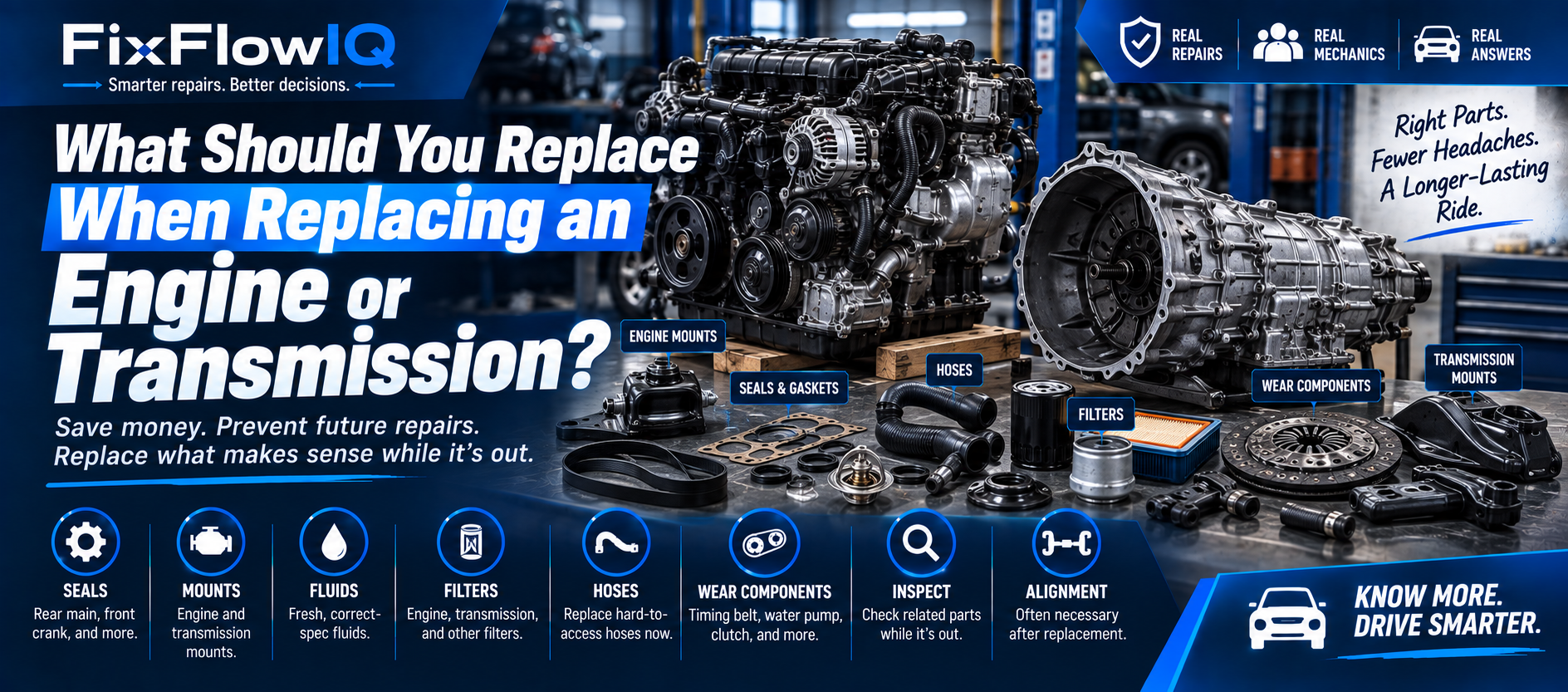 Smart Repair & Replacement Tips
Join hundreds of verified repair professionals already growing their businesses with FixFlowIQ. Receive qualified auto repair leads in Asheville, NC, and across North Carolina, manage bookings, and build your reputation—all from one dashboard.
Offer exclusive partner discounts to attract more customers and grow your business faster.
✓ Water pump
✓ Required gasket/O-ring/seal
✓ Correct coolant as needed to refill the system
✓ Serpentine/accessory belt
✓ Belt tensioner
✓ Idler pulleys
✓ Thermostat
✓ Radiator hoses
✓ Heater hoses
✓ Hose clamps
✓ Plastic cooling-system fittings
✓ Expansion tank
Depending on age, mileage, and manufacturer procedure:
✓ Timing belt
✓ Timing-belt tensioner
✓ Timing idler pulley(s)
✓ Required timing hardware
✓ Correct coolant specification
✓ Coolant quantity/concentration
✓ Cooling-system bleeding
✓ Fastener torque
✓ One-time-use hardware
A water-pump job does not automatically mean you need:
A NEW RADIATOR.
ALL NEW HOSES.
A THERMOSTAT.
A SERPENTINE BELT.
A TENSIONER.
A TIMING BELT.
or:
AN EXPANSION TANK.
Each component needs:
A REASON.
If possible:
Ask the technician to explain the failure.
For example:
“The pump is leaking from the shaft seal.”
“The bearing has excessive play.”
“The pulley is wobbling.”
“The electric pump isn't operating despite correct power and command.”
Understanding:
WHAT FAILED
helps you understand:
WHAT ELSE MAY HAVE BEEN AFFECTED.
Ask:
“Why did the water pump fail?”
“Is it leaking, seized, noisy, or electrically failed?”
“How is my water pump driven?”
“Is it driven by the serpentine belt or timing belt?”
“Does the timing system have to be removed to replace it?”
“How old is my timing belt?”
“If I replace the timing components now, how much labor overlap is there?”
“Does the pump include a new gasket or seal?”
“What coolant will be used?”
“Does the thermostat actually need replacement?”
“What condition are the hoses in?”
“Was the drive belt contaminated or damaged?”
“Was the engine severely overheated?”
“Will the cooling system be properly bled after the repair?”
“What warranty comes with the water pump?”
These questions help you understand:
THE COMPLETE REPAIR.
Consider:
Water pump only
versus:
Water pump + seal + correct coolant + proper bleeding
versus:
For a timing-belt-driven pump:
Water pump + timing belt + tensioner + idlers + coolant
The cheapest quote may simply contain:
LESS WORK.
That doesn't automatically make it wrong.
But it doesn't automatically make it:
THE BEST VALUE EITHER.
If one provider quotes:
$500
and another quotes:
$900
ask:
WHAT DOES EACH QUOTE INCLUDE?
Maybe the $900 quote includes a timing-belt service that would otherwise be due:
10,000 MILES LATER.
Or:
Maybe it contains several parts that:
DON'T ACTUALLY NEED REPLACEMENT.
You won't know until you compare:
REPAIR SCOPE.
This remains one of the most important FixFlowIQ principles.
A mechanic shouldn't automatically say:
“Water pump? Let's replace the thermostat, every hose, belt, tensioner, radiator, and reservoir.”
There should be:
EVIDENCE.
CONDITION.
MANUFACTURER GUIDANCE.
or:
MEANINGFUL LABOR OVERLAP.
The opposite can cost you money.
If the water pump sits behind a timing belt that's almost due:
Replacing:
ONLY THE WATER PUMP
could mean paying for:
THE SAME MAJOR DISASSEMBLY AGAIN SOON.
The goal isn't:
FEWEST PARTS POSSIBLE.
It's:
BEST LONG-TERM REPAIR VALUE.
Before approving the repair:
Leak?
Bearing?
Seizure?
Electrical failure?
External belt?
Timing belt?
Internal system?
Electric?
This determines:
LABOR OVERLAP.
Belt?
Pulley?
Coolant hoses?
Timing components?
Thermostat?
Hoses?
Tensioner?
Radiator?
Now you can make:
A BETTER-INFORMED DECISION.
When replacing a water pump:
You will generally need:
THE WATER PUMP.
THE CORRECT GASKET OR SEAL.
and:
THE CORRECT COOLANT AS REQUIRED.
Beyond that:
The repair depends heavily on:
ENGINE DESIGN.
If the pump is externally driven:
Inspect:
BELT • TENSIONER • IDLERS
and replace them only when:
CONDITION JUSTIFIES IT.
Inspect:
THERMOSTAT • HOSES • FITTINGS
but don't automatically replace them.
If the water pump is located inside a:
TIMING-BELT SERVICE
then the smartest repair may involve:
TIMING BELT.
TENSIONER.
IDLER PULLEYS.
and:
WATER PUMP
together.
Why?
Because:
THE LABOR OVERLAPS.
And paying for the same disassembly twice can turn a cheaper repair today into:
A MORE EXPENSIVE REPAIR TOMORROW.
The goal isn't:
REPLACE EVERYTHING AROUND THE WATER PUMP.
It's:
UNDERSTAND THE SYSTEM.
INSPECT THE RELATED PARTS.
USE LABOR OVERLAP INTELLIGENTLY.
and:
REPLACE WHAT ACTUALLY MAKES SENSE.
When you submit a cooling-system repair request through FixFlowIQ:
Don't just write:
“NEED WATER PUMP.”
Describe what happened.
For example:
“Coolant is leaking near the water pump.”
“The water-pump pulley has play and is making noise.”
“The engine overheated and a shop diagnosed the water pump.”
“My water pump is behind the timing belt, which is also close to its replacement interval.”
Then compare provider quotes based on:
Water Pump • Gaskets/Seals • Coolant • Belts • Timing Components • Thermostat Recommendations • Warranty • Reviews • Provider Discounts
One provider may quote:
THE PUMP ONLY.
Another may quote:
THE PUMP + TIMING SERVICE
because the labor overlaps.
Understanding those differences helps you compare:
THE ACTUAL REPAIR
instead of:
JUST THE FINAL PRICE.
Because the best repair isn't automatically:
THE FEWEST PARTS.
And it isn't automatically:
THE MOST PARTS.
It's:
THE RIGHT PARTS AT THE RIGHT TIME.
SYMPTOMS FIRST.
DIAGNOSIS SECOND.
REPAIR THIRD.
Oral Thompson
Writes about vehicle care and the FixFlowIQ platform.
Replacing an engine or transmission? Learn which seals, mounts, fluids, hoses, filters, and wear parts may save you serious labor costs while the powertrain is already removed.