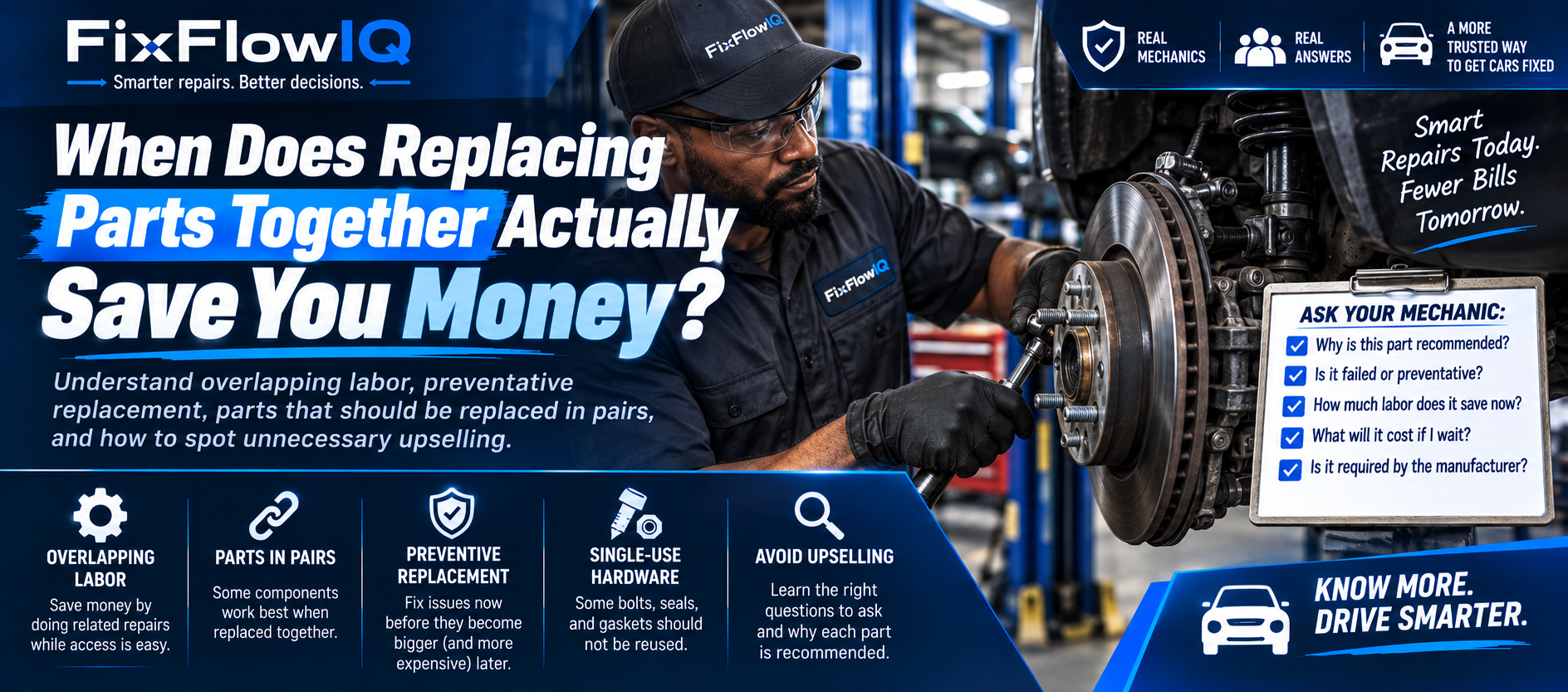
Learn why shocks and struts are commonly replaced in axle pairs, which related parts may need service, and when an alignment should follow the repair.

Your vehicle needs a:
SHOCK
or:
STRUT.
Maybe one side is leaking.
Maybe one corner is bouncing.
Maybe a shop says:
“You should replace both.”
That can immediately sound like:
AN UPSELL.
But in many cases:
Replacing shocks or struts in:
AXLE PAIRS
is good repair practice.
That means:
BOTH FRONTS
or:
BOTH REARS.
Why?
Because shocks and struts control:
VEHICLE MOVEMENT.
TIRE CONTACT.
BODY MOTION.
BRAKING STABILITY.
and:
RIDE CONTROL.
If one side has a brand-new damper and the other side has:
100,000 MILES OF WEAR
the vehicle may not respond evenly.
But just because you're replacing shocks or struts doesn't mean:
EVERY COMPONENT AROUND THEM NEEDS REPLACEMENT TOO.
The smart approach is:
PAIR THE DAMPERS.
INSPECT THE RELATED PARTS.
REPLACE ONLY WHAT'S JUSTIFIED.
Shocks and struts are:
DAMPERS.
Their job is to control spring movement.
Your vehicle's springs support the vehicle and absorb road movement.
But without damping:
The vehicle could continue bouncing after every bump.
Shocks and struts help control:
HOW FAST THE SUSPENSION MOVES.
This distinction matters.
A shock or strut generally does not:
“HOLD THE VEHICLE UP”
in the same way the spring does.
Its main job is to:
CONTROL SUSPENSION MOVEMENT.
That helps maintain:
TIRE CONTACT WITH THE ROAD.
A shock absorber is typically a:
SEPARATE DAMPING COMPONENT.
A strut is commonly part of a larger suspension assembly and may also serve as:
A STRUCTURAL SUSPENSION COMPONENT.
Depending on the vehicle:
A strut assembly may interact with:
Coil spring
Upper mount
Bearing
Steering knuckle
Bump stop
Dust boot
This is why replacing a strut can involve:
MORE COMPONENTS AND MORE LABOR.
Because damping performance changes with:
AGE AND WEAR.
Imagine:
LEFT FRONT STRUT: BRAND NEW
RIGHT FRONT STRUT: ORIGINAL WITH 120,000 MILES
Even if the old one isn't completely failed:
It may not control movement the same way.
That can create:
UNEQUAL DAMPING.
When both dampers on an axle are similar in condition:
The vehicle is more likely to respond consistently during:
Braking
Cornering
Bumps
Emergency maneuvers
Uneven road surfaces
That's why shocks and struts are commonly replaced:
LEFT + RIGHT TOGETHER.
Not necessarily in every situation.
But it is widely considered:
GOOD PRACTICE.
Especially when:
Both components are similar age
Both have similar mileage
One has worn enough to fail
Ride-control balance matters
The opposite side is significantly aged
The key idea is:
MATCHED PERFORMANCE ACROSS THE AXLE.
No.
This is important.
If the:
FRONT STRUTS
are worn out but the:
REAR SHOCKS
are still in good condition:
You generally do not replace all four simply because:
THE FRONTS NEED SERVICE.
Suspension damping is usually evaluated:
BY AXLE.
So:
BOTH FRONTS
or:
BOTH REARS.
Not automatically:
ALL FOUR.
Possible symptoms include:
Excessive bouncing
Nose dive during braking
Excessive body roll
Poor ride control
Tire cupping
Fluid leakage
Clunking
Instability over bumps
Excessive movement in crosswinds
Poor control on rough roads
But:
SYMPTOMS ALONE DON'T ALWAYS PROVE THE DAMPER IS THE ONLY PROBLEM.
Inspection still matters.
If a strut or shock is:
ACTIVELY LEAKING OIL
that may indicate internal failure.
But small amounts of external film or residue should be evaluated carefully.
Ask:
“Is this actually leaking, or is it just light seepage?”
That distinction matters.
Poor ride control can also involve:
Broken spring
Worn control-arm bushings
Ball joints
Tire problems
Sway-bar components
Mount problems
Other suspension faults
Don't replace struts because:
“IT FEELS BOUNCY.”
Have the suspension:
INSPECTED.
If one shock or strut is confirmed failed:
Replacing both on the same axle is commonly recommended.
That helps restore:
BALANCED DAMPING.
For example:
LEFT FRONT + RIGHT FRONT
or:
LEFT REAR + RIGHT REAR.
A strut mount connects the strut assembly to the vehicle body.
Depending on design:
It may also isolate:
NOISE AND VIBRATION.
Should it automatically be replaced?
NOT ALWAYS.
But it should usually be:
INSPECTED.
Possible reasons include:
Cracked rubber
Separation
Excessive movement
Noise
Corrosion
Damage
Bearing failure when integrated
Because the strut is already removed:
There may be significant:
LABOR OVERLAP.
So if the mount is worn:
Replacing it during strut service can make financial sense.
Access alone isn't enough.
Ask:
“What condition is the mount in?”
If it's:
GOOD, QUIET, AND UNDAMAGED
there may be no reason to replace it.
Many front strut assemblies use an upper:
STRUT BEARING.
This allows the strut assembly to rotate as you:
STEER THE VEHICLE.
If the bearing binds or fails:
You may notice:
Popping
Grinding
Binding
Spring noise
Steering resistance
Not automatically.
But:
If the bearing is integrated with the mount and the assembly is high-mileage:
Replacement may be reasonable depending on condition and repair strategy.
Again:
INSPECT FIRST.
The bump stop helps limit suspension travel during:
SEVERE COMPRESSION.
It helps prevent metal components from:
BOTTOMING OUT HARSHLY.
Over time:
Bump stops can:
Crack
Crumble
Split
Deteriorate
If damaged or deteriorated:
YES.
If still in good condition:
They may not need replacement.
They're often inexpensive compared with the labor required to access them later.
That can make them a smart replacement:
WHEN CONDITION JUSTIFIES IT.
Dust boots help protect the damper shaft from:
Dirt
Sand
Road debris
Contamination
A torn boot can expose the shaft and seal area.
Replace them if they are:
Torn
Missing
Brittle
Severely damaged
But:
A perfectly good boot does not automatically need replacement.
A coil spring does not usually need replacement just because:
THE STRUT IS BEING REPLACED.
But it should be inspected.
Look for:
Broken coils
Severe corrosion
Sagging
Cracks
Damage
A broken coil spring can affect:
RIDE HEIGHT
and:
VEHICLE CONTROL.
If one spring is broken:
The repair strategy may depend on:
Vehicle design
Age
Mileage
Opposite-side spring condition
Manufacturer guidance
Spring replacement may also be recommended:
IN PAIRS.
Some hardware may be:
ONE-TIME USE.
Depending on the vehicle, this can include:
Strut-to-knuckle bolts
Nuts
Locking hardware
Other fasteners
If the manufacturer specifies:
REPLACE AFTER REMOVAL
follow that procedure.
Suspension hardware should be tightened to:
CORRECT SPECIFICATION.
Some fasteners also require:
TORQUE + ANGLE.
Improper tightening can affect:
SAFETY AND ALIGNMENT.
These should be inspected during suspension service.
But:
DO NOT AUTOMATICALLY REPLACE THEM BECAUSE THE STRUTS ARE OFF.
Look for:
Excessive play
Torn boots
Bushing separation
Damage
Corrosion
Condition determines:
REPLACEMENT.
Strut replacement sometimes requires disconnecting:
SWAY-BAR END LINKS.
This can expose worn or seized hardware.
But again:
Access does not mean:
AUTOMATIC REPLACEMENT.
Replace links if:
Loose
Noisy
Damaged
Seized
Boots torn
Required because removal damages the hardware
This is one of the biggest questions after strut replacement.
Should you get an alignment?
Often:
YES—ESPECIALLY AFTER FRONT STRUT REPLACEMENT.
Why?
Because struts may affect:
CAMBER
and other suspension geometry depending on vehicle design.
Removing and reinstalling the strut may involve:
STRUT-TO-KNUCKLE MOUNTING POINTS.
Small changes in position can alter:
WHEEL ALIGNMENT.
Even if everything is installed correctly:
Alignment may not return exactly to:
WHERE IT WAS BEFORE.
Especially when:
Front struts are replaced
Strut-to-knuckle bolts are disturbed
Adjustable camber hardware is involved
Ride height changes
Suspension geometry is altered
Steering is off-center afterward
Tire wear already exists
A proper alignment can help protect:
THE TIRES.
Simple rear shock replacement often does not alter alignment geometry.
So:
A REAR SHOCK JOB DOES NOT AUTOMATICALLY REQUIRE AN ALIGNMENT.
But rear:
STRUTS OR MULTI-LINK COMPONENTS
may be different.
Vehicle design matters.
This is the smart question.
Instead of:
“Does every shock job need alignment?”
ask:
“Does replacing these components on my vehicle affect alignment settings?”
That's more accurate.
Another important point:
Don't perform an alignment before correcting:
LOOSE OR WORN SUSPENSION COMPONENTS.
If the wheel moves because of:
A BAD BALL JOINT
or:
A FAILED CONTROL-ARM BUSHING
the alignment may not remain correct.
Repair:
THE MECHANICAL PROBLEM FIRST.
Then:
ALIGN.
Worn dampers can contribute to:
CUPPING OR SCALLOPED TIRE WEAR.
Replacing the shocks or struts will not magically repair:
THE EXISTING TIRE DAMAGE.
The tires should be inspected for:
Cupping
Uneven wear
Low tread
Damage
Pressure issues
You may need to address:
BOTH THE SUSPENSION AND TIRES.
A worn damper may allow the tire to:
BOUNCE MORE THAN IT SHOULD.
That can reduce consistent tire contact with the road.
Over time:
This may contribute to:
IRREGULAR TREAD WEAR.
That's one reason ride-control components matter beyond:
COMFORT.
A repair quote may offer:
BARE STRUTS
or:
COMPLETE / LOADED STRUT ASSEMBLIES.
A loaded assembly may include:
Strut
Spring
Mount
Bearing
Bump stop
Boot
depending on the product.
No.
It may reduce installation complexity and replace several worn components at once.
But:
A complete assembly also means replacing parts that may not all have been:
FAILED.
Quality also varies significantly between brands.
Ask:
“Why are you recommending complete assemblies instead of reusing the original springs and serviceable components?”
Suspension components strongly affect:
RIDE AND HANDLING.
Different dampers can be tuned differently.
Ask whether the replacement parts are:
OEM
OEM-equivalent
Premium aftermarket
Economy aftermarket
Performance-oriented
You generally want:
MATCHING PARTS LEFT AND RIGHT.
Avoid:
LEFT SIDE BRAND A
and:
RIGHT SIDE BRAND B
with different damping characteristics.
Likewise:
Don't intentionally mix:
ONE PERFORMANCE STRUT
with:
ONE STANDARD STRUT.
The goal is:
MATCHED CONTROL.
Imagine:
One front strut only
Both front struts
Both front struts + worn mounts + alignment
Which is best?
You can't answer from:
PRICE ALONE.
You need to know:
WHY THE STRUT FAILED.
CONDITION OF THE OTHER SIDE.
CONDITION OF THE MOUNTS.
and:
WHETHER ALIGNMENT IS REQUIRED.
Suppose another estimate includes:
STRUTS
MOUNTS
BEARINGS
SPRINGS
CONTROL ARMS
BALL JOINTS
SWAY-BAR LINKS
ALIGNMENT
all because:
“WE'RE ALREADY IN THERE.”
That's not enough.
Ask:
WHAT FAILED INSPECTION?
Every recommended part should have:
A REASON.
There is no universal list for every vehicle.
But generally:
 Smart Repair & Replacement Tips
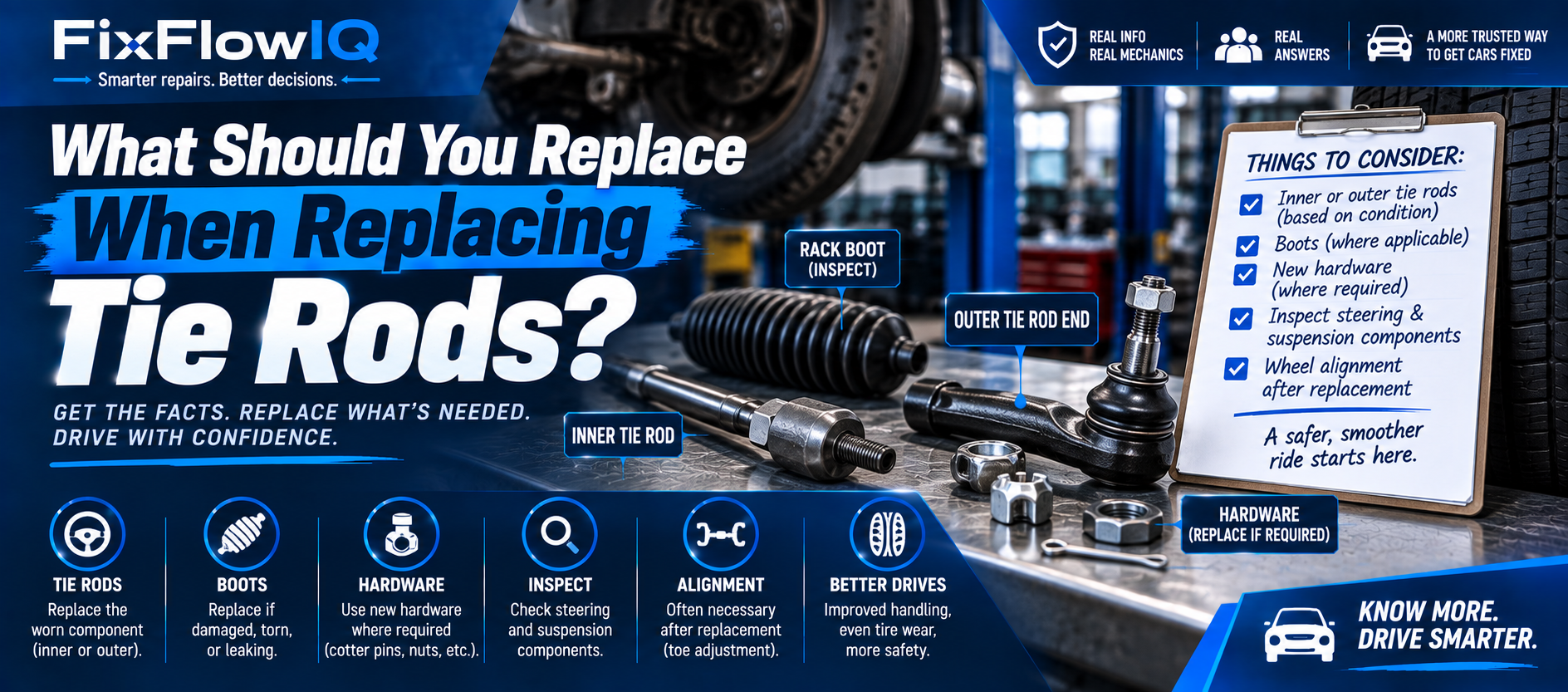
Replacing tie rods? Learn when inner or outer tie rods, boots, and hardware need attention, what else should be inspected, and why an alignment usually follows.
Read Article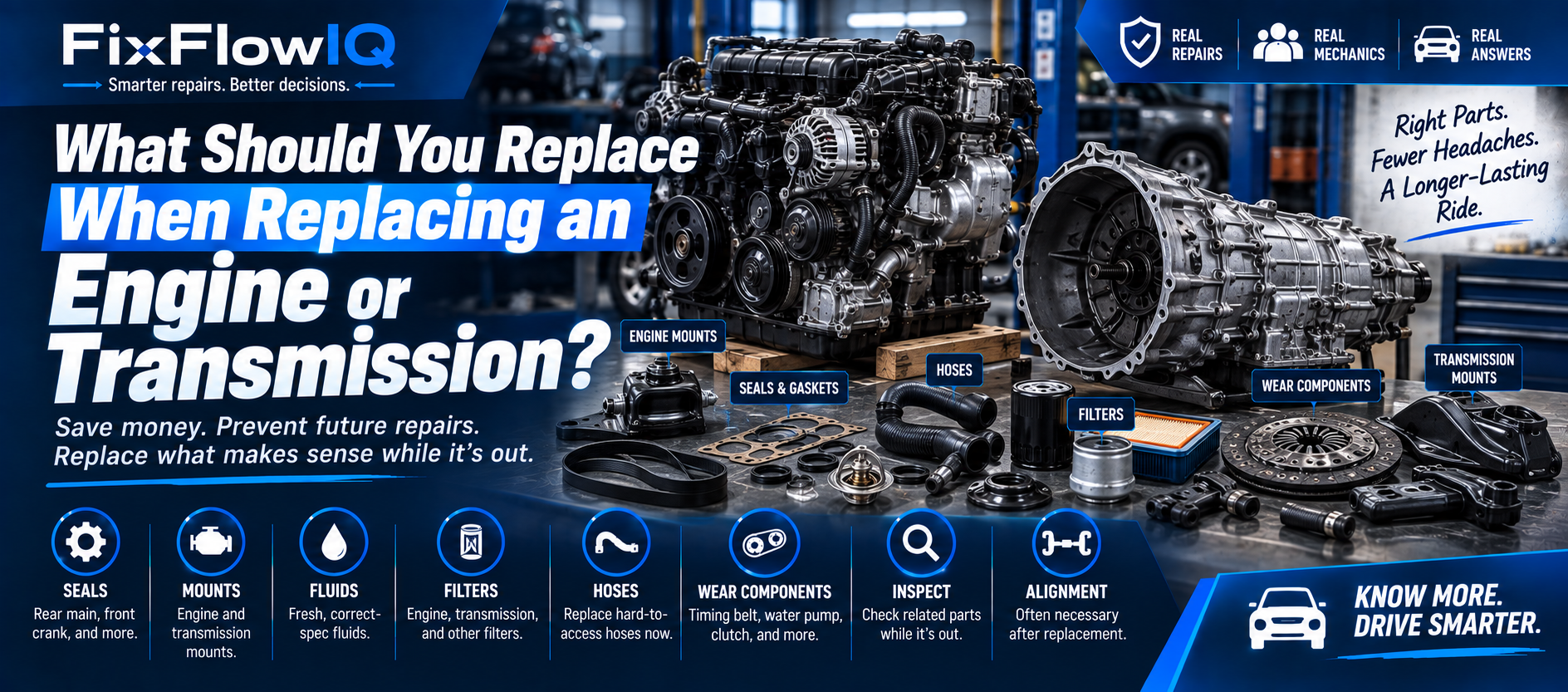 Smart Repair & Replacement Tips
Join hundreds of verified repair professionals already growing their businesses with FixFlowIQ. Receive qualified auto repair leads in Asheville, NC, and across North Carolina, manage bookings, and build your reputation—all from one dashboard.
Offer exclusive partner discounts to attract more customers and grow your business faster.
✓ Front struts
✓ Rear struts
✓ Front shocks
✓ Rear shocks
✓ Strut mounts
✓ Strut bearings
✓ Bump stops
✓ Dust boots
✓ Coil springs
✓ Sway-bar links
✓ Control arms
✓ Ball joints
✓ One-time-use suspension hardware
✓ Wheel alignment
especially when suspension geometry has been disturbed.
Ask:
“Which shock or strut failed?”
“Why does it need replacement?”
“Is it leaking or mechanically worn?”
“What condition is the opposite side in?”
“Are you recommending both because of balanced damping?”
“Are the mounts worn?”
“Are the bearings noisy or binding?”
“Are the bump stops or boots damaged?”
“Are the springs in good condition?”
“Will this repair affect alignment?”
“Is an alignment included?”
“Are any suspension fasteners one-time-use?”
“What brand of shocks or struts are being installed?”
“What warranty comes with the repair?”
These questions help you compare:
THE REPAIR SCOPE.
If a shop says:
“Your strut is leaking.”
ask to see:
THE LEAK.
If they say:
“The mount is broken.”
ask to see:
THE DAMAGE.
If they say:
“The bearing is binding.”
ask them to explain:
WHAT THEY FOUND.
Transparency helps customers understand:
WHY THEY'RE PAYING FOR THE PART.
This is important.
“The right-front strut is leaking, and both front struts have 110,000 miles. We recommend replacing both so damping remains balanced.”
That has:
A TECHNICAL REASON.
“You need all four shocks, all mounts, all springs, and control arms because one strut leaks.”
Ask for:
EVIDENCE.
When reviewing a shock or strut estimate:
Shock?
Strut?
Mount?
Bearing?
Spring?
Usually:
YES.
If a mount is clearly worn and the strut is already disassembled:
Replacing it now may save labor later.
If yes:
ALIGN IT AFTERWARD.
If one front or rear shock or strut needs replacement:
It is commonly good practice to replace:
BOTH ON THE SAME AXLE.
Why?
Because dampers wear over time.
Matched components help provide:
BALANCED RIDE CONTROL.
CONSISTENT HANDLING.
and:
MORE EVEN RESPONSE.
But that doesn't mean automatically replacing:
MOUNTS.
BEARINGS.
BUMP STOPS.
BOOTS.
SPRINGS.
CONTROL ARMS.
or:
BALL JOINTS.
Those parts should be:
INSPECTED.
Then replaced when:
CONDITION JUSTIFIES IT.
And after strut replacement:
An alignment may be appropriate—especially when the repair disturbs:
SUSPENSION GEOMETRY.
The goal isn't:
REPLACE EVERYTHING.
And it isn't:
REPLACE ONLY THE ONE OBVIOUSLY FAILED PART.
The goal is:
MATCH THE DAMPERS.
INSPECT THE RELATED COMPONENTS.
CORRECT WHAT'S ACTUALLY WORN.
and:
PROTECT THE TIRES WITH PROPER ALIGNMENT WHEN REQUIRED.
When you submit a suspension repair request through FixFlowIQ:
Don't just write:
“NEED STRUTS.”
Describe the symptoms.
For example:
“The right-front strut is leaking.”
“The vehicle keeps bouncing after bumps.”
“I hear a clunk from the front suspension.”
“My front tires are cupping.”
“A shop says both front struts and mounts need replacement.”
Then compare provider quotes based on:
Shocks/Struts • Mounts • Bearings • Boots • Bump Stops • Alignment • Parts Quality • Warranty • Reviews • Provider Discounts
One quote may include:
ONE STRUT ONLY.
Another may include:
BOTH STRUTS.
Another may include:
BOTH STRUTS + FAILED MOUNTS + ALIGNMENT.
Understanding those differences helps you compare:
LIKE WITH LIKE.
Because the best suspension repair isn't automatically:
THE LOWEST PRICE.
And it isn't automatically:
THE MOST PARTS.
It's the repair that restores:
BALANCED CONTROL
without replacing:
PARTS THAT DON'T NEED IT.
SYMPTOMS FIRST.
DIAGNOSIS SECOND.
REPAIR THIRD.
Oral Thompson
Writes about vehicle care and the FixFlowIQ platform.
Replacing an engine or transmission? Learn which seals, mounts, fluids, hoses, filters, and wear parts may save you serious labor costs while the powertrain is already removed.